I had a reader write in last month asking which smart ring would finally “fix” her sleep. She’d already tried two. Both times, the ring showed her the same thing: low deep sleep, high resting heart rate at 2 a.m., a readiness score that never cracked 60. She wanted to know if a third ring, a better one, would change the numbers.
It won’t. And that’s not a knock on the hardware.
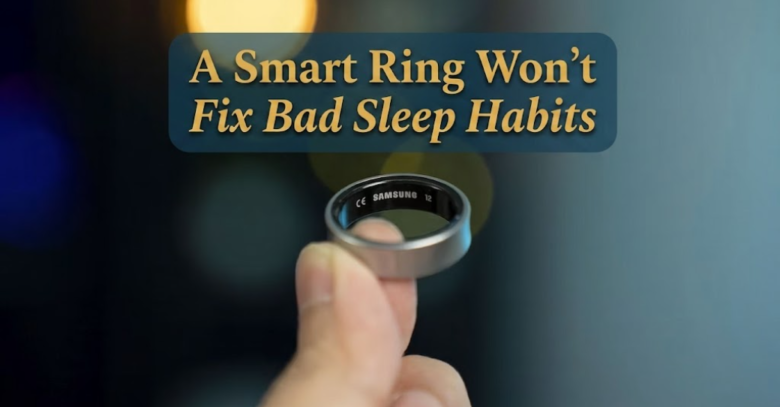
A smart ring is a mirror, not a mechanic. It can tell you that you went to bed at 12:40 a.m. after three glasses of wine and woke up four times. What it can’t do is stop you from doing that again tomorrow. At Ar Body Health, we test a lot of wearables, and the pattern is always the same: people buy the device expecting the device to do the behavior change for them. It doesn’t work that way, and it was never going to.
1. What a Ring Actually Measures
A ring on your finger is picking up a few core signals: heart rate, heart rate variability, skin temperature, and movement. From those, the software infers sleep stages, respiratory rate, and a composite “score” that’s meant to summarize your night in one number you can glance at over coffee.
That’s genuinely useful data. Finger-based photoplethysmography (the light-based sensor most rings use) tends to be steadier than wrist-based sensors because the finger has better blood perfusion and less motion noise during sleep. If you’ve compared a ring against a wrist tracker, you’ve probably noticed the ring’s overnight readings look cleaner.
But measuring something and improving it are two different jobs. A bathroom scale measures weight. It has never once caused anyone to lose it.
2. The Gap Between Insight and Action
Here’s where people usually go wrong: they treat the readiness score as a diagnosis instead of a data point. A 54 isn’t a medical verdict. It’s the ring’s best guess, built from an algorithm that doesn’t know you stayed up finishing a work deadline, or that your neighbor’s dog barked at 3 a.m., or that you’re getting over a cold.
I’ve watched this play out with people who’ve never had insomnia in their life. They get a ring, see a mediocre score three nights running, and start lying in bed anxious about their sleep instead of, you know, sleeping. There’s a name creeping into sleep medicine circles for this: orthosomnia, an unhealthy fixation on optimizing sleep data that ends up wrecking actual sleep. The device becomes the problem it was bought to solve.
And look, most nights the fix isn’t complicated. It’s caffeine after 2 p.m. It’s scrolling in bed until midnight. It’s a bedroom that’s 72 degrees when it should be closer to 65. None of that requires a ring to diagnose. It requires someone to actually change the behavior, which is the part no piece of jewelry can do for you.
3. What the Data Is Actually Good For
I don’t want this to read as anti-wearable, because it isn’t. Where a ring earns its price is pattern recognition over weeks, not verdicts over single nights.
If your resting heart rate creeps up every night you have a drink, that’s a pattern worth noticing. If your deep sleep tanks every week you skip exercise, same thing. The ring is doing what a human keeping a paper sleep diary used to do, just automatically and with more precision on the heart rate side.
| What to track | Why it matters | What a single bad night means |
|---|---|---|
| Resting heart rate trend | Rises with alcohol, illness, stress, poor recovery | Almost nothing on its own |
| HRV trend (weekly average) | Drops signal accumulated fatigue or overtraining | One low night is noise |
| Sleep timing consistency | Irregular bedtimes disrupt circadian rhythm more than short nights do | A single late night, not a crisis |
| Respiratory rate | Sudden spikes can flag illness or, rarely, sleep apnea | Worth a second look if sustained across nights |
Use the trend line. Ignore the single dot.
4. Where This Connects to Fitness Tracking Generally
This isn’t unique to sleep rings, either. It’s the same story we’ve covered with why fitness tracker numbers never quite match between two devices on the same wrist, or why step counts drop during slow walks even though you clearly walked the same distance. Wearables are estimators. Good ones, increasingly. But estimators.
If you’re newer to this category entirely, it’s worth reading through what a smart ring actually tracks at night before you buy one, so the number on the app doesn’t come as a surprise the first week. A lot of buyer’s remorse in this space isn’t about the ring being bad. It’s about expectations that were never realistic to begin with.
5. What Actually Moves the Needle
If sleep is genuinely the problem, and for a lot of people it is, the interventions that work are almost embarrassingly unglamorous:
- A consistent wake time, seven days a week, including weekends
- Caffeine cutoff early enough that it’s fully cleared by bedtime (roughly 8-10 hours depending on your metabolism)
- Getting daylight within the first hour of waking, which anchors your circadian rhythm far more reliably than any app reminder
- A wind-down window where screens go away, even 20 minutes helps
- A cool, dark room, consistently, not just on nights you remember
None of that needs a ring. A ring can confirm the changes are working once you make them. It cannot make them for you, and honestly, no product on the market can.
I’ll admit I was skeptical the first time I heard someone recommend keeping a wake time fixed even on weekends. Seemed excessive. It’s one of the few pieces of sleep advice I’ve come across that actually holds up under real scrutiny, and it’s free.
Common Mistakes Worth Naming Directly
People chase the score instead of the symptom. They feel fine, sleep score says 61, and they spiral about a number instead of asking whether they actually feel rested. Conversely, they feel exhausted, score says 88, and they ignore how they feel because the app told them they’re fine. Trust how you feel first. Use the ring to explain patterns, not to override your own judgment about your own body.
The other mistake is buying a second, “better” ring hoping for different results, which is exactly the situation the reader I mentioned earlier was in. New hardware measuring the same bad habits will just report the same bad habits with slightly more precision.
FAQs
Does a more expensive smart ring give more accurate sleep stages? Marginally, sometimes, but the differences between competing rings on sleep-stage accuracy are small compared to how much a bad night’s habits swing the data. Spending more rarely fixes the underlying issue.
Can a smart ring actually detect sleep apnea? Some newer rings flag irregular breathing patterns or blood oxygen dips that are worth bringing to a doctor, but none of them diagnose sleep apnea. That still requires a clinical sleep study.
Why does my score drop on nights I felt fine? Usually heart rate variability or a temperature shift the algorithm weighted heavily. Alcohol, a late meal, or an unusually warm room can all do this even when subjectively you slept fine.
Should I stop looking at my sleep score altogether? Not necessarily, but check it weekly instead of every morning. Daily checking is where the anxiety creeps in for most people.
Is it worth wearing the ring every single night, forever? Not really. A few months of consistent data is usually enough to identify your patterns. After that, spot-checking during stressful periods or after habit changes tells you what you need to know.
If you’re deciding whether a ring is worth it in the first place, our beginner’s breakdown of smart rings is a reasonable place to start before you spend the money.