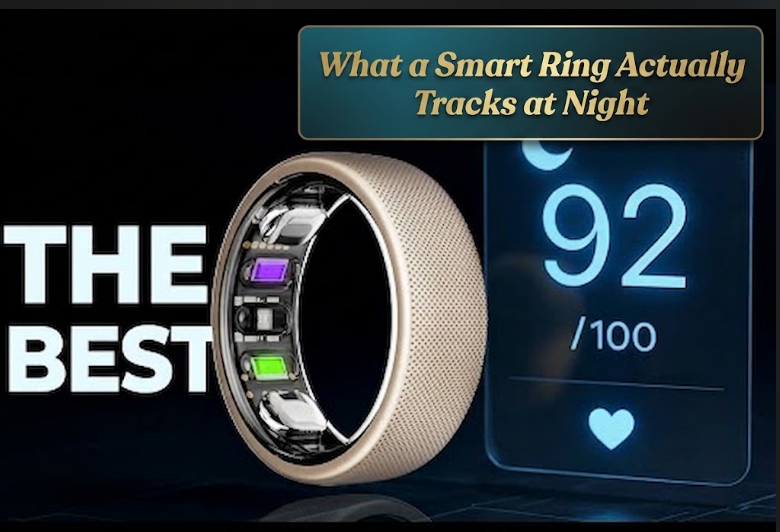
I used to assume a smart ring just measured sleep the way a stopwatch measures a run. Time in bed, time asleep, done. Then I actually sat down and read through what one of these devices logs across eight hours, and it turned out to be closer to a dozen different data streams running quietly while you’re doing nothing but lying there.
That gap between what people assume and what’s actually happening matters, mostly because it changes how much weight you should give the numbers in the morning. A ring isn’t reading your mind or diagnosing anything. It’s inferring a lot from a small number of physical signals, and knowing which signals those are makes the whole output far less mysterious.
1. The Core Signals a Ring Is Actually Reading
Almost everything a smart ring reports at night traces back to three raw inputs: heart rate, heart rate variability, and skin temperature, with a motion sensor layered on top. That’s it. No brainwave sensors, no oxygen sensor doing anything exotic beyond basic pulse oximetry in most models, nothing that’s actually watching your dreams.
Heart rate variability, or HRV, tends to get the most attention and deserves it. It measures the tiny variation in time between each heartbeat, and that variation shifts depending on how active your nervous system’s rest-and-recover mode is at any given moment. Higher variability during sleep generally signals your body is settling into deeper recovery. Lower variability suggests something, stress, alcohol, illness, poor timing, is keeping your system more activated than it should be at 3am.
2. How Sleep Stages Get Calculated From So Little Data
Here’s where people usually go wrong, assuming the ring somehow directly detects light sleep, deep sleep, and REM the way a lab sleep study would. It doesn’t. A clinical sleep study uses brain wave monitoring through EEG. A ring uses none of that. Instead, it runs your heart rate, HRV, and movement data through an algorithm trained to guess which stage you’re probably in based on patterns those numbers tend to follow.
And that guess is decent, not perfect. Studies comparing consumer ring devices to clinical polysomnography generally find reasonable accuracy for total sleep time and wake detection, but noticeably lower accuracy for precisely separating light from deep sleep stage by stage. If your ring says you got 43 minutes of deep sleep instead of 51, that’s within the normal margin of error for this kind of inference, not a meaningful health signal on its own.
3. What Skin Temperature Is Actually Telling You
Skin temperature tracking surprises people the most, mostly because it’s easy to assume it’s just measuring how warm your bedroom is. It’s measuring something more specific than that. Your body temperature naturally drops as you fall asleep and follows a predictable overnight curve, and deviations from your personal baseline can flag things worth noticing, an oncoming illness, ovulation timing for cycle tracking, or simply a night where alcohol or a late meal threw off your normal pattern.
This is one of the more genuinely useful nighttime metrics precisely because it’s not trying to guess something complicated. It’s a direct physical measurement compared against your own trend line, and trend lines built from your own data tend to be more reliable than any single night’s snapshot.
4. Nighttime Metrics at a Glance
| Metric | What It Measures | How Reliable |
|---|---|---|
| Heart rate | Direct pulse reading via optical sensor | High |
| HRV | Beat-to-beat interval variation | Moderate to high |
| Skin temperature | Deviation from personal baseline | High |
| Sleep stages | Inferred pattern from HR, HRV, motion | Moderate |
| Blood oxygen | Periodic pulse oximetry reading | Moderate, varies by fit |
| Respiratory rate | Estimated from HRV and motion patterns | Moderate |
Notice that the most directly measured metrics, heart rate and temperature, land at the top of the reliability list, while the more heavily inferred ones sit lower. That’s not a coincidence and it’s a decent rule of thumb for interpreting any wearable, not just rings specifically.
5. Getting More Out of the Data You’re Already Collecting
None of this data means much as a single isolated night. Where it earns its keep is in the trend. A ring that shows your HRV consistently 15 percent below your personal average for three consecutive nights is telling you something worth paying attention to, even if you can’t point to an obvious cause. A single low night, especially after a stressful day or a late workout, usually isn’t worth much concern on its own.
If you’re new to reading this kind of data, our guide on AR fitness for beginners, where to start covers a related idea, that raw numbers matter less than the pattern they form over time. Same principle applies here. And worth mentioning, if you’re combining nighttime ring data with AR workout tracking during the day, checking how those workouts affect your form live can help explain why certain nights show elevated stress signals when a hard session ran later than usual.
Skin temperature dips, HRV climbing back toward baseline, resting heart rate settling lower over weeks rather than days, these are the signals actually worth building habits around. The nightly number is a data point. The trend is the story.
FAQs
Does a smart ring actually know if I’m dreaming? No. Rings infer sleep stages, including estimated REM periods, from heart rate, HRV, and movement patterns, not from any direct measurement of brain activity or dream content.
Why does my ring show different sleep scores than my phone’s sleep app? Different devices use different algorithms and sometimes different raw sensors, so scoring can vary. Trust the trend within one device over comparing exact numbers across different tools.
Is skin temperature tracking useful if I don’t care about cycle tracking? Yes. Temperature deviations from your personal baseline can flag early illness or unusual physical stress regardless of gender or cycle tracking use.
Can a smart ring detect sleep apnea? Most consumer rings can flag signs like unusual blood oxygen dips or irregular breathing patterns, but they are not diagnostic tools. A flagged pattern is worth discussing with a doctor, not a substitute for a clinical sleep study.
Why does my HRV look so different from my friend’s, even though we sleep similar hours? HRV varies significantly by age, fitness level, and individual physiology. Comparing your own trend over time is far more useful than comparing raw HRV numbers between different people.
For more on how wearable sensors handle motion and interference, our piece on how motion capture tech learned from dancers digs into the sensor side of things from a different angle.