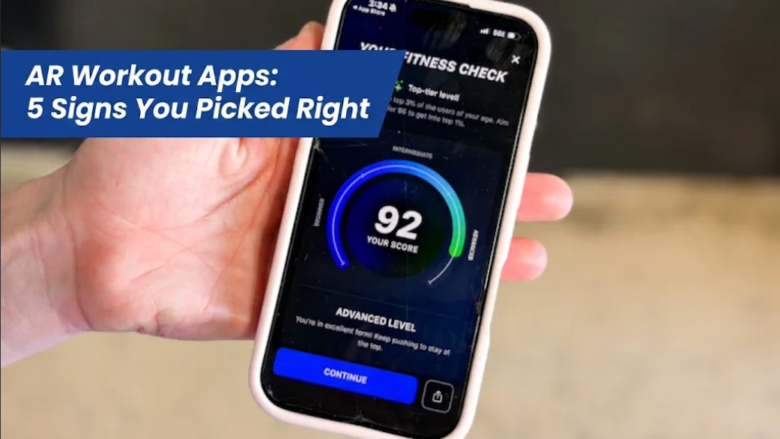
We get a version of the same message every few weeks: “I downloaded an AR fitness app and I don’t know if it’s actually good or if I just like the novelty.” That’s a fair question, and it’s harder to answer than most reviews make it sound. A lot of augmented reality workout apps look impressive in a 30-second demo and fall apart the moment you’re three weeks into actually using one.
At Aeryon Wellness, our focus has always been on sustainable health tools women can actually trust, not just the shiniest new thing on the App Store. So instead of ranking apps by download numbers or flashy graphics, here are five real signs that the AR workout app you picked is one worth keeping.
1. It Corrects Your Form, Not Just Your Rep Count
A lot of AR fitness apps are really just rep counters with a filter on top. They’ll tell you that you did 15 squats, but they have no idea if your knees caved in on rep 12 or if your back rounded on rep 9.
The apps worth your time use pose estimation to actually track joint angles in real time and flag when something’s off. If an app only cheers you on and never once tells you to adjust anything, it’s not really coaching you. It’s just watching.
This matters more than people think, especially for anyone training around an old injury or building strength after time off. Bad form repeated 500 times doesn’t build strength, it builds a pattern you’ll eventually have to unlearn, usually after it starts hurting.
Where people usually go wrong here: they assume any app with a skeleton overlay on screen is “tracking form.” Overlay graphics and actual biomechanical feedback are two different things. One is visual. The other requires the app to actually be doing something with the data it collects.
2. The Calibration Process Actually Adjusts to Your Space, Not the Other Way Around
Here’s something nobody tells you before you buy: most AR workout failures aren’t about the workout. They’re about calibration. If an app forces you to clear an unrealistic amount of floor space, or the tracking drifts the moment lighting changes, you’ll quietly stop using it within two weeks. Not because the workouts were bad. Because the setup became a chore.
A good app calibrates to your actual room. Bad lighting, a couch in the corner, a rug that isn’t perfectly flat, none of that should break tracking. If you find yourself constantly recalibrating mid-session, that’s not a “you” problem. That’s the app.
Some of our readers have found this section on home workout setup tips genuinely useful for troubleshooting space and equipment issues that trip up AR tracking specifically.
3. It Adapts the Program Over Time, Not Just the Difficulty Slider
Plenty of apps let you bump the difficulty up manually. That’s not adaptive programming, that’s just a settings menu. What separates a genuinely well-built AR fitness app is whether it changes your program based on what it’s actually observing about you.
Did your balance improve on single-leg work over the last four sessions? Did your range of motion on overhead movements plateau? A well-designed app should notice patterns like this and quietly shift what it gives you next, the same way a good trainer would after watching you move for a month.
| What You Want | What You’re Settling For |
|---|---|
| Program adjusts based on tracked movement data over weeks | Program only adjusts when you manually change a slider |
| Notices plateaus and changes stimulus | Repeats the same circuit indefinitely |
| Flags asymmetries (left vs right side) | Only reports total reps, no side-to-side comparison |
| Progress based on movement quality | Progress based on time spent in app |
If your app has been giving you the exact same style of workout for six weeks straight regardless of how you’re performing, it isn’t adapting. It’s on autopilot, and so, probably, are you.
4. It Doesn’t Punish You for Missing a Session
This one has nothing to do with the technology and everything to do with the psychology behind it, but it matters just as much. Some AR apps are built around streaks, guilt notifications, and a general tone of “you’re falling behind.” That model works for about six weeks before it burns people out, particularly women juggling training around work, hormonal cycles, recovery needs, and, frankly, life.
The apps that actually get used long-term tend to treat a missed day as data, not a failure. They adjust the next session slightly instead of guilt-tripping you back into last week’s plan. Small distinction. Big difference over six months.
We touch on this more in our piece on training consistency without burnout, which was written after hearing this exact frustration from more women than we could count.
5. The Community or Social Features Don’t Feel Like Performance Theater
A surprising number of AR fitness apps have leaned hard into social features, leaderboards, shareable clips, that kind of thing. Some people genuinely thrive on that. Others find it turns a private, sometimes vulnerable process into something that feels like it’s being watched and judged.
Pick an app that lets you turn this off completely, not just mute notifications, actually disable it. If the app assumes everyone wants their workout broadcast somewhere, that’s a design choice made for engagement metrics, not for you.
And one honest note here. We’ve noticed a habit among newer AR fitness apps of over-promising accuracy on calorie burn and muscle activation estimates. Treat those numbers as rough guidance, not gospel. Actual measurement of muscle activation requires EMG sensors, not a phone camera. Any app claiming lab-grade accuracy from camera tracking alone is stretching the truth.
Choosing One and Actually Sticking With It
None of this means you need the most expensive or most feature-packed app available. It means paying attention to whether the app is actually responding to you, or just running you through a script with better graphics than a YouTube video.
If you’re rebuilding a habit after time off, our guide on starting strength training again after a break covers some of the same pacing principles that apply here, just without the camera involved.
At the end of testing a handful of these apps ourselves and hearing feedback from the Aeryon Wellness community, the pattern was consistent. The apps people kept using for months, not weeks, were the ones that adjusted to the person instead of expecting the person to adjust to the app.
Pick the one that respects that difference. The rest tends to sort itself out.
FAQs
Do I need special equipment for an AR workout app to work properly? No, most rely entirely on your phone or tablet’s front camera. Some higher-end options integrate with AR headsets, but that’s optional, not required for accurate form tracking.
How much space do I actually need? Roughly 6×6 feet of clear floor is enough for most bodyweight and strength-based AR programs. Anything requiring significantly more is usually built for a studio setting, not home use.
Can these apps replace a personal trainer? For form correction and consistency, many do a solid job. For nuanced coaching around injuries, pregnancy, or complex medical history, they’re a supplement, not a replacement for professional guidance.
Why does the tracking sometimes lose me mid-exercise? Usually lighting, loose clothing that obscures joint lines, or camera angle. Overhead lighting tends to work better than side lighting for most pose-tracking systems.
Is it normal for an app to feel less accurate for certain body types? Some earlier pose-estimation models were trained on limited datasets and performed inconsistently across body types. It’s worth researching whether an app addresses this directly, since it’s a legitimate and common complaint.
For more on building a home fitness routine that actually holds up over time, visit Ar Body Health Online.