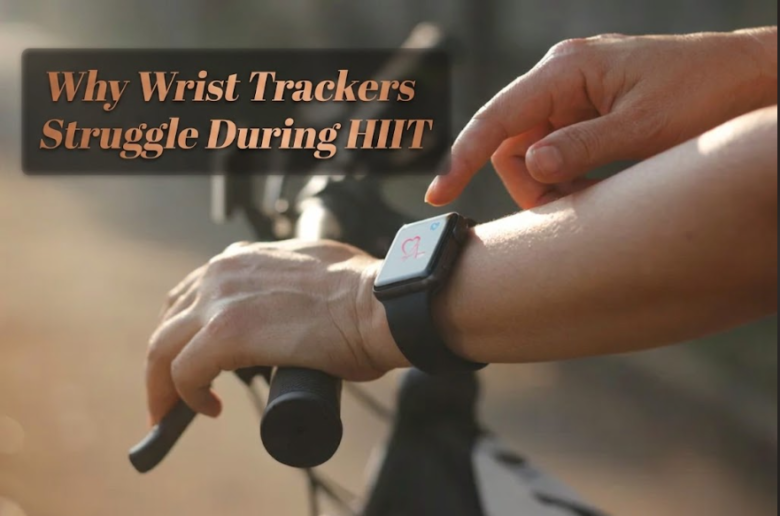
There’s a persistent belief that a wrist tracker giving you a heart rate number means that number is accurate. It doesn’t. Accuracy during steady-state activity and accuracy during high-intensity interval training are two different technical problems, and most consumer wearables solve the first one reasonably well while still struggling with the second.
This isn’t a knock on the technology broadly. Wrist-based optical sensors have gotten genuinely good over the last several years. The issue is specific to HIIT, and understanding why helps explain readings that otherwise seem random or unreliable mid-workout.
1. The Core Technical Problem
Optical heart rate sensors work by shining light into the skin and measuring how much bounces back, a method called photoplethysmography. Blood absorbs more light when a pulse passes through, so the sensor detects tiny brightness changes and converts that into a heart rate reading. This works well when your wrist stays relatively still.
HIIT breaks that assumption constantly. Burpees, jump squats, mountain climbers, kettlebell swings, all of these involve rapid, often unpredictable wrist movement. Every jolt or twist introduces what’s called motion artifact, essentially noise that the sensor has to filter out from the actual pulse signal. During steady jogging, the wrist moves in a repetitive, predictable pattern that’s easier to filter around. During HIIT, it doesn’t.
The result is readings that lag behind your actual heart rate, spike inaccurately, or occasionally just flatline and refuse to update for ten or fifteen seconds at a time.
2. Where People Usually Go Wrong Interpreting This
Here’s where people usually go wrong. They see an inconsistent or oddly low heart rate reading during an intense HIIT circuit and assume they’re not working hard enough, or worse, assume something is off with their body. Nine times out of ten, it’s a sensor limitation, not a fitness or health issue.
This matters because HIIT programs often use heart rate zones to guide intensity. If your tracker is undercounting during the most explosive movements, you might unnecessarily push harder in an attempt to hit a zone you’re likely already in. That’s not a small distinction. It affects recovery, injury risk, and whether you’re actually training the energy system you think you’re training.
Ar Body Health Online’s piece on gamified workouts versus regular cardio touches on a related issue, where intensity perception and actual physiological load don’t always match what the numbers on screen suggest.
3. Which Movements Cause the Worst Readings
Not all HIIT movements affect sensor accuracy equally. Movements involving sharp wrist rotation or impact, like battle ropes, boxing combinations, or plyometric jumps where arms swing hard, tend to produce the least reliable data. Movements that keep the wrist relatively stable, like squat jumps with hands at the hips or a stationary bike sprint interval, tend to track more consistently.
A quick reference for what to expect:
| Movement Type | Typical Tracking Reliability | Why |
|---|---|---|
| Squat jumps, wrist stable | Good | Minimal wrist-specific motion |
| Kettlebell swings | Poor | Sharp rotational wrist movement |
| Battle ropes | Very poor | Constant rapid wrist motion |
| Boxing combinations | Poor | Fast, unpredictable wrist speed changes |
| Stationary bike sprints | Good | Wrist largely stationary |
| Burpees | Moderate to poor | Mixed movement, hand contact with floor |
If your HIIT circuit leans heavily on the poor-reliability end of that list, expect the heart rate graph afterward to look choppier than the workout actually felt.
4. What Actually Improves Accuracy
A few practical adjustments genuinely help. Wearing the device slightly higher on the wrist, roughly two finger-widths above the wrist bone rather than right against it, improves skin contact during high-motion movement. Tightening the band during HIIT sessions specifically, even if it feels slightly less comfortable, reduces the sensor’s ability to slide against the skin, which is a major source of motion artifact.
For anyone training seriously around heart rate zones, a chest strap remains the more reliable option during HIIT specifically, since it measures electrical activity directly rather than optical blood flow, and isn’t affected by wrist motion at all. Several AR fitness platforms now support pairing a chest strap alongside the built-in tracking, which solves the accuracy problem without giving up the gamified format entirely. Ar Body Health Online covers this pairing setup in more detail in the guide on what equipment AR fitness actually needs.
And to be fair to the wrist sensors, they’re not trying to be lab equipment. They’re built for general daily tracking with exercise as one use case among many, sleep, resting heart rate, daily activity. HIIT is simply the hardest scenario to ask them to perform well in, given the physics involved.
Where This Leaves Your Training
If HIIT is a small part of your routine, the tracking inaccuracy probably isn’t worth solving with extra hardware. Note the limitation, trust perceived exertion over the exact number during the workout, and rely on post-workout summary data instead of live numbers. If HIIT is a core part of your training and you’re adjusting intensity in real time based on heart rate zones, a chest strap is a reasonable investment rather than an accessory. The wrist device isn’t wrong to own. It’s just answering a different question than the one HIIT training usually asks of it.
Anyone newer to structured interval training might also find Ar Body Health Online’s list of common early mistakes useful, since misreading heart rate data is one of several patterns that shows up often in the first few months of HIIT-style training.
FAQs
Why does my heart rate reading drop suddenly during a HIIT set? This is almost always motion artifact, where fast or sharp wrist movement interferes with the optical sensor’s ability to read blood flow accurately. It’s a hardware limitation, not typically a sign your heart rate actually dropped.
Should I trust my watch’s calorie burn number during HIIT? Treat it as a rough estimate. Since it’s often derived partly from heart rate data, and that data can be unreliable during HIIT, the calorie estimate inherits the same inaccuracy.
Does a tighter band actually help with accuracy? Yes, a snugger fit during high-motion workouts reduces sensor slide against the skin, which is one of the main causes of inaccurate readings during fast movement.
Is a chest strap really necessary for HIIT, or is that overkill? It depends on how precisely you’re training around heart rate zones. Casual HIIT doesn’t need it. Structured interval training built around specific zones benefits meaningfully from the more consistent data a chest strap provides.
Can software updates fix this, or is it purely a hardware issue? Some improvement comes from better motion-filtering algorithms over time, but the underlying physical limitation of an optical sensor on a moving wrist remains. Expect gradual improvement, not a full fix.
For a broader look at wearable accuracy across different workout types, see Ar Body Health Online’s guide on how AR workouts track form live.