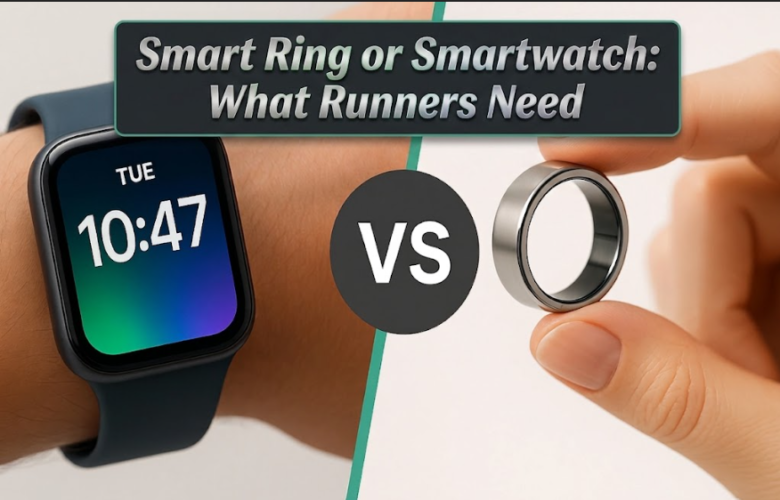
“Which one should I actually buy?” That question comes up constantly, usually from someone standing in an aisle or scrolling a product page at midnight, torn between a sleek ring and a watch loaded with running metrics. It’s not a bad question. It’s just one that gets answered badly most of the time, usually with a generic “it depends on your preference” that doesn’t actually help anyone decide.
So let’s actually decide. Not preference, function. What does a runner need from a wearable, and which format gives it to them.
1. What a Smart Ring Actually Tracks Well
Smart rings are built around passive, continuous data. Sleep stages, resting heart rate trends, heart rate variability, temperature shifts. They’re excellent at this because a ring sits against a blood vessel in a stable spot on your finger, with minimal movement interference compared to a wrist device bouncing around during a run.
For runners specifically, this matters more on rest days than run days. A ring will give you a cleaner picture of recovery status the morning after a hard training block than most watches manage, because the sensor placement is simply better suited to passive monitoring. If your training plan leans heavily on recovery-based adjustments, a ring earns its keep here.
Where it falls short is real-time run data. Most rings don’t have GPS. None that I’m aware of offer live pace feedback on your finger mid-run. You’ll finish the run and sync the data afterward, which is fine for casual runners but a real limitation for anyone training around specific paces or splits.
2. What a Smartwatch Does That a Ring Cannot
A running watch gives you what a ring physically can’t: live GPS tracking, real-time pace, cadence, distance, and for many models, on-wrist coaching cues during the run itself. If you’ve ever needed to know your current pace to hit a specific split at mile four, that’s a watch feature, full stop.
Here’s where people usually go wrong when comparing the two. They compare sleep tracking and recovery scores, decide the ring wins, and then buy a ring without accounting for the fact that they run structured workouts three times a week and now have no way to see live pace data. The ring isn’t worse. It’s just not built for that specific job.
Watches also tend to offer more detailed running-specific metrics: ground contact time, vertical oscillation, running power in some models. None of this exists on a ring yet, and probably won’t for a while, given the sensor and battery constraints of something that small.
3. Battery Life and the Trade-Off Nobody Mentions
Rings win on battery life by a wide margin, often lasting four to seven days per charge compared to a running watch’s one to three days depending on GPS use. That sounds like a clear point in the ring’s favor, and for daily wear it is.
But run a lot of GPS-tracked sessions and that gap narrows fast. A watch actively recording a run drains faster than its passive daily battery life suggests, sometimes significantly, especially with music playback or always-on display enabled. Meanwhile the ring’s battery life stays consistent regardless of how much you run, because it isn’t doing the GPS work at all.
This is a genuine trade-off, not a clear winner. It depends entirely on whether your priority is uninterrupted daily tracking or accurate in-run data.
| Category | Smart Ring | Running Watch |
|---|---|---|
| Live pace and GPS during runs | Not available | Core feature |
| Sleep and recovery tracking | Strong, minimal interference | Good, some wrist movement noise |
| Battery life | 4 to 7 days typically | 1 to 3 days with regular GPS use |
| Running-specific metrics (cadence, ground contact) | None | Extensive on most models |
| Comfort for all-day wear | Very high, easy to forget it’s there | Moderate, bulkier on wrist |
| Cost for comparable data depth | Often lower | Higher for advanced running features |
4. Who Should Actually Choose Which
If your running is casual, three or four easy runs a week without structured pace targets, and your bigger interest is understanding sleep and recovery trends, a ring covers what you need and does it comfortably. You’ll sync your runs after the fact and that’s a fine trade for a device you genuinely forget you’re wearing.
If you’re training toward a race with pace zones, interval work, or anything requiring real-time feedback mid-run, a watch is not optional. This isn’t really a preference call at that point. It’s a function call. You need live data a ring cannot provide.
Some runners end up owning both, which sounds excessive until you actually try it. Ring for daily recovery tracking, watch for structured training days. It’s not the cheapest setup, but it solves the actual gap between the two device types rather than forcing one device to do a job it wasn’t built for.
Ar Body Health Online has a breakdown on how AR workout apps track your form live, which covers a related but different tracking challenge worth understanding if you’re combining wearables with any kind of gamified training.
A Practical Note Before You Buy
Don’t buy based on the marketing photo of someone running with a sleek ring on their finger and no watch in sight. That image sells a lifestyle, not a training tool. Buy based on what your actual weekly running looks like, structured or casual, and let that decide the format, not the aesthetics. And if you’re not sure yet what your training structure will look like long term, the watch is the safer starting point, since it does everything the ring does at a basic level plus the run-specific data you might need later.
If you’re just getting into structured training and wearables generally, Ar Body Health Online’s beginner guide to AR fitness is a reasonable place to see how wearable data fits into a broader routine, not just running.
FAQs
Can a smart ring track my running pace at all? No, not in real time. Most rings lack GPS entirely, so pace and distance are either estimated after the fact from motion data or not tracked at all, depending on the model.
Is a smartwatch worth it if I only run casually? Probably not necessary. If you’re running without pace targets or structured intervals, a ring’s recovery and sleep tracking may serve you just as well at a lower cost and with less bulk on your wrist.
Do smart rings interfere less with sleep tracking than watches? Generally yes, since the ring’s placement on the finger tends to produce steadier sensor readings during sleep than a watch on a moving wrist, particularly for heart rate variability data.
Which one is more accurate for heart rate during a run? Watches with dedicated running modes usually edge out rings during active exercise, since rings are optimized more for passive, steady-state tracking than high-motion activity like running.
Should I check out related comparisons before deciding? Ar Body Health Online’s piece on gamified workouts versus regular cardio is worth a look too, especially if wearable choice is part of a bigger decision about how you want to train overall.
For more wearable comparisons specific to runners, the full breakdown is available at arbodyhealth.online/what-equipment-ar-fitness-actually-needs.