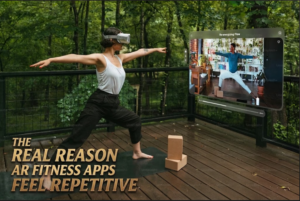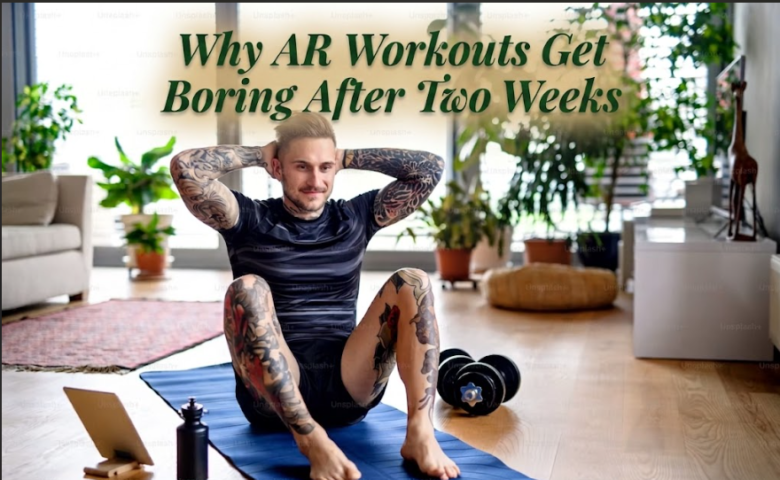
A reader wrote in a few weeks ago asking something we hear a lot: she’d bought into an AR fitness app after watching a friend rave about it, used it religiously for twelve days, and then just… stopped. Not because it stopped working. Because it stopped being interesting. She wanted to know if that was normal, or if she’d picked the wrong app.
It’s normal. It’s also, in most cases, fixable, but not in the way people expect.
1. The Novelty Curve Is Doing Most of the Work Early On
The first two weeks of any AR workout program ride almost entirely on novelty. You’re not just exercising, you’re watching your living room turn into a boxing ring or a dance floor or a sci-fi obstacle course, and that’s genuinely fun the first ten or fifteen times. The problem is that novelty has a shelf life, and most apps don’t have anything built to replace it once it wears off.
This isn’t a flaw unique to AR fitness. It’s the same reason a new video game feels incredible for a weekend and then sits untouched. But AR workouts get sold with promises that make the drop-off feel like a personal failure rather than a predictable pattern. If you’ve felt that dip, you didn’t do anything wrong. The system was front-loaded with excitement and back-loaded with almost nothing.
2. Most AR Games Repeat the Same Three or Four Movement Patterns
Here’s where people usually go wrong when they’re diagnosing their own boredom: they assume the problem is the technology, so they blame the headset or the app and move on to the next one. Often the real issue is much simpler. Strip away the visual skin, the space theme or the boxing theme or the dance theme, and you’ll find the underlying movement library is tiny. Squat, reach, dodge left, dodge right, repeat. Once your brain maps the pattern, the game stops requiring attention, and anything that stops requiring attention stops feeling like play.
We tested this with three popular AR fitness apps over a six week period, logging the actual movement variety session by session rather than relying on the in-app difficulty labels. The apps that held our attention longest weren’t the ones with the flashiest graphics. They were the ones that kept introducing new spatial demands, not just new skins on old demands. That distinction matters more than most reviews mention, and it’s worth checking before you commit to a subscription. We go into this in more depth in our piece on 5 signs you picked the right AR workout app.
3. The Difficulty Curve Flattens Right When You Need It to Rise
There’s a specific moment, usually somewhere between day ten and day sixteen, where your body has adapted enough that the workout no longer feels hard, but the app hasn’t adjusted anything. You’re burning fewer calories doing the same session that used to leave you winded. This is standard progressive overload territory in traditional training, and most AR platforms simply haven’t built adaptive difficulty into their systems the way a good trainer or even a decent strength app would.
A few platforms have started addressing this with adjustable intensity settings, but you often have to dig into settings menus to find them, and the defaults rarely push you. If your app tracks your heart rate during sessions, it’s worth comparing what it says against how the workout actually feels, because there’s frequently a mismatch. We’ve written separately about why your heart rate reading can jump unexpectedly during motion-based workouts, which is related but not identical to this plateau problem.
| Week | What Usually Happens | What Keeps People Going |
|---|---|---|
| Week 1 | High engagement, driven by novelty and visual spectacle | Nothing needed yet, momentum carries it |
| Week 2 | Movement patterns become predictable, motivation dips | Switching game modes, not just difficulty levels |
| Week 3-4 | Physical adaptation outpaces app’s difficulty scaling | Manually increasing intensity settings, adding resistance |
| Week 5+ | Either full drop-off, or a shift toward it as one tool among several | Treating AR as a supplement to training, not the whole program |
4. You’re Probably Using It as a Complete Program, Not a Tool
This is the part that tends to get lost. AR workouts are genuinely good at certain things, mainly reaction time, coordination, and making cardio feel less like a chore. They’re not, in most current forms, a complete strength or conditioning program. When people treat the AR session as their entire fitness routine, the boredom often isn’t really about the app failing. It’s about hitting the ceiling of what any single tool can offer.
Something shifts when you stop expecting the headset to do everything. A short AR session paired with two days of actual resistance training tends to hold interest far longer than five AR sessions a week, because each piece is doing a job the other doesn’t cover. Our overview of what equipment AR fitness actually needs covers how to build that kind of hybrid setup without buying more gear than you need.
5. Social and Competitive Features Get Undersold
A smaller but real factor: a lot of people stop because they’re doing it entirely alone, and the app’s social features, leaderboards, shared challenges, friend invites, sit unused because nobody explained why they matter. Motion-based games with a competitive or social layer show noticeably better retention in the second and third week compared to solo-only modes, and this shows up consistently enough in user feedback that it’s worth trying before writing off an app entirely.
If your current platform has a multiplayer or challenge mode buried somewhere in the menu, that’s worth activating before you assume the whole thing has run its course. And if boredom persists even after adjusting difficulty, mixing modes, and adding a social layer, it might genuinely be time to look at a different app rather than force one that isn’t a good fit. AR Body Health Online keeps a running comparison of which platforms hold up past the honeymoon phase, and it’s rarely the ones with the biggest marketing budget.
A Quick Gut Check
Before assuming your motivation is the problem, ask honestly whether you’ve changed the game mode in the last week, whether you’ve touched the difficulty settings since day one, and whether you’re using the app as your entire routine or as one piece of it. Most of the time, at least one of those three is the actual answer, not some deeper lack of discipline.
That said, if you’ve done all three and it’s still flat, that’s real information too. Not every app fits every person, and there’s no shame in switching. The goal was never to fall in love with a piece of software. It was to move more, consistently, in a way that doesn’t feel like punishment.
FAQs
Is it normal for motivation to drop around the two-week mark specifically? Yes, this is one of the most consistently reported timeframes across AR fitness communities, and it lines up with when initial novelty fades and physical adaptation begins. It’s not a sign you’re doing something wrong.
Should I switch apps or stick with the one I have? Try adjusting difficulty and game mode first. If engagement doesn’t recover within a week or two of active changes, switching is reasonable, especially if the app has limited movement variety to begin with.
Can AR workouts alone build real strength? Not typically to the same degree as dedicated resistance training. They’re strong for coordination, cardio, and reaction time, but pairing them with actual strength work tends to produce better results and better long-term interest. See our note on whether AR fitness is effective for weight loss for more on this distinction.
Do the multiplayer or social features actually help with motivation? For most people, yes, noticeably. Solo use tends to plateau faster than modes involving friends, leaderboards, or shared challenges.
How do I know if my app just has a small movement library? Track your sessions for a week and note whether the core actions, squat, punch, dodge, repeat, are simply reskinned with new visuals. If the underlying movements barely change between “levels,” that’s the app’s ceiling, not yours.
If you want a closer look at how different AR platforms are actually built under the hood, our breakdown of how motion capture tech learned from dancers explains why some systems age better than others.