A reader once messaged asking why their wrist-based tracker showed 88 beats per minute standing still, then spiked to 165 the second they lifted their arm to adjust their headset strap. No exercise involved. Just a shoulder movement. That kind of jump looks alarming if you don’t know what’s actually happening behind the sensor, and it comes up constantly with AR fitness setups specifically.
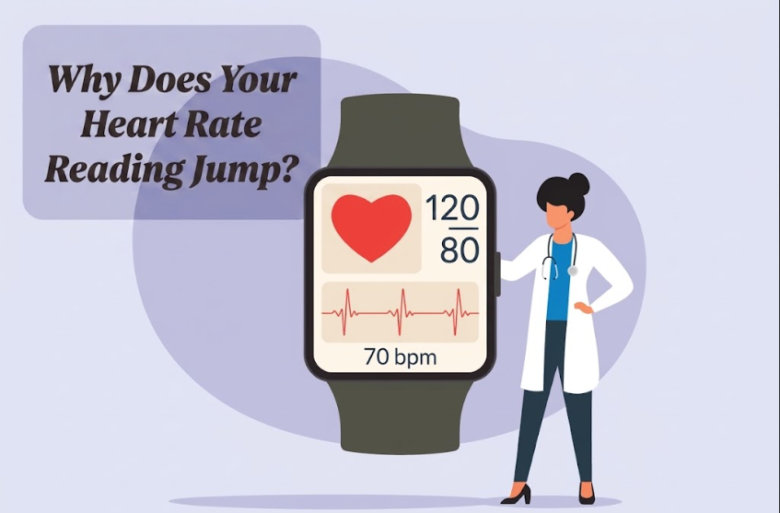
The short version is that most of these spikes are not your heart doing anything unusual. They’re the sensor losing its grip on reality for a second. But “most” is doing some work in that sentence, so it’s worth separating the harmless glitches from the readings actually worth paying attention to.
1. What’s Actually Causing the Sudden Jump
Wrist-based optical sensors work by shining light into your skin and measuring how blood flow changes the light that bounces back. It’s a clever system, but it’s also fragile. Any movement that shifts the sensor’s contact with your skin, even briefly, can produce a reading that has nothing to do with your actual pulse.
AR workouts are particularly rough on this kind of sensor. Boxing games involve fast wrist rotation. Dance-based titles involve constant directional changes. Every one of those movements has the potential to momentarily lift the sensor off the skin or press it at a different angle, and the device fills that gap with a guess rather than admitting it lost the signal. That guess is usually wrong, and it’s usually wrong in the direction of a spike, not a dip, because motion artifacts tend to read as rapid signal noise that algorithms interpret as a fast heartbeat.
2. When the Jump Is Actually Real
Not every spike is a glitch though, and this is the part people sometimes brush off too quickly. A genuine, physiologically real jump usually has company. It shows up alongside breathlessness, sudden fatigue, dizziness, or chest discomfort, and it tends to persist rather than snap back to baseline within a few seconds.
Sensor artifacts, by contrast, usually resolve almost immediately once movement settles. If your tracker says 165 for two seconds during a fast combo sequence and then drops back to 120 as soon as you slow down, that’s motion noise. If it climbs and stays elevated well past when your effort level would explain it, and especially if it comes with symptoms, that’s worth actually taking seriously rather than dismissing as a glitch.
3. Comparison: Glitch Spike Versus Real Spike
| Signal | Sensor Glitch | Genuine Cardiac Response |
|---|---|---|
| Duration | Seconds, resolves quickly | Sustained, doesn’t snap back fast |
| Trigger | Sudden movement or sensor shift | Correlates with sustained effort |
| Accompanying symptoms | None typically | Dizziness, chest tightness, breathlessness |
| Pattern | Erratic, jumps around | Rises and falls in a logical curve |
| Recovery | Immediate once movement stops | Gradual, tracks with rest |
If you’re ever unsure which category a reading falls into, the recovery pattern is usually the most reliable tell. Real cardiac responses come down gradually. Glitches snap back almost instantly, like they were never there.
4. Where Most AR Fitness Users Go Wrong With This
Here’s where people usually go wrong, and it’s an easy trap to fall into. They either panic over every erratic reading during a fast-paced session, or they swing the other way and start ignoring heart rate data entirely because “it’s always glitchy anyway.” Neither response is quite right.
The better habit, and one worth actually building, is checking sensor fit before a session rather than troubleshooting after. A tracker worn too loose is the single biggest cause of motion artifacts during AR fitness, more than the app or the movement type. Snug but not tight, positioned about a finger’s width above the wrist bone, resting flat against skin rather than over a bony area. Small adjustment, disproportionately large effect on data reliability. If you’re still deciding on hardware, what equipment AR fitness actually needs breaks down which sensors and accessories are worth the money.
And if you’ve read our piece on how AR workouts track your form live, you’ll notice a similar theme there. Sensor placement and contact quality quietly determine how trustworthy the whole system is, whether it’s tracking form or heart rate.
5. Getting More Reliable Readings Going Forward
A few things genuinely help beyond fit. Chest strap monitors, if you have access to one, use electrical signals instead of optical ones and are far less prone to motion-related noise, which makes them a better option for anyone doing especially fast or rotational AR workouts like boxing or dance titles. If a wrist-based tracker is your only option, keeping the strap slightly tighter during high-motion sessions specifically, then loosening it back for daily wear, is a reasonable compromise.
It’s also worth checking your app’s settings. Some AR fitness platforms let you smooth heart rate data over a longer window, which reduces the visual drama of short spikes without hiding a genuinely sustained change. Ar Body Health Online has found this setting buried in menus more often than not, so it’s worth hunting for if your app supports it.
None of this means you should stop trusting your tracker. Most of the time it’s giving you something close to accurate. It just helps to know when a number on the screen is telling you something real and when it’s just confused about what your wrist is doing.
FAQs
Should I stop my AR workout if I see a sudden heart rate spike? Not automatically. If the spike resolves within a few seconds and you feel fine, it’s most likely a sensor artifact. Stop and assess if the elevated reading persists alongside dizziness, chest discomfort, or unusual breathlessness.
Why does my heart rate reading jump specifically during boxing-style AR games? Fast wrist rotation and impact-style movements are the worst case scenario for optical sensors, since they repeatedly shift the sensor’s contact with skin. This is more of a hardware limitation than anything about the specific game.
Is a chest strap actually more accurate than a wrist tracker for AR fitness? Generally yes, particularly for high-motion workouts. Chest straps read electrical signals directly rather than relying on optical light reflection, which makes them far less sensitive to sudden movement.
Can dehydration cause erratic heart rate readings during workouts? It can, though indirectly. Dehydration reduces blood volume and can affect skin conductivity, which sometimes makes optical sensors less reliable, separate from any actual cardiac effect.
How tight should my fitness tracker actually be during AR workouts? Snug enough that it doesn’t slide when you move your wrist quickly, but not so tight it leaves an indentation. Positioned a finger’s width above the wrist bone tends to work best for most people.
Our guide on AR fitness mistakes beginners make early covers a few other setup habits worth fixing before they turn into bigger frustrations.