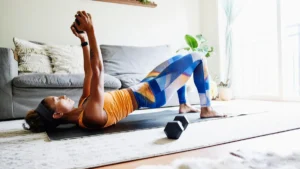
There was a point last winter where I’d completely fallen off my workout routine. Not dramatically — I didn’t quit the gym in a blaze of frustration or anything like that. I just… stopped going. Gradually. One skipped session became three, three became two weeks, and before I knew it, my running shoes had collected enough dust to double as décor.
The problem wasn’t motivation exactly. It was boredom. The same treadmill, the same playlist, the same four walls. My body was capable of more, but my brain kept voting against it.
A friend who’s way more into tech than I am suggested I try some AR-based workouts. I nodded politely and ignored the advice for about six weeks. Then one Sunday afternoon with nothing else going on, I strapped on a Meta Quest 2 and loaded up a fitness app — mostly out of curiosity.
Forty-five minutes later, I was drenched. I hadn’t checked my phone once. And I actually wanted to do it again the next day.
That was several months ago. Since then I’ve tried more AR fitness formats than I can count, tracked my calorie burn obsessively, and figured out which ones actually deliver results versus which ones are just clever entertainment. Here’s what I found.
1. Supernatural Flow Sessions — Full-Body Cardio That Doesn’t Feel Like Cardio
If you own a Meta Quest headset and haven’t tried Supernatural yet, you’re leaving serious calorie burn on the table.
Flow sessions are the core workout format — you’re moving through real-world landscapes (deserts, glaciers, volcanic craters) while hitting targets to music. The targets are positioned deliberately to make you squat, lunge, twist, and reach. It’s not random. There’s real movement design behind it.
On an average 30-minute flow session, I burn between 310 and 380 calories based on my chest strap heart rate monitor. That’s comparable to a moderate-intensity HIIT session — except I’m not watching the clock waiting for it to end.
Step-by-step to get started:
- Get the Supernatural app from the Meta Quest store (free trial available)
- Complete the initial tutorial — don’t skip it, it teaches you how to read target positioning
- Start with “Moderate” intensity flows before jumping to “Intense”
- Track your heart rate with an external monitor for accurate calorie data — the Quest’s built-in estimates run low
The subscription is around $19/month, which I was annoyed about initially. I’ve since stopped caring because I use it almost daily.
2. Beat Saber on Expert+ — Arm Endurance and Cardio Combined

Everyone knows Beat Saber as a game. Fewer people treat it seriously as a calorie-burning workout. That’s a mistake.
At Expert and Expert+ difficulty levels, Beat Saber becomes a genuine cardiovascular challenge. You’re moving constantly, your arms are never static, and the footwork requirement (yes, you actually need to move your feet to pass certain songs) keeps your whole body engaged.
I averaged 220–260 calories per 30 minutes at Expert difficulty during a dedicated session — not casual play. When I treated it like a workout (warming up, playing back-to-back songs without long breaks, pushing into difficult tracks), the numbers climbed noticeably.
What most people get wrong:
They stand still and only move their arms. That’s fine for casual play but leaves at least 40% of the potential calorie burn unused. Bend your knees. Step side to side. Treat the space like an athletic arena, not a living room.
A practical approach:
- Set a 25-minute timer
- Pick 6–8 songs at Expert level
- No pausing between songs except for a 30-second water break halfway through
- Focus on full-body movement, not just arm swings
It’s not as “designed” as Supernatural, but it’s accessible, fun, and the music library is enormous.
3. Les Mills Body Combat in VR — The Martial Arts Workout That Hits Hard

I didn’t expect to like this one. Kickboxing-style workouts always seemed like something that required a lot of coordination I don’t have. The VR version changed that assumption fast.
Les Mills Body Combat uses AR overlays to guide you through punch combos, kicks, and defensive movements. Targets appear, you hit them in sequence, and the whole thing flows like a martial arts class — but without the self-consciousness of doing it in front of strangers.
A 45-minute session burns somewhere in the 400–480 calorie range for me. That’s the highest of anything I’ve tested consistently.
The reason: it uses your largest muscle groups continuously. Legs are almost always engaged (you’re in a fighting stance or transitioning between movements), your core is rotating, and your arms are punching at different heights and angles.
What surprised me:
The upper body fatigue hits differently than regular cardio. After two weeks of regular sessions, I noticed more definition in my shoulders and arms than I’d seen from months of traditional weight training. That wasn’t something I was aiming for — it was just a side effect.
For anyone comparing AR workout formats and wondering which ones deliver the best results for effort invested, 8 game-changing AR fitness tricks that’ll transform the way you work out for good breaks down some of the principles behind why certain formats outperform others.
4. FitXR Boxing Sessions — Interval Training Without Knowing It
FitXR is available on Meta Quest and offers multiple workout formats. The boxing module is where the calorie numbers get interesting.
The structure is essentially interval training disguised as a boxing workout. You’ll punch a sequence of targets, then there’s a brief “reset” period, then another burst. That on-off pattern mirrors proper HIIT structure — high intensity followed by active recovery — which is one of the most effective calorie-burning approaches out there.
I measured my heart rate through a 30-minute FitXR boxing session and found I spent about 18 minutes above 75% of my max heart rate. That’s an excellent ratio for a workout that felt more like playing than training.
Practical notes:
- The multiplayer mode adds accountability — you can see other people’s scores in real time, which makes you push harder
- Use the “Custom Workout” feature to string together longer sessions (default sessions are often 10–15 minutes, which is too short for serious calorie burn)
- The dance and HIIT modules are also solid, but boxing delivers the highest intensity per minute in my experience
5. Holofit on a Stationary Bike — Cardio Machine Transformed
I’ve touched on Holofit before but it deserves a full spot here because the calorie burn from cycling-based AR is underrated.
Holofit overlays immersive environments onto your stationary bike or rowing machine session. You’re pedaling through sci-fi landscapes or natural environments, and your virtual speed responds to your actual effort. Pedal harder, move faster. Slow down, and you feel it.
The psychological effect on output is real and measurable. In sessions without Holofit, I averaged about 180–200 calories per 30 minutes on my stationary bike at moderate effort. With Holofit running, that number climbed to 240–270 — same duration, same perceived effort level, meaningfully higher actual output.
Why? Because I wasn’t managing boredom. My mental energy stayed in the workout rather than fighting the urge to stop.
Getting the most out of it:
- Pair a cadence sensor if your bike doesn’t have Bluetooth output built in
- Use the “Race” mode rather than “Explore” — it creates competitive pressure that elevates effort
- Set sessions for 40+ minutes — the immersion effect compounds over longer rides
6. Synth Riders — Rhythm Cardio With Surprisingly Serious Output
Synth Riders gets less attention than Beat Saber but it deserves more. Rather than slicing targets, you’re catching orbs in flowing streams — the movement is more continuous, less staccato, which means your heart rate stays elevated rather than spiking and dropping.
The music leans toward electronic and synthwave, and the visual design is genuinely beautiful (which matters more than it sounds — you work harder in environments you enjoy).
Calorie comparison between rhythm-based AR workouts (30 min, my data):
| Game | Avg Calories Burned | Heart Rate Zone | Difficulty to Learn |
|---|---|---|---|
| Beat Saber (Expert+) | 240–260 | Moderate-High | Medium |
| Synth Riders (Hard) | 210–235 | Moderate-Consistent | Low |
| Supernatural Flow | 320–380 | High | Low |
| FitXR Boxing | 290–340 | High-Interval | Low |
| Les Mills Body Combat | 400–480 | Very High | Medium |
Synth Riders sits in a sweet spot for people who want steady-state cardio without the intensity spikes of boxing or flow formats. Less demanding on joints, more forgiving on recovery.
7. Thrill of the Fight — The One That Humbled Me
I want to be upfront: this one is genuinely hard.
Thrill of the Fight is a VR boxing simulation — not an AR game with music and targets, but an actual virtual opponent who moves, feints, and counters. To win, you have to move your feet, manage your positioning, and throw punches with actual weight behind them.
My first session lasted 12 minutes before I had to stop. Not because of time — because I was physically exhausted in a way I haven’t been since competitive sport.
Calorie burn estimates for a 20-minute serious session: 300–360 calories. Per 20 minutes. That’s an extraordinary rate.
What makes it different from other AR workouts:
The opponent’s AI creates genuine uncertainty. You can’t learn a pattern and coast through it. Every round requires real-time physical and mental engagement, which keeps your effort level honest in a way scripted workouts can’t match.
Fair warning: Start with the tutorial opponents and work up gradually. I jumped to mid-tier opponents in week one and woke up with forearm soreness I didn’t expect. Your arms are doing real work here.
If you’re interested in how this kind of high-intensity AR workout fits into a broader fitness plan, 5 unexpected AR fitness hacks that make you never want to skip a workout again has some genuinely useful thinking on structuring AR sessions around recovery.
8. Arena Scale Multiplayer AR Workouts (Void-Style Experiences) — Group Cardio Reimagined
This one requires access to a location-based AR facility, so it’s not a home option — but it burns calories at a rate that nothing else on this list matches, and it deserves a mention.
Void-style arena AR experiences (and their successors operating today) put you in a physical space with haptic feedback gear, AR overlays, and multiplayer objectives. You’re running, ducking, climbing, and coordinating with other players through real physical space.
I did one 45-minute session at a facility in my city earlier this year. My heart rate monitor showed an average of 162 BPM over the full session. That’s sustained moderate-to-high intensity for 45 minutes without ever feeling like “exercise.”
Calories burned: 510 for the session. That’s the highest single-session number I’ve recorded from any fitness format, AR or traditional.
These experiences are pricier (typically $30–60 per session) and less accessible than home AR gear. But if there’s a facility near you and you haven’t tried it, it’s worth the expense at least once — if only to recalibrate what you think is possible when movement becomes play.
9. AR-Guided Outdoor Running (Zombies, Run! + AR Overlays) — Taking It Outside
Not every high-calorie AR workout happens in a headset.
Zombies, Run! is an audio AR experience for outdoor runners — it builds a narrative around your actual run, with zombie chases that require you to speed up in real time to escape. It’s been around for years, but the newer versions include visual AR elements through your phone camera.
What it does for calorie burn is straightforward: it makes you run faster than you normally would because something is chasing you (virtually, but your nervous system doesn’t entirely distinguish).
My average pace on a non-AR run: 6:10 per kilometer. My average pace during a Zombies, Run! chase sequence: 5:20 per kilometer. That’s a meaningful difference, sustained over real distance.
How to set it up:
- Download Zombies, Run! (iOS and Android)
- Enable “Chase Mode” in settings — this is what triggers the speed intervals
- Run your normal route; the narrative plays through your earphones
- During chase sequences, push your pace until the app confirms you’ve escaped
- The chase-and-recover structure naturally creates interval training patterns
It’s low-tech compared to the headset options, but it’s free to start and works with gear you already have.
10. AR Yoga and Mobility Flows — The Slow Burn That Adds Up
I know, I know. Yoga for a calorie-burn list feels counterintuitive. Stick with me.
AR-guided yoga and mobility apps — particularly Tripp (which uses immersive AR environments) and some features within Apple Fitness+ with spatial AR overlays — don’t burn calories at the rate of boxing or rhythm games. But they serve a function the other workouts on this list don’t: they keep your body capable of doing everything else.
After a month of daily Body Combat and Thrill of the Fight sessions, my hips were tight and my lower back was complaining. I added three AR mobility sessions per week. Within 10 days, the tightness resolved and my performance in the higher-intensity workouts improved noticeably.
The calorie burn from a 40-minute AR yoga session is modest — around 120–160 calories. But the compound effect on your overall training capacity is significant.
A practical weekly structure that worked for me:
| Day | Workout Type | Duration | Est. Calories |
|---|---|---|---|
| Monday | Supernatural Flow | 35 min | 350 |
| Tuesday | AR Yoga/Mobility (Tripp) | 40 min | 140 |
| Wednesday | FitXR Boxing | 30 min | 310 |
| Thursday | Rest or Light Walk | — | — |
| Friday | Les Mills Body Combat | 45 min | 450 |
| Saturday | Thrill of the Fight | 20 min | 320 |
| Sunday | Holofit Cycling | 45 min | 380 |
| Weekly Total | ~235 min | ~1,950 |
That’s close to 2,000 calories per week from AR workouts alone, without setting foot in a gym.
Mistakes I Made (So You Don’t Have To)
Treating every session like a maximum effort. The first two weeks I went hard every day because I was excited. By week three I was overtrained and exhausted. AR workouts are real workouts. Build in recovery days.
Ignoring the physical space setup. I knocked over a lamp, stubbed my toe on a chair, and clipped my knuckles on a door frame. Clear your space properly before every session. Minimum 6×6 feet for most headset workouts.
Trusting the in-headset calorie estimates. They’re almost universally optimistic. Get a chest strap heart rate monitor (Polar H10 is the one I use) for accurate data. The difference between Quest estimates and actual numbers can be 20–30%.
Only doing the formats I was already good at. I stayed in Beat Saber for too long because I was comfortable. The formats that challenged me most — Body Combat, Thrill of the Fight — delivered the best results. Deliberately try the uncomfortable ones.
Skipping warm-up. VR makes you forget you’re exercising until you’re already deep into it. Your body still needs preparation. Five minutes of dynamic stretching before any headset session reduces injury risk significantly.
For beginners who want to understand how to layer these workouts into a sustainable routine, 9 must-have AR fitness tools for beginners lays out a sensible progression from zero to consistent training.
Quick Reference: Which AR Workout Is Right for You?
| Goal | Best AR Workout | Why |
|---|---|---|
| Maximum calorie burn | Les Mills Body Combat | Highest sustained intensity |
| Fun first, fitness second | Supernatural / Beat Saber | Engaging, low learning curve |
| Joint-friendly cardio | Holofit Cycling / Synth Riders | Low impact, steady effort |
| Athletic challenge | Thrill of the Fight | Dynamic opponent, full body |
| Outdoor runners | Zombies, Run! | Works with existing routine |
| Recovery + mobility | Tripp AR Yoga | Maintains training capacity |
| Beginners | FitXR Boxing | Structured, guided, scalable |
Wrapping Up
The thing that genuinely changed my relationship with exercise wasn’t any single app or piece of gear. It was the realization that my brain needed novelty and engagement to stay consistent — and AR workouts provide that in a way conventional training doesn’t.
The calorie numbers are real. I’ve tracked them carefully with proper equipment across months of testing. The workouts on this list deliver genuine cardiovascular results, not just entertainment.
But the bigger win — the one that actually matters for long-term health — is that I stopped skipping sessions. Not because I became more disciplined. Because I started looking forward to it.
Start with one format. Give it two full weeks. Track your heart rate with something accurate. Then add a second format once the first becomes comfortable. Build from there.