My apartment is 420 square feet. I measured my “workout area” once — it’s roughly the size of a generous bathroom mat, give or take a few inches on each side. For years, that was my excuse. Not enough space for a proper workout. Can’t swing a kettlebell without hitting the bookshelf. Definitely can’t do burpees without my downstairs neighbor filing a noise complaint.
Then I started experimenting with AR fitness workouts, and that excuse quietly fell apart.
The thing about AR fitness that nobody really talks about is how well it’s actually designed for small spaces. Most of it is intentionally built around the reality that not everyone has a garage gym or a dedicated home studio. A lot of these workouts were made for people exactly like me — living in apartments, studio flats, small bedrooms — with maybe a 6×6 foot patch of floor to work with.
Here are five AR fitness workouts that I’ve personally tested in cramped quarters and can genuinely recommend.
1. Supernatural (Meta Quest) — The One That Fits in Your Living Room
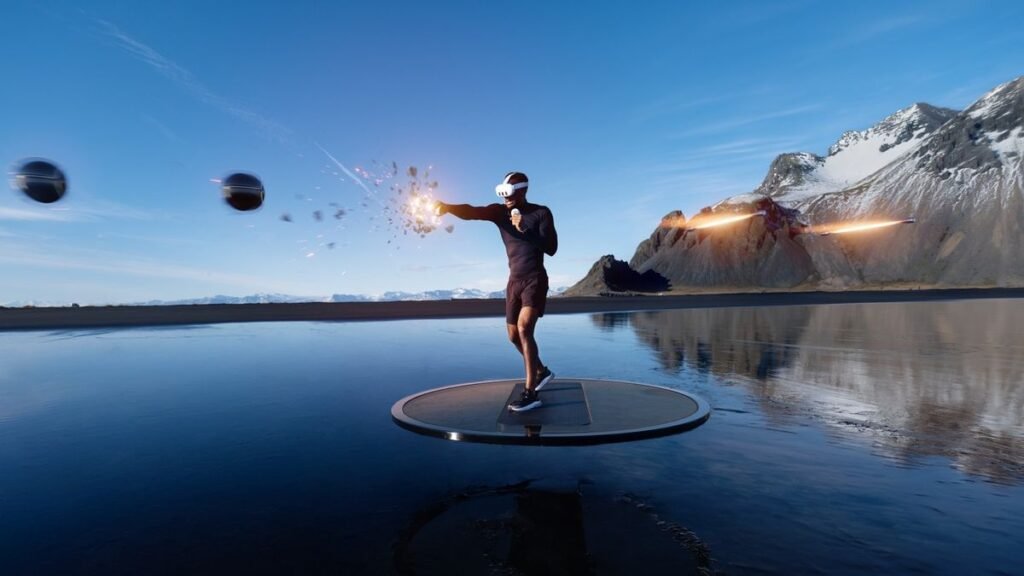
Before I tried Supernatural, I assumed VR/AR fitness meant a lot of jumping around and knocking things over. My coffee table had already survived three near-misses with a resistance band incident, so I was cautious.
Supernatural surprised me. The gameplay is almost entirely vertical and in-place — you’re squatting, lunging in place, and reaching side to side rather than moving forward or backward. The system actually tells you the minimum space requirement upfront: roughly 2m x 2m (about 6.5 x 6.5 feet). That fits in my living room if I push the couch back two feet.
How a typical session looks:
The app overlays moving targets in your augmented environment. You slash, dodge, and squat in rhythm with music — it’s almost like a fitness-meets-rhythm game. Your lower body does a LOT of work. After my first real session, I couldn’t walk downstairs properly for two days. That was week one. By week four, the soreness stopped and I was doing 30-minute sessions without thinking twice.
What I got wrong at first:
I kept trying to physically step toward the targets. Rookie mistake. The targets come to you. Once I stopped moving my feet and started letting the AR guide my upper body movement while my lower body handled the squats and lunges, everything clicked.
Space tip: Move your coffee table to the side, not just back. You need the side clearance for the lateral reaches more than the forward space.
| Workout Type | Space Needed | Intensity | Price |
|---|---|---|---|
| Supernatural | ~6.5 x 6.5 ft | Medium–High | $19.99/month |
| Device Required | Meta Quest 2/3 | — | ~$299–$499 |
Best for: Cardio, full-body conditioning, stress relief
2. FitXR (Meta Quest & PSVR2) — Structured Classes Without the Square Footage
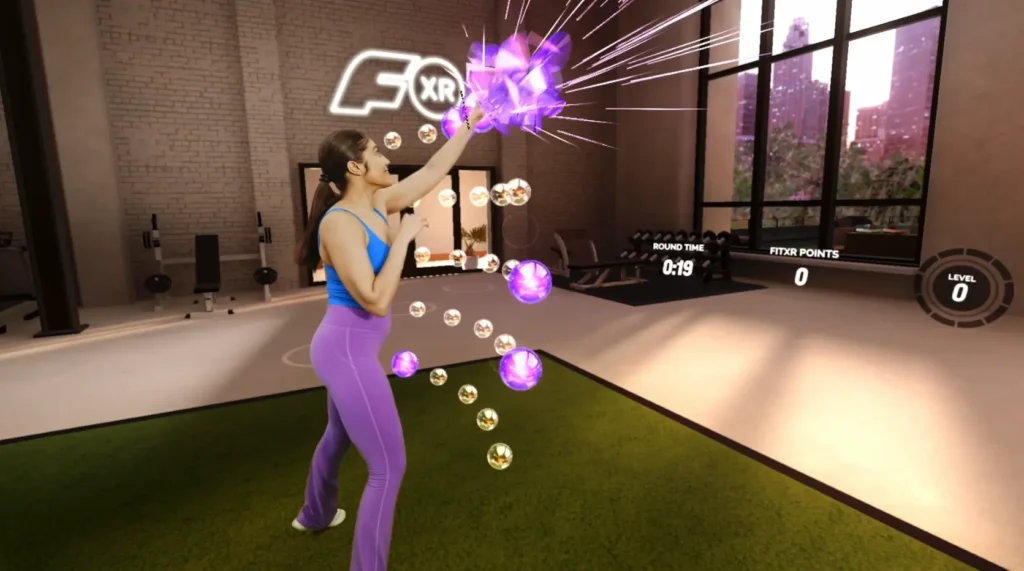
If Supernatural is the fun cousin, FitXR is the slightly more serious sibling who still knows how to have a good time. It offers structured fitness classes — boxing, dance, HIIT, and sculpt — all designed with mixed reality in mind.
The boxing module is where FitXR really shines for small spaces. You stand in place, feet shoulder-width apart, and punch at AR targets that float around you. There’s no footwork required (well, there’s optional footwork for advanced users, but the default is fully stationary). I did a 20-minute boxing class in a space where I couldn’t have done a single proper jumping jack, and burned more calories than I expected.
Step-by-step to get started:
- Clear a 5×5 ft area — genuinely the minimum
- Put on the headset and open FitXR
- Select a class type (start with Boxing — easiest to manage spatially)
- Do the guardian/boundary setup and keep it small
- Follow the on-screen instructor and match your punches to the targets
The sculpt classes are almost entirely standing core and upper body work — perfect if you’re dealing with a super narrow space that doesn’t even allow full lateral movement.
For anyone building out a full small-space AR routine, pairing FitXR with some of the AR fitness hacks that make you never want to skip a workout can really help with consistency over time.
One thing I didn’t expect:
The sweat is real. I wore my headset without a face liner the first time and deeply regretted it. Get a silicone face cover or at minimum a sweat-absorbing cover — they cost about $15 and save you from a very unpleasant situation.
Best for: Structured classes, boxing training, upper body sculpting
3. Les Mills Bodycombat (Meta Quest) — High Intensity, Zero Floor Space Drama
Les Mills is a name that gym-goers will recognize immediately. Their Bodycombat program has been a staple of group fitness classes for years. The AR/VR version on Meta Quest is basically that, but in your living room, and you don’t have to awkwardly make eye contact with strangers.
What makes this especially small-space friendly is the choreography design. Les Mills has decades of experience building group fitness routines that work on a small patch of studio floor. That discipline carries over perfectly to the home AR environment.
The workouts combine martial arts-inspired moves — punches, kicks, knee strikes — with dynamic music and real-time form coaching overlaid in your view.
My honest first month breakdown:
- Week 1: Completely winded after 15 minutes. Felt embarrassed even though I was alone.
- Week 2: Made it through 20 minutes. Started to get the rhythm.
- Week 3: Completed a full 30-minute class. Felt unreasonably proud.
- Week 4: Started doing back-to-back classes. Might be addicted.
The space requirement is similar to FitXR — about 5×5 feet minimum. Most of the kicks are controlled and not wild, so you’re not booting your TV stand across the room.
One mistake to avoid:
Don’t skip the warm-up. I know it feels like extra time you don’t want to spend, but the Les Mills warm-ups are genuinely functional. I skipped one, went hard on a roundhouse sequence, and tweaked my hip flexor. Lesson learned the painful way.
| Feature | Detail |
|---|---|
| Class Length | 15, 30, 45 minutes |
| Space Required | ~5 x 5 ft |
| Intensity Options | Beginner to Advanced |
| Platform | Meta Quest |
| Price | Included with Meta+ or standalone purchase |
Best for: Cardio, martial arts conditioning, calorie burning
4. Holofit Home Cardio (Rowing/Cycling Mode) — When You Have ONE Piece of Equipment
This one’s slightly different from the others because it works with existing equipment rather than replacing it. If you own a stationary bike, a rowing machine, or an elliptical — even a cheap one — Holofit can turn that single piece of gear into an immersive AR cardio experience.
The reason this belongs on a small-space list is specific: a stationary bike or compact rowing machine has a fixed, known footprint. You already know exactly how much space it takes. Holofit doesn’t add to that. You just put on a compatible headset, sync the machine, and suddenly you’re cycling through AR environments — fjords, space stations, underwater — while your body does the actual work in your same tiny corner.
Setup process (took me about 25 minutes the first time):
- Download Holofit on your Meta Quest headset
- Open the app and select your equipment type
- Use the equipment sensor pairing (most modern machines have Bluetooth)
- Choose an environment and start pedaling/rowing
- Your real effort translates directly to your virtual movement speed
The thing that got me was how much longer I stayed on the bike. Normally, 15 minutes on a stationary bike and my brain is already composing grocery lists. With Holofit, I did 42 minutes on my first proper session because I was genuinely trying to see around the next virtual corner.
If you’re exploring how AR tools are reshaping home cardio more broadly, this guide on AR fitness tools for home workouts covers a lot of ground worth reading.
Space reality check:
A compact stationary bike takes about 4×2 feet. Add a foot on each side for safe movement and you’re at roughly 6×4 feet. That works in most bedrooms or corners of a studio apartment.
Best for: Cyclists, rowers, anyone who owns cardio equipment and hates being bored by it
5. Nike Training Club with AR Overlays (Phone-Based AR) — No Headset Required
Look, not everyone wants to spend $300+ on a VR headset. Totally fair. This one’s for you.
Nike Training Club (NTC) has been steadily building AR-assisted features into its app that work through your smartphone camera. The AR functionality overlays movement guides, form cues, and positioning markers directly onto your phone screen as you work out — no headset needed.
You set your phone up facing you (propped against a wall or on a small stand), start a workout, and the app uses your camera to track your movement and overlay real-time guidance. It’s not as immersive as a headset experience, but it’s genuinely useful and the space efficiency is exceptional.
Why it’s perfect for small spaces specifically:
NTC’s home workout library is built around minimal equipment and tight spaces. A lot of the bodyweight sessions are designed for apartment living — no jumping, low noise, high effort. The AR guidance layer just makes the form coaching more precise than audio alone.
Workouts I’ve personally used in my tiny apartment:
- 20-minute standing core session (barely moved my feet the whole time)
- 15-minute upper body resistance band workout
- 25-minute yoga flow with AR alignment guides
The yoga flow with AR overlays is genuinely impressive. The app projects alignment lines and positioning guides that help you understand whether your warrior pose looks like a warrior pose or like someone trying to look at their own elbow.
One honest limitation:
Phone-based AR depends heavily on lighting. Low light = poor tracking = frustrating experience. Make sure you have decent natural or artificial light facing you, not behind you. Learned this after a whole session where the app kept losing track of my movements because I was backlit by a window.
For those who want to take this further and layer in more consistency tricks, these AR fitness apps designed for busy people pair really well with the NTC approach.
| Feature | Detail |
|---|---|
| Device Required | Smartphone (iOS/Android) |
| Space Needed | As little as 4 x 4 ft |
| Cost | Free (premium subscription optional) |
| AR Type | Phone camera overlay |
| Best For | Beginners, budget-conscious users |
Small Space AR Fitness: What Actually Works vs What Doesn’t
Here’s a quick reality check based on my experience — some things people assume about small-space AR workouts that aren’t quite right:
What works really well:
- Standing, in-place cardio (boxing, rhythm games, martial arts)
- Upper body and core focused routines
- Stationary equipment + AR overlay combinations
- Phone-based AR for yoga and bodyweight training
What doesn’t work in tight spaces:
- Workouts with running-in-place components (more room than you think)
- Full VR experiences designed for room-scale movement
- Anything requiring jumps in apartments with downstairs neighbors (learned this socially the hard way)
Quick Comparison: All 5 Workouts Side by Side
| Workout | Platform | Min Space | Cost | Headset Needed |
|---|---|---|---|---|
| Supernatural | Meta Quest | 6.5 x 6.5 ft | $19.99/mo | Yes |
| FitXR | Meta Quest / PSVR2 | 5 x 5 ft | $9.99/mo | Yes |
| Les Mills Bodycombat | Meta Quest | 5 x 5 ft | Varies | Yes |
| Holofit | Meta Quest + equipment | Equipment footprint | $14.99/mo | Yes |
| Nike Training Club AR | iOS / Android | 4 x 4 ft | Free / Premium | No |
A Few Things Worth Knowing Before You Start
Clear the space properly — don’t “mostly” clear it. One session I thought I’d moved everything out of the way. I had not moved a floor lamp that was directly behind my left shoulder. I found out mid-session. The lamp did not survive.
Start with shorter sessions. AR workouts are deceptively intense. The immersion makes you push harder than you realize. Your first week, aim for 15–20 minutes and build up from there.
Have water close but not on the floor. Stepping on a water bottle mid-session while wearing a headset is genuinely dangerous. Keep hydration accessible but elevated — on a shelf, a table edge, somewhere you won’t stand on it.
Headset hygiene matters more than you think. You will sweat. A lot. Get silicone covers or washable face gaskets before day one, not after a week of questionable hygiene choices.
Wrapping It Up
Living in a small space used to be my biggest workout excuse. It genuinely felt like a real barrier. And in some ways it is — you can’t do deadlifts in a studio apartment without rearranging your whole life.
But for cardio, conditioning, core work, and consistency? AR fitness has quietly solved the small-space problem better than almost any other approach I’ve tried. You don’t need a gym. You don’t need a big room. You need a cleared patch of floor, a bit of gear, and the willingness to look slightly ridiculous while actually getting fitter.
Start with whatever matches your budget — Nike Training Club costs nothing and your phone is already in your pocket. If it works and you want more, move toward a headset-based option. The progression makes sense.