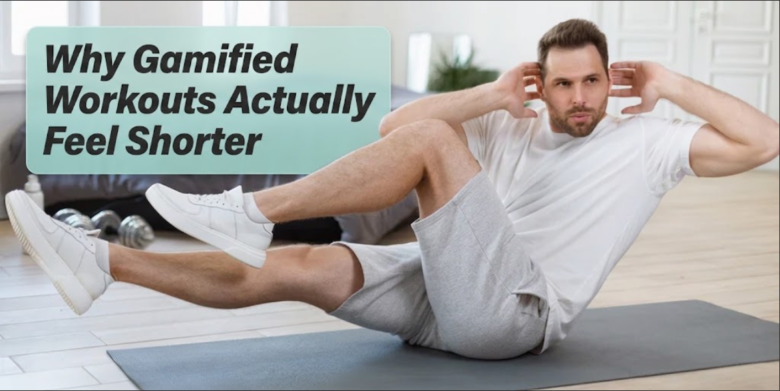
There’s a strange thing that happens in a twenty minute AR boxing session versus twenty minutes on a treadmill staring at a wall. One feels like it dragged. The other feels like it barely started before it ended. Same twenty minutes, same heart rate zone, wildly different experience of time passing.
That gap is not imagined and it is not really about fitness level either. It comes down to how your brain tracks time when it is focused on a goal versus when it is just enduring an activity. Gamified workouts hijack that system, and once you understand how, a few things about training start to make more sense.
1. The Misconception That Gamified Just Means Fun
Most people assume gamified workouts feel shorter because they’re more enjoyable, full stop. That’s part of it, but it’s not the whole story, and treating “fun” as the entire explanation misses what’s actually happening.
The real driver is attention allocation. When you’re dodging a virtual obstacle, tracking a score, or chasing a combo streak, your brain is busy processing external stimuli in real time. There’s no spare processing power left over to monitor how tired you are or how much time has passed. Compare that to a treadmill run with no visual stimulation, where your mind is essentially free to fixate on fatigue, boredom, and the clock, all three of which make time feel like it’s crawling.
This is why a genuinely hard AR session can still feel shorter than an easy, boring cardio session. Difficulty and perceived duration aren’t tied together the way people assume.
2. What’s Actually Happening in Your Brain During Gamified Training
Time perception during exercise runs through a few overlapping systems, but the one that matters most here is called attentional narrowing. Athletes and gamers both experience it. Under focused task demands, especially ones with immediate feedback like a score popping up or a combo counter ticking, the brain narrows its attention onto the task and away from internal signals like effort and time tracking.
AR fitness platforms are built almost entirely around this principle, whether the developers frame it that way or not. Real-time scoring, visual targets, and reactive gameplay all create the exact conditions attentional narrowing needs to kick in. It’s not an accident that most AR fitness apps show your score prominently and update it constantly. That constant feedback loop is doing a lot of quiet work.
3. Myth Versus Reality Quick Reference
| Common Belief | What’s Actually True |
|---|---|
| Gamified workouts feel shorter because they’re easier | They often feel shorter even when objectively harder |
| Any distraction during exercise reduces perceived effort | Only task-relevant, feedback-driven distraction reliably shifts time perception |
| Music alone creates the same effect | Music helps but lacks the real-time feedback loop that scoring systems provide |
| The effect fades with repetition | It can dull slightly with familiarity but rarely disappears entirely |
That third row surprises people the most. Music is genuinely useful for workouts, but it’s passive. Gamified feedback is active and reactive, which is a meaningfully different mechanism even though both get lumped under “distraction.”
4. Where This Goes Wrong for People Training at Home
Here’s where a lot of home AR users undercut themselves without realizing it. They pause constantly to check their phone, adjust the headset, or glance at a score on a separate screen instead of within their field of view. Every one of those interruptions resets the attentional narrowing effect, pulling the brain back into monitoring mode. And once that happens, the workout starts to feel like its actual length again, sometimes longer, because the interruption itself becomes a new thing to be annoyed about.
Consistent setups matter more than people expect. A stable headset fit, a charged device, and a play area that doesn’t require mid-session adjustments all protect that immersive feedback loop. It sounds like a small detail. It is not.
5. Using This on Purpose
Once you know the mechanism, you can lean into it deliberately. Choosing AR fitness modes with visible real-time scoring over ones with passive background stats tends to produce sessions that feel noticeably shorter. Stacking harder intervals into the sections of a workout with the most active feedback, rather than the calmer stretches, also works in your favor, since that’s exactly when attentional narrowing is strongest.
Ar Body Health Online has covered headset stability separately, since a slipping or uncomfortable fit is one of the fastest ways to break the immersion this entire effect depends on. Worth checking if you’ve noticed your sessions feeling long lately despite decent effort.
None of this means boring cardio is useless. Steady state training still has its place. But if the goal is consistency, and for most people it is, choosing formats that make time distort in your favor is a legitimate strategy, not a gimmick.
FAQs
Is it actually true that gamified workouts burn the same calories as regular ones? Calorie burn depends on intensity and duration, not on whether the format is gamified. A high intensity AR session burns comparably to a similarly intense traditional workout of the same length.
Why do some AR fitness sessions still feel long even with scoring? Usually it comes down to interruptions. Constant pausing, adjusting gear, or checking external screens breaks the feedback loop that makes time compress in the first place.
Does this effect work for everyone or just people who like video games? It works broadly, not just for gamers. Attentional narrowing is a general cognitive response to real-time feedback, not something limited to people with a gaming background.
Can I get the same effect from a regular workout app with a timer? Not really. A countdown timer is passive information, while gamified feedback like scoring or combo tracking is active and reactive, which produces a stronger effect.
Does the time-distortion effect wear off the more I use AR fitness? It can soften slightly with heavy familiarity, but most users report it staying fairly consistent, especially if they rotate between different games or modes rather than repeating the same one endlessly.
For more on why headset comfort quietly affects workout consistency, our piece on choosing the right AR fitness headset for small spaces is worth a read.