A designer working on an early motion-tracking fitness app once said something worth remembering: the hardest part wasn’t building the sensor, it was making a squat feel like it mattered. That’s a game design problem, not a fitness problem, and it explains more about why AR workouts feel the way they do than any spec sheet.
Most people assume AR fitness apps are exercise software with some visual flair bolted on. That gets it backwards. A lot of what makes these apps engaging, or frustrating, was borrowed directly from decades of video game design, sometimes deliberately, sometimes because the same problems kept showing up and game designers had already solved versions of them.
1. Feedback Loops Didn’t Come From Fitness, They Came From Games
Traditional workout tracking gives you a number after the fact. Reps completed, calories burned, minutes elapsed. AR fitness apps do something different. They give you feedback while you’re moving, not after.
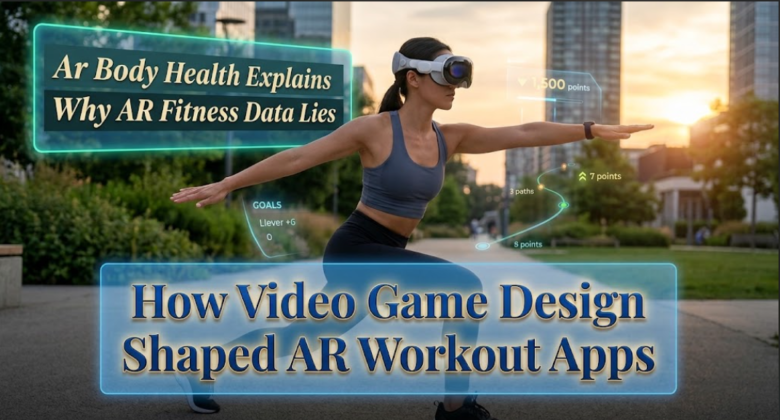
That’s a straight import from game design, specifically from how action and rhythm games handle player feedback. A well-designed game never waits until the end of a level to tell you how you’re doing. It tells you constantly, through small visual and audio cues, so the player adjusts in real time instead of learning from a summary screen. AR fitness apps that track your form live are applying the exact same principle to a lunge or a punch instead of a jump or a combo.
The apps that get this right feel responsive. The ones that get it wrong feel like a workout video with extra steps, because the feedback loop is too slow or too vague to actually change what you’re doing mid-movement.
2. Difficulty Curves, Borrowed and Adapted
Game designers spend enormous energy on pacing difficulty. Too easy too long and players get bored. Too hard too fast and they quit. This is the same curve that determines whether someone sticks with a fitness app past week two or abandons it entirely.
Here’s where a lot of AR fitness apps go wrong, and it’s a mistake straight out of bad game design. They front-load difficulty to impress new users in the first session, then plateau, offering nothing new for weeks. Reader familiar with why AR workouts get boring after two weeks will recognize the pattern immediately. It’s not that people lose motivation randomly. It’s that the app stopped pacing difficulty the way a well-designed game would.
The apps that hold attention longer tend to introduce complexity gradually and unpredictably, similar to how a good game introduces new mechanics one at a time rather than dumping them all in a tutorial.
3. Where Motion Capture Actually Came From
This part surprises people. A meaningful chunk of the motion tracking technology inside modern AR fitness apps traces back to techniques refined in animation and game studios, not fitness labs. Studios needed a way to translate a real performer’s movement into digital characters convincingly, and that work on capturing natural human motion eventually filtered into consumer fitness hardware.
There’s a longer breakdown of this on Ar Body Health Online in how motion capture tech learned from dancers, which goes into how choreography-trained movement data shaped the algorithms these apps now use to judge whether your squat depth or your form on a punch actually counts.
The practical result is that AR fitness apps are often better at reading fluid, continuous movement, the kind found in dance or martial arts style workouts, than isolated static holds. That’s a direct inheritance from the source material the motion tracking was originally trained on.
4. Gamification Works, But Only When It’s Not Just a Sticker Chart
Slap points and badges on anything and call it gamified. That’s the lazy version, and plenty of fitness apps still do exactly that. Real game design uses reward systems tied to meaningful progress, not arbitrary point totals disconnected from actual skill or effort.
| Weak Gamification | Strong Gamification |
|---|---|
| Points for simply opening the app | Points tied to form accuracy or consistency |
| Generic badges with no context | Milestones tied to a visible skill improvement |
| Streaks that reset with no explanation | Streak systems with fair grace periods |
| Leaderboards with no matchmaking | Leaderboards grouped by skill or activity type |
Apps that borrow the shallow version of gamification tend to feel hollow after the novelty wears off. The ones that borrow the deeper mechanics, the kind that made certain games replayable for hundreds of hours, hold attention because the reward actually reflects something real about the player’s performance. There’s a fuller comparison of this in gamified workouts vs regular cardio if you want to see how that distinction plays out in practice.
And to be fair, not every gamified feature needs to be deep. Sometimes a simple, honest streak counter is exactly what a beginner needs, nothing more elaborate than that.
5. The Mistake Most New AR Fitness Apps Make
New entrants to this space frequently copy the aesthetic of games, bright visuals, sound effects, on-screen combos, without copying the underlying design discipline that makes those elements work. The result looks flashy in a demo video and falls apart after the third real workout, because the visuals aren’t connected to anything meaningful about the user’s actual movement or progress.
This is the same mistake plenty of early gamified software made outside fitness too. Visual polish is not the same thing as good feedback design. A beginner exploring this space for the first time is often better off starting with something simpler, and ar fitness for beginners where to start covers what actually matters in those first few sessions, well before flashy visuals become relevant at all.
Good AR fitness design borrows its best instincts from an industry that spent thirty years figuring out how to keep people engaged without lying to them about their progress. When that discipline is missing, no amount of visual polish covers for it. When it’s present, even a simple app built around a single movement type can hold attention far longer than its feature list would suggest.
Frequently Asked Questions
Do AR fitness apps actually use real game engines? Many do, yes. Several popular AR fitness platforms are built on the same underlying engines used in commercial video games, adapted for motion tracking rather than traditional controller input.
Why do some AR workouts feel more like a game than exercise? That’s usually intentional design, borrowing feedback and reward systems from game design to keep engagement high. It works well for motivation but occasionally comes at the cost of pure training efficiency compared to a more traditional structured program.
Is gamified fitness actually effective, or just fun? Both, depending on execution. Effectiveness depends heavily on whether the underlying exercise science is sound, not just whether the interface is engaging. A fun app with poor exercise programming still won’t deliver strong fitness results.
Why does my AR workout app get repetitive so fast? Usually because the difficulty curve flattens out early, offering no new movement complexity after the first couple of sessions. Apps with stronger long-term retention tend to introduce variation more gradually and less predictably.
Do these apps track form accurately enough to prevent injury? Accuracy varies significantly by device and movement type. Fast, complex movements are harder to track reliably than slower, more controlled ones, so form feedback should be treated as a helpful guide rather than a substitute for proper technique instruction.
For a broader honest assessment of where this technology is actually heading, arbodyhealth.online has a longer piece worth reading on the subject.