“So is this basically replacing my trainer, or not?” That question comes up constantly, usually from someone who just tried an AR fitness app for the first time and isn’t sure whether to cancel their gym membership or keep both. It’s a fair question, and the honest answer is more nuanced than either a yes or a no.
AR coaching and a human trainer aren’t really competing for the same job, even though they look like they are on the surface. Once you break down what each one actually does well, the picture gets a lot clearer.
1. What AR Coaching Actually Gets Right
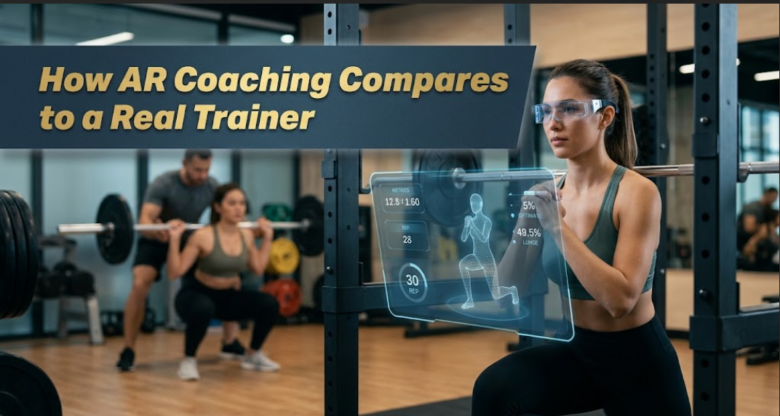
Real-time form feedback is where AR coaching genuinely shines. A camera or sensor watching your movement can flag issues instantly, every single rep, without getting tired or distracted. A human trainer, even a good one, can’t watch every rep of every set with that level of consistency, especially in a group class setting.
Availability is the other clear win. AR coaching doesn’t care what time it is. Someone squeezing in a workout at 6am before work or 10pm after putting kids to bed gets the same quality of feedback they’d get at noon. That consistency matters more than people expect, and it’s part of why AR workouts feel the way they do when you compare them to traditional coaching models. The technology behind how AR workouts track your form live has gotten genuinely good at catching things like knee alignment or spine position that a distracted eye might miss.
Cost is worth mentioning too, though it’s not the whole story. A monthly app subscription runs a fraction of what personal training sessions cost, which matters for people who need consistent coaching but can’t justify the ongoing expense of one-on-one sessions every week.
2. Where a Human Trainer Still Wins, Clearly
Here’s where people usually go wrong when comparing the two: they treat this as a technology-versus-tradition debate, when really it’s about two different kinds of expertise.
A trainer reads context an algorithm can’t. They notice that you’re favoring your left knee today because you mentioned tweaking it last week. They adjust a program on the fly because you look exhausted, or because your form is technically fine but something about your energy suggests you need a lighter day. AR coaching evaluates the movement in front of it. It doesn’t know your history, your mood, or the conversation you had with your doctor last month.
Programming depth is another gap. A skilled trainer builds a progression tailored to your specific goals, injuries, and schedule constraints, adjusting week to week based on how you’re actually responding. Most AR fitness apps offer structured programs, but they’re built for a general population, not for the person who has a shoulder impingement and needs certain movements modified indefinitely.
3. Pros and Cons, Side by Side
| AR Coaching | Human Trainer | |
|---|---|---|
| Cost | Low, subscription-based | High, per-session or package |
| Availability | Anytime, no scheduling | Limited to booked sessions |
| Form feedback | Consistent every rep | Depends on trainer attention |
| Context awareness | None, evaluates movement only | High, knows your history |
| Program customization | General, template-based | Fully individualized |
| Motivation style | Gamified, self-directed | Personal accountability |
| Injury adaptation | Limited or none | Real-time adjustment possible |
Neither column wins outright. The honest read is that AR coaching handles the mechanical, repeatable side of training extremely well, while a human trainer handles the judgment calls that come from actually knowing the person in front of them.
4. The Combination Most People Overlook
Very few articles on this topic mention the option that actually makes the most sense for a lot of people: using both, just not at the same time or for the same purpose. Someone might work with a trainer for the first month to build a solid program and correct fundamental form issues, then use AR coaching for daily maintenance and consistency once the foundation is set.
That approach solves the two biggest weaknesses of each option. AR coaching stops being generic because a trainer already tailored the starting point. And the trainer’s limited availability stops being a bottleneck because daily accountability shifts to the app. Ar Body Health Online sees this hybrid pattern come up often among readers who started with one option and eventually layered in the other rather than treating it as a strict either-or decision.
If budget is the deciding factor and hiring a trainer even briefly isn’t realistic, it’s worth reading ar fitness for beginners where to start, which covers how to build reasonable form awareness without professional supervision in the early stages.
5. A Common Misconception Worth Correcting
People often assume AR coaching apps are only good for beginners, and that anyone with real training experience has outgrown them. That’s not quite accurate. Advanced lifters and athletes use motion tracking for very different reasons than beginners do, mainly for catching small technical breakdowns during fatigue or high-volume training blocks, the kind of subtle form drift that even experienced trainers sometimes miss during a busy session.
The gap isn’t skill level. It’s what the technology is actually being asked to do in each case.
Cost concerns come up here too, and it’s worth being direct about it. AR coaching doesn’t replace judgment built over years of hands-on coaching experience. It replaces the parts of coaching that are repetitive and mechanical, which is a real and useful thing, just not the whole job.
Closing Thought
Most people asking whether AR coaching replaces a trainer are really asking the wrong question. It’s not a replacement, it’s a different tool solving a narrower problem extremely well. Whether that’s enough depends entirely on what someone actually needs help with, and that answer looks different for a total beginner than it does for someone chasing a specific performance goal.
Frequently Asked Questions
Can AR coaching catch injuries before they happen? It can flag form patterns associated with injury risk, like poor knee tracking or spine rounding, but it can’t diagnose an existing issue or account for pre-existing conditions the way a trainer aware of your history could.
Is AR coaching enough for someone training for a specific event, like a race or competition? Usually not on its own. Event-specific training benefits from periodized programming that adjusts based on performance data over months, something most consumer AR apps aren’t built to handle at that level of detail.
Do trainers ever recommend AR coaching to their own clients? Some do, particularly for accountability between in-person sessions. It’s increasingly common for trainers to suggest an app for daily movement tracking while reserving in-person time for programming and technique correction.
Why does AR coaching feel less motivating over time compared to a trainer? Human accountability tends to carry more social pressure and personal connection than app-based reminders, which can lose their pull once the novelty wears off. That’s part of why streaks and gamified elements matter so much to how these apps hold attention long term.
Is one clearly better for weight loss specifically? Neither has an inherent advantage for weight loss on its own. Results depend more on consistency and nutrition than on which coaching method delivers the workout, though the option someone will actually stick with consistently tends to outperform the technically superior one they abandon after a month.
For a deeper look at where the honest limits of this technology sit, arbodyhealth.online has a longer piece worth reading before deciding which route fits your situation.