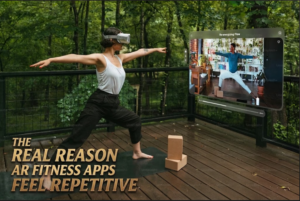
A reader wrote in last month asking whether her new AR workout headset was actually tracking her squats correctly, because her knees felt fine but the app kept flashing warnings about her form. That question sits at the center of almost everything wrong with how smart fitness gear gets marketed right now. The tech is genuinely good in places and genuinely overstated in others, and most people never find out which is which until they’ve already spent the money.
This is Ar Body Health’s attempt at sorting the real value from the noise. Not a takedown of AR fitness, and not a sales pitch either. Just a straight look at what the hype gets right, what it glosses over, and what actually matters if you’re deciding whether any of this belongs in your routine.
1. What “Smart” Actually Means in a Workout Context
The word smart gets slapped on everything from a $30 pedometer to a $400 mixed-reality headset, and that range causes most of the confusion. In practice, smart fitness tech falls into three rough categories: motion tracking (cameras or sensors reading your body position), biometric tracking (heart rate, oxygen, sleep), and gamified feedback (points, levels, competitive elements layered on top of exercise).
Most AR fitness platforms combine all three, which is exactly why the marketing sounds so ambitious. The reality is that each layer has a different level of accuracy, and lumping them together under one glowing product page hides that. If you’re new to this category entirely, Ar Body Health’s beginner breakdown is a decent place to get oriented before spending anything.
2. Where the Motion Tracking Genuinely Delivers
Here’s where credit is due. Modern motion capture, the kind borrowed from techniques originally built for animation and dance training, has gotten remarkably good at reading joint angles in real time. A camera-based system watching your squat depth or your lunge alignment is, for most amateur lifters, more consistent than a mirror and more honest than your own sense of how deep you went.
That said, it struggles the moment lighting changes, clothing is loose, or you move outside the camera’s field of view. And it struggles more than most people expect with fast, chaotic movement. A slow yoga flow gets read beautifully. A sprint interval or boxing combo gets read approximately. There’s a reason wrist-based trackers also fall apart during high-intensity intervals, and it’s the same underlying problem: sensors, whether visual or worn, are built around assumptions of steady, predictable motion.
Where People Usually Go Wrong
The common mistake here isn’t buying bad gear. It’s trusting the form feedback more than it deserves during fast or compound movements, then getting frustrated when the “corrections” contradict what a real coach would say. Motion tracking is a supplement to body awareness, not a replacement for it.
3. The Gamification Layer, and Why It Works Better Than It Sounds
There’s a temptation to dismiss points, streaks, and virtual leaderboards as gimmicks bolted onto exercise to make it more addictive. Some of that is fair criticism. But the underlying psychology isn’t fake. Workouts that give immediate, visible feedback do tend to feel shorter and less effortful than identical workouts without that feedback loop, and that’s been observed consistently enough that it’s worth taking seriously rather than rolling your eyes at.
The honest caveat: gamification helps adherence far more than it helps performance. It gets people to show up and finish the session. It does very little to actually improve your squat mechanics or your cardiovascular base beyond what the underlying exercise would do anyway. If you’re curious how this compares to plain cardio in terms of actual output, this comparison is worth reading before assuming the game layer is doing more than it is.
And a quick side note, because this comes up constantly: no, a gamified AR workout is not inherently more effective for fat loss than a regular one at the same intensity. The energy expenditure math doesn’t change because there’s a scoreboard. What changes is whether you actually do the workout three times a week instead of once. That’s not nothing, but it’s a different claim than the marketing usually makes.
4. Biometric Accuracy: The Part Nobody Wants to Talk About
This is the section that gets skipped in most product reviews, probably because it’s less flattering. Heart rate readings from wrist-worn or ring-worn sensors during AR workouts are frequently off by a meaningful margin, especially during movements involving a lot of arm motion or grip tension. It’s not that the sensors are broken. It’s that optical heart rate sensing was never built to be perfectly accurate during boxing-style or resistance-heavy movement, and the jumps you sometimes see mid-session are usually a sensor artifact, not an actual cardiac event.
| Metric | Typical Accuracy During Steady Cardio | Typical Accuracy During AR/HIIT Movement |
|---|---|---|
| Heart rate | Good, within a few BPM | Inconsistent, can spike or drop unexpectedly |
| Calories burned | Rough estimate, often underestimated | Less reliable, formula-based guessing |
| Step or rep count | Fairly reliable | Depends heavily on movement type |
| Form/posture reading | Strong for slow, controlled movement | Weaker during fast or compound movement |
None of this means the numbers are useless. It means they should be read as trends over weeks, not gospel from a single session. Ar Body Health has gone deeper into why trackers underestimate calorie burn specifically, and the short version is that the underlying algorithms are still built on population averages, not you.
5. So Is Any of It Worth Buying
Depends entirely on what you’re trying to solve. If the barrier to working out has been boredom or lack of accountability, the gamified layer of AR fitness genuinely helps, and that’s a real, non-hype benefit. If the barrier has been uncertainty about form, the motion tracking helps, with the caveat above about fast movement. If what you actually want is precise biometric data for training zones or serious performance work, this category of product is still not there yet, and treating it like a lab-grade tool will lead to bad decisions.
The equipment question trips people up too. Not everything requires a full setup, and this breakdown of what’s actually needed tends to surprise people who assumed they’d need a dedicated room and a few hundred dollars in sensors before starting.
If you’re weighing whether to start with an app-based system versus a full headset setup, it’s worth spending ten minutes reading through the signs that you’ve picked the right AR workout app rather than going by app store ratings alone, since those ratings skew heavily toward people who were already going to like the product.
There’s no clean verdict to hand you here. The tech works well in specific, narrower ways than the advertising suggests, and it works poorly in ways that rarely make it into a product description. Go in with that expectation and you’ll probably end up happy with whatever you choose.
Frequently Asked Questions
Does AR fitness actually track my heart rate accurately? Not perfectly, especially during fast or resistance-heavy movement. It’s reliable enough to spot trends over time but shouldn’t be treated as medical-grade data for any single workout.
Is a headset necessary, or can I get similar benefits from an app on my phone? Many of the gamification and coaching benefits come through on phone or TV-based apps without a headset. A headset adds immersion, not necessarily better tracking accuracy.
Why does my rep count seem off during faster exercises? Motion tracking systems are tuned around steady, predictable movement patterns. Fast or irregular motion, like boxing or jump training, is harder for both camera-based and wearable sensors to read cleanly.
Will AR workouts help me lose weight faster than regular workouts? Not inherently. The advantage is usually in consistency and enjoyment, which leads to more workouts completed over time, rather than any built-in fat-loss multiplier.
How do I know if an AR fitness app is legitimate versus just flashy marketing? Look for apps that are upfront about their tracking limitations rather than claiming lab-level precision, and check whether the coaching cues match what a real trainer would say for the same movement.
More comparisons and honest breakdowns like this one are up at arbodyhealth.online.