A trainer I know spent years correcting the same three mistakes in every beginner’s squat. Knees caving in. Heels lifting. Torso pitching too far forward. She could spot it from across the room. The problem was never her eye. The problem was that she could only be in one room at a time, watching one person, while everyone else in the gym repeated the same error a hundred times before anyone noticed.
That’s the gap AR fitness tracking is actually built to close. Not to replace a coach’s judgment, but to put a version of that judgment on your wrist, your phone, or in front of your eyes, whenever a real trainer isn’t there to see it.
1. What’s Actually Happening Behind the Screen
When people hear “AR workout tracking,” they picture something closer to a video game overlay than what’s really going on underneath. The visual layer, the glowing lines and angle readouts, is the easy part. The hard part is everything that happens before your phone or headset ever draws a line on your elbow.
Most systems rely on computer vision models trained to recognize the human skeleton in real time. The camera doesn’t see “you.” It sees a moving collection of points, roughly corresponding to joints, and it tracks how those points shift frame by frame. Some setups add depth sensors so the system understands not just where a joint is on a flat plane but how far it is from the camera, which matters enormously for something like a lunge, where forward lean can look fine from one angle and terrible from another.
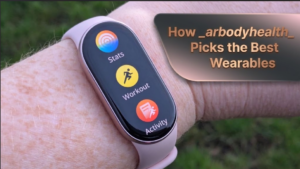
Higher-end AR fitness gear layers in inertial sensors too, the same accelerometer and gyroscope tech phones have used for years, strapped to a wrist or waist. That’s what lets a system tell the difference between a controlled squat and a fast, sloppy one, even when the camera angle is imperfect.
None of this is guessing. It’s pattern matching against thousands of hours of recorded movement, most of it labeled by actual trainers and physical therapists during development. That labeling step matters more than people assume, and it’s a big part of why cheap AR fitness apps tend to feel less accurate than the pricier ones. The model is only as good as what it was trained to recognize as correct form in the first place.
2. Why Live Feedback Works Differently Than a Recap
There’s a meaningful difference between an app that reviews your set afterward and one that corrects you mid-rep. Delayed feedback is useful for pattern recognition over time. Live feedback interrupts a bad habit before your body has a chance to encode it as normal.
This matters more for some movements than others. A deadlift with a rounding lower back is a classic example. By the time a person finishes the rep and checks a summary screen, their nervous system has already rehearsed the wrong pattern once. Do that for three sets and the body starts treating the flaw as the default. Real-time correction, even something as simple as a haptic buzz on the wrist the moment the spine starts to round, interrupts that loop before it sets.
I’ve watched this play out with people who swore they had perfect form and were genuinely surprised by what a live overlay showed them. Not because they were lying to themselves. Body awareness under load is just unreliable. Fatigue especially distorts it. Your form on rep two and your form on rep ten rarely match, even when it feels identical from the inside.
3. What Kind of Errors Get Caught, and What Doesn’t
AR systems are genuinely strong at catching a specific category of mistake: angle deviations, tempo inconsistencies, range of motion that’s cut short, and asymmetry between left and right sides. These are things a camera or sensor array can quantify cleanly.
They’re weaker at catching things that require context a machine doesn’t have. Pain is the obvious one. A slight wince, a hesitation before a rep, a person favoring one side because of an old injury rather than poor mechanics, these read very differently to a human trainer than they do to a model looking at joint angles alone. This is where people usually go wrong with AR fitness tools. They treat a clean form score as a green light to push harder, when the score only ever measured mechanics, never how the body actually felt doing it.
A good rule of thumb: let the AR feedback catch what your eyes can’t see, and let your own judgment catch what the camera can’t feel.
4. Comparing the Two Main Tracking Approaches
Not all AR fitness setups work the same way, and the differences change what kind of feedback you actually get.
| Feature | Camera-Based Tracking | Wearable Sensor Tracking |
|---|---|---|
| Setup | Phone or dedicated camera, no equipment worn | Straps or bands on wrists, waist, ankles |
| Best at | Full-body posture, joint angles, symmetry | Tempo, force output, rep consistency |
| Weak point | Loses accuracy in low light or tight framing | Can’t see posture directly, only motion data |
| Typical use case | Home workouts, bodyweight training | Weightlifting, running form, cycling cadence |
| Feedback style | Visual overlay showing correct vs. actual position | Haptic buzz, audio cue, or on-screen number |
A lot of the newer platforms are combining both, using cameras for the visual read and a light wearable for the data a camera alone can’t capture, like grip pressure or ground contact time. That hybrid approach tends to produce the most trustworthy feedback, though it’s also the most expensive to build well, which is part of why pricing varies so wildly across the AR fitness category right now.
5. Getting Useful Data Out of an AR Session
The feedback is only as good as the setup. A few things make a real difference in accuracy that most people skip.
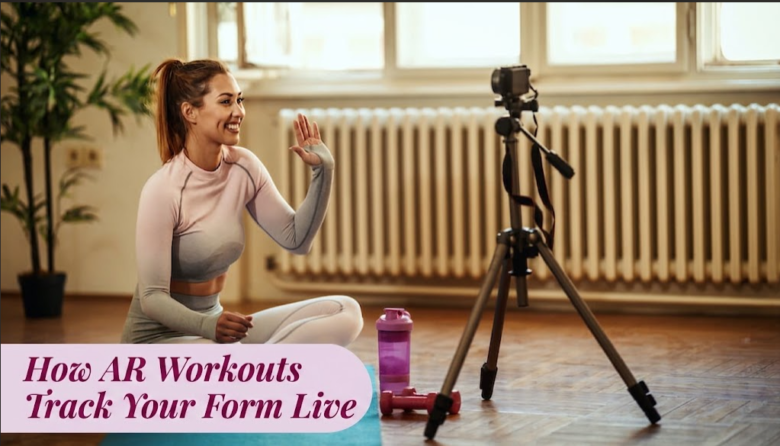
Camera placement matters more than almost anything else. Too close and the system loses the full range of a movement. Too far and joint detection gets noisy. A distance that shows your full body plus a bit of space above and below tends to work best for most home setups.
Lighting affects computer vision more than people expect. Harsh backlighting from a window behind you can throw off skeletal tracking enough to generate false corrections, telling you your form is off when it’s actually the camera struggling to see you clearly.
And calibration, the step almost everyone rushes through or skips entirely, is what teaches the system what your normal range of motion looks like before comparing it to “ideal” form. Skipping it means the app is comparing you to a generic model instead of your own baseline, which produces feedback that’s technically accurate but practically useless if your proportions or mobility differ from the average.
6. Where This Is Actually Heading
The direction most of this technology is moving in isn’t flashier overlays. It’s better context. Systems that can factor in fatigue over a session, that adjust feedback thresholds as a workout progresses, that start distinguishing between a form breakdown from bad technique versus one from genuine muscular failure near the end of a set. That second distinction is subtle, and right now most consumer AR tools can’t reliably make it. The ones that figure it out first are going to be the ones worth paying attention to over the next few years.
For now, the honest way to use these tools is as a second set of eyes, not a replacement for the ones that know what pain and effort actually look like on your particular body.
If you’re weighing whether a camera-based setup or a wearable-first system fits your training better, it usually comes down to what you’re training for. Lifters tend to get more out of sensor data. People working on bodyweight movement and mobility get more out of the visual overlay.
FAQs
Does AR form tracking work in a small apartment or home gym? Yes, for most bodyweight and light equipment work, though camera-based systems need enough clearance to see your full body through the movement. A cramped space can clip the frame and cause inaccurate joint readings, especially on movements with a lot of forward or lateral reach.
Can these systems replace a personal trainer? Not for injury history, pain management, or programming decisions that need real judgment. They’re strongest as a between-sessions tool that catches mechanical drift a trainer wouldn’t be there to see.
Why does my form score change between reps of the same set? Fatigue changes mechanics measurably, even when it doesn’t feel that way. A score drop late in a set is often the system correctly picking up on small compensations your body makes as it tires, not a tracking error.
Is camera tracking or wearable tracking more accurate? Neither is universally better. Cameras are stronger for posture and joint angle. Wearables are stronger for tempo, force, and repeated-motion consistency. The most reliable feedback tends to come from setups combining both.
Do I need special lighting or a dedicated space to get accurate readings? Not special lighting exactly, just consistent and even lighting without strong backlight. Most living rooms work fine once the camera has a clear, well-lit view of the full movement.
For a closer look at how wearable sensors specifically calculate tempo and load, arbodyhealth.online has a deeper technical breakdown worth reading next.