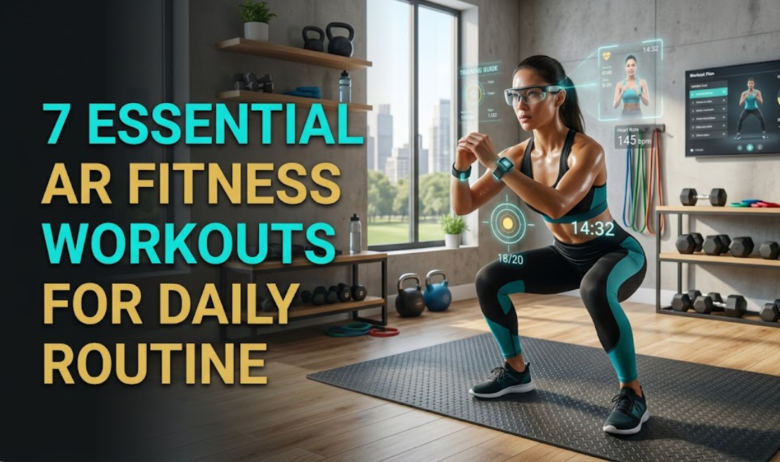
Augmented Reality (AR) fitness has started reshaping how people approach daily exercise. Instead of treating workouts as a repetitive obligation, AR turns movement into something interactive, responsive, and surprisingly engaging. Your home becomes a training ground, your body becomes the controller, and your phone, glasses, or mirror becomes a live coach reacting in real time.
But here’s the part most people miss: AR fitness only works well when it’s structured into a routine. Random sessions don’t deliver consistent results. What actually makes AR fitness effective is repetition, variation, and progression—just like traditional training, but with interactive layers built in.
This guide breaks down 7 essential AR fitness workouts that can realistically fit into a daily routine. Each one serves a different purpose—cardio, strength, mobility, coordination, or recovery. Alongside that, you’ll find structured tables, practical breakdowns, and usage patterns that show how to actually apply AR fitness instead of just experimenting with it.
why AR fitness workouts are changing daily exercise habits
The biggest shift AR brings is not intensity—it’s engagement. People don’t fail at fitness because they don’t know what to do. They fail because they stop doing it.
AR changes that by introducing interaction.
comparison of workout experience:
| Traditional Workout | AR Workout |
|---|---|
| Repetitive motions | Interactive challenges |
| Passive guidance | Real-time feedback |
| Fixed structure | Adaptive difficulty |
| Low engagement | Game-like experience |
| High dropout rate | Higher consistency |
AR fitness doesn’t magically make workouts easier. It makes them harder to ignore.
how to structure a daily AR fitness routine
Before jumping into workouts, it’s important to understand how they fit together.
A balanced AR routine typically includes:
- Activation (light movement warm-up)
- Cardio (heart rate elevation)
- Strength (muscle engagement)
- Coordination (reaction + agility)
- Mobility (flexibility and recovery)
daily structure table:
| Time of Day | Workout Type | Duration |
|---|---|---|
| Morning | Activation + cardio AR | 10–15 min |
| Midday | Strength AR session | 15–25 min |
| Evening | Coordination + mobility AR | 10–20 min |
This structure prevents burnout while maintaining daily consistency.
workout 1: AR reaction cardio drills
This is one of the most common AR fitness workout types because it combines movement with responsiveness.
how it works:
Virtual objects appear in your environment and require you to move, dodge, or reach them quickly.
what it trains:
- Cardiovascular endurance
- Reflex speed
- Coordination
- Agility
example session:
| Drill Type | Action |
|---|---|
| Target chase | Move toward floating markers |
| Dodge zones | Avoid virtual obstacles |
| Speed bursts | Sprint in place on cue |
intensity comparison:
| Level | Duration | Difficulty |
|---|---|---|
| Beginner | 10 min | Low |
| Intermediate | 15 min | Medium |
| Advanced | 20 min | High |
why it works:
It turns cardio into a reaction-based game, reducing boredom while increasing intensity naturally.
workout 2: AR guided strength training
Strength training in AR fitness is not about lifting heavier weights alone. It’s about form accuracy and controlled movement.
how it works:
AR overlays guide your posture, depth, and alignment during bodyweight or weighted exercises.
what it trains:
- Muscle strength
- Posture control
- Stability
- Movement precision
example exercises:
| Exercise | AR Function |
|---|---|
| Squats | Knee alignment correction |
| Push-ups | Depth guidance overlay |
| Lunges | Balance tracking feedback |
| Planks | Stability timer visualization |
performance tracking table:
| Metric | Beginner Focus | Advanced Focus |
|---|---|---|
| Form accuracy | Basic correction | Optimization |
| Repetition quality | Moderate | High precision |
| Stability score | Intro level | Advanced control |
why it matters:
Most injuries in home workouts come from incorrect form. AR reduces this significantly.
workout 3: AR agility obstacle training
This workout is more dynamic and resembles sports training.
how it works:
Virtual obstacles appear in your room, requiring you to move around, jump, or change direction.
what it trains:
- Footwork
- Agility
- Reaction timing
- Spatial awareness
drill examples:
| Drill | Movement |
|---|---|
| Side dodge lanes | Lateral movement |
| Jump gates | Vertical jumps |
| Zigzag paths | Direction changes |
difficulty progression:
| Stage | Complexity |
|---|---|
| Beginner | Slow-paced patterns |
| Intermediate | Mixed speed obstacles |
| Advanced | Randomized movement flow |
why it works:
It simulates real-world athletic movement patterns, making workouts more functional.
workout 4: AR rhythm-based movement training
This workout blends music, timing, and movement into one interactive experience.
how it works:
You follow AR prompts synced to rhythm cues or beats.
what it trains:
- Timing
- Coordination
- Endurance
- Rhythm awareness
example structure:
| Beat Type | Movement |
|---|---|
| Slow beat | Controlled squats |
| Medium beat | Step movements |
| Fast beat | Quick jumps |
effectiveness table:
| Factor | Traditional Cardio | AR Rhythm Training |
|---|---|---|
| Engagement | Medium | High |
| Consistency | Moderate | High |
| Enjoyment | Variable | High |
why it works:
It removes the feeling of repetitive exercise by turning movement into rhythm interaction.
workout 5: AR core stability training
Core workouts in AR fitness focus heavily on balance and precision rather than just repetition.
how it works:
AR systems display stability challenges that require maintaining posture under visual feedback conditions.
what it trains:
- Core strength
- Balance control
- Postural endurance
example exercises:
| Exercise | AR Element |
|---|---|
| Plank hold | Stability meter overlay |
| Leg raises | Alignment tracking |
| Balance stands | Virtual ground markers |
core engagement chart:
| Difficulty | Duration | Stability Demand |
|---|---|---|
| Beginner | 10 min | Low |
| Intermediate | 15 min | Medium |
| Advanced | 20 min | High |
why it works:
It introduces feedback loops that standard core workouts lack.
workout 6: AR mobility and flexibility flow
This is often overlooked but extremely important for recovery and injury prevention.
how it works:
AR guides stretching movements with visual alignment markers and timed flow sequences.
what it trains:
- Flexibility
- Joint mobility
- Recovery efficiency
example flow:
| Movement | Focus Area |
|---|---|
| Shoulder rolls | Upper mobility |
| Hamstring stretch | Lower body flexibility |
| Spine rotation | Core flexibility |
mobility comparison:
| Type | Static Stretching | AR Mobility Flow |
|---|---|---|
| Engagement | Low | Medium |
| Guidance | None | Visual cues |
| Consistency | Low | Higher |
why it works:
People tend to skip stretching. AR makes it interactive and structured.
workout 7: AR full-body mixed challenge sessions
This is the most complete AR workout type, combining multiple training styles into one session.
how it works:
The system alternates between cardio, strength, agility, and coordination challenges.
what it trains:
- Full-body conditioning
- Endurance
- Reaction
- Strength integration
example session flow:
| Phase | Activity |
|---|---|
| Warm-up | Light movement cues |
| Phase 1 | Cardio reaction drills |
| Phase 2 | Strength challenges |
| Phase 3 | Agility obstacles |
| Cool-down | Mobility flow |
performance impact table:
| Metric | Improvement Range |
|---|---|
| Heart rate control | High |
| Full-body activation | High |
| Calorie burn | High |
| Engagement | Very high |
why it works:
It mimics athletic training rather than isolated gym exercises.
weekly AR fitness routine structure
Here’s how all 7 workouts fit into a weekly cycle:
weekly plan table:
| Day | Workout Type |
|---|---|
| Monday | AR reaction cardio |
| Tuesday | AR strength training |
| Wednesday | AR mobility flow |
| Thursday | AR agility training |
| Friday | AR core stability |
| Saturday | Mixed full-body AR session |
| Sunday | Rest or light mobility |
This structure balances intensity and recovery.
benefits of daily AR fitness routines
| Benefit | Impact |
|---|---|
| Higher consistency | Reduced workout dropouts |
| Better engagement | Less boredom |
| Real-time feedback | Improved form |
| Adaptive difficulty | Personalized progress |
| Home accessibility | No gym dependency |
AR fitness improves not just physical output but behavioral consistency.
common mistakes in AR fitness routines
| Mistake | Result |
|---|---|
| Overtraining daily | Fatigue |
| Ignoring calibration | Tracking errors |
| Poor lighting setup | Reduced accuracy |
| Skipping mobility | Increased injury risk |
fixing these improves results significantly even without changing workouts.
future of AR fitness workouts
The direction of AR fitness is moving toward:
- AI-personalized daily workout generation
- Full-room immersive training environments
- Wearable-integrated real-time coaching
- Multiplayer AR fitness sessions at home
- Adaptive difficulty based on biometric data
future gyms may feel less like physical spaces and more like interactive digital environments.
final thoughts
AR fitness workouts are not just a trend—they are a shift in how daily exercise is structured and experienced. The 7 essential workouts outlined here cover the full spectrum of fitness: cardio, strength, agility, mobility, coordination, and recovery.
When combined into a routine, they create a balanced system that is flexible, engaging, and adaptable to different fitness levels.
The key is consistency. AR doesn’t replace effort—it makes effort harder to avoid.
FAQs
- Can I do AR fitness workouts every day?
Yes, but intensity should vary. Mixing high and low-intensity sessions helps prevent fatigue. - Do I need special equipment for AR fitness workouts?
Most workouts only require a smartphone or basic AR device. Advanced setups enhance experience but are not required. - Are AR fitness workouts good for weight loss?
Yes, especially cardio and mixed sessions, as they improve consistency and calorie burn. - Can beginners start with all 7 workouts?
Yes, but beginners should start with shorter durations and gradually increase intensity. - Are AR fitness workouts safe at home?
Yes, if you maintain clear space, proper lighting, and follow guided form corrections. - What is the most effective AR workout for daily use?
AR reaction cardio and mobility flow are the most sustainable for daily routines due to low strain and high engagement.