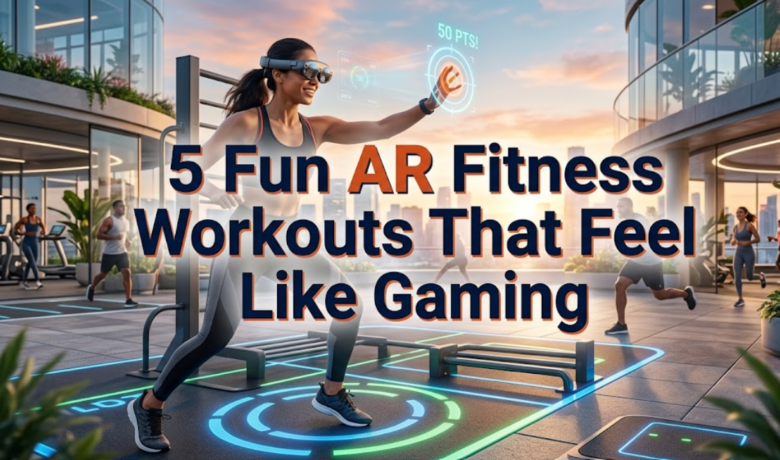
There’s a reason most people don’t stick to traditional workouts: repetition gets boring fast. Even the most disciplined routines eventually feel like obligation rather than enjoyment. Augmented reality (AR) fitness flips that problem on its head by turning movement into gameplay.
Instead of counting reps, you’re dodging virtual obstacles, chasing digital targets, surviving missions, or competing in real-time challenges. The result is simple: you move more without feeling like you’re forcing it.
This article breaks down 5 AR fitness workouts that feel less like exercise and more like gaming experiences. Each one has a different style of movement, intensity, and engagement level—so you can choose based on your mood or fitness goal.
Along the way, you’ll also find comparison tables, calorie insights, and structured breakdowns to understand how these workouts actually perform in real life.
why AR fitness feels like gaming (and why that matters)
The biggest advantage of AR fitness is psychological. Your brain stops categorizing movement as “workout” and starts processing it as “interaction.”
That shift changes everything:
- You stay active longer
- You push harder without noticing
- You recover faster mentally
- You repeat workouts more often
Here’s a simple comparison:
| Factor | Traditional Workout | AR Fitness Workout |
|---|---|---|
| Motivation source | Discipline | Gameplay |
| Perceived effort | High | Medium |
| Session duration | Fixed | Extended |
| Dropout rate | Higher | Lower |
Now let’s dive into the five most engaging AR fitness workouts that feel like actual games.
- zombie escape survival runs
This is one of the most popular AR fitness game-style workouts because it turns running into a survival mission.
Instead of jogging aimlessly, you’re:
- Escaping zombie waves
- Collecting survival supplies
- Completing story missions
- Making split-second sprint decisions
The app narrates a scenario, and your speed determines survival.
why it feels like gaming:
You are not running for fitness—you are running to survive a story.
movement breakdown:
| Phase | Activity Type | Intensity |
|---|---|---|
| Story buildup | Jogging | Low |
| Zombie chase | Sprinting | High |
| Supply missions | Interval run | Medium |
calorie burn estimate:
| Duration | Calories Burned |
|---|---|
| 20 min | 180–250 kcal |
| 40 min | 350–500 kcal |
The unpredictability increases interval intensity naturally, which improves cardiovascular conditioning.
- ar rhythm boxing battles
This workout feels like stepping into a music-based fighting game.
You are:
- Punching floating targets
- Dodging incoming attacks
- Matching rhythm beats
- Competing against virtual opponents
It blends boxing, rhythm timing, and reflex training.
why it feels like gaming:
It’s essentially a fighting rhythm game where your body is the controller.
comparison of engagement levels:
| Workout Type | Engagement Score |
|---|---|
| Traditional boxing | Medium |
| AR rhythm boxing | Very high |
movement structure:
- Jab sequences → beat matching
- Hooks → timing accuracy
- Dodges → reaction gameplay
calorie comparison:
| Session Type | Calories (30 min) |
|---|---|
| Standard boxing | 300–400 kcal |
| AR rhythm boxing | 350–500 kcal |
The added reaction layer increases heart rate variability and keeps intensity consistently high.
- fantasy quest adventure workouts
This AR workout turns your living space into a fantasy game world.
You become a character completing missions like:
- Defeating virtual enemies
- Collecting energy points
- Unlocking new levels
- Completing movement-based puzzles
Exercises are disguised as gameplay actions:
- Squats = shield defense
- Lunges = forward attacks
- Arm swings = spell casting
why it feels like gaming:
It uses role-playing mechanics and progression systems.
mission structure:
| Level Type | Movement Style |
|---|---|
| Beginner quests | Basic movement |
| Mid-level battles | Combo exercises |
| Boss fights | HIIT bursts |
calorie output comparison:
| Difficulty Level | Calories (30–40 min) |
|---|---|
| Easy quests | 200–250 kcal |
| Advanced battles | 350–450 kcal |
The progression system keeps users engaged longer than standard workouts.
- ar dance battle arenas
This workout transforms dance into a competitive AR arena experience.
You don’t just follow choreography—you compete:
- Against AI opponents
- Against timing challenges
- Against score thresholds
- Against rhythm accuracy
why it feels like gaming:
It behaves like a competitive rhythm fighting game.
movement breakdown:
- Footwork timing
- Upper body coordination
- Reaction-based transitions
performance comparison:
| Mode | Intensity Level |
|---|---|
| Free dance | Medium |
| AR dance battle | High |
calorie burn:
| Duration | Calories |
|---|---|
| 20 min | 150–220 kcal |
| 40 min | 300–400 kcal |
As engagement increases, users naturally extend session time without noticing fatigue.
- ar obstacle sprint challenges
This workout simulates parkour-style obstacle courses in real environments.
You might see:
- Virtual walls to “jump” over
- Speed gates to sprint through
- Directional arrows for movement changes
- Timing-based barriers
why it feels like gaming:
It’s a real-life platformer game where movement is continuous.
difficulty scaling:
| Level | Obstacle Complexity |
|---|---|
| Beginner | Simple gates |
| Intermediate | Multi-step courses |
| Advanced | Reaction-based traps |
calorie comparison:
| Workout Type | Calories (30 min) |
|---|---|
| Normal running | 250–300 kcal |
| AR obstacle run | 300–450 kcal |
The unpredictability increases sprint frequency and intensity spikes.
overall comparison of the 5 AR gaming workouts
| Workout Type | Game Style | Intensity | Avg Calories (30–40 min) |
|---|---|---|---|
| Zombie escape runs | Survival game | High | 300–500 kcal |
| Rhythm boxing battles | Fighting rhythm | Very high | 350–500 kcal |
| Fantasy quest workouts | RPG adventure | Medium | 250–450 kcal |
| AR dance arenas | Rhythm competition | Medium | 300–400 kcal |
| Obstacle sprint courses | Platform runner | High | 300–450 kcal |
what makes AR fitness gaming so effective
The effectiveness comes from three psychological mechanisms:
- loss of time awareness
Players often forget how long they’ve been working out. - goal-based movement
Each action has meaning beyond repetition. - adaptive challenge scaling
Difficulty increases automatically based on performance.
engagement impact:
| Motivation Type | Workout Completion Rate |
|---|---|
| Traditional gym | Moderate |
| AR gaming workouts | High |
how to maximize results from AR gaming workouts
To get the most benefit:
- Switch between workout types
- Use interval intensity spikes
- Follow progression systems
- Track performance metrics
weekly example structure:
| Day | Workout Type |
|---|---|
| Monday | Zombie run |
| Tuesday | AR boxing |
| Wednesday | Recovery dance flow |
| Thursday | Obstacle sprint |
| Friday | Fantasy quest |
| Saturday | Mixed AR challenge |
| Sunday | Rest |
faqs
- are AR gaming workouts actually effective for fitness
Yes, they combine cardio, strength, and reaction training, often leading to higher calorie burn due to longer engagement. - do I need VR headsets for these workouts
Not necessarily. Many AR fitness games work with smartphones or tablets using camera-based tracking. - which AR workout burns the most calories
Rhythm boxing and zombie survival runs typically produce the highest calorie burn due to interval intensity. - are AR fitness games suitable for beginners
Yes, most apps include beginner levels and adaptive difficulty systems. - can AR gaming workouts replace traditional exercise
They can replace most cardio workouts, but strength training may still benefit from additional resistance training. - why do AR workouts feel less tiring even when intense
Because your brain focuses on gameplay and objectives rather than physical effort, reducing perceived exertion.