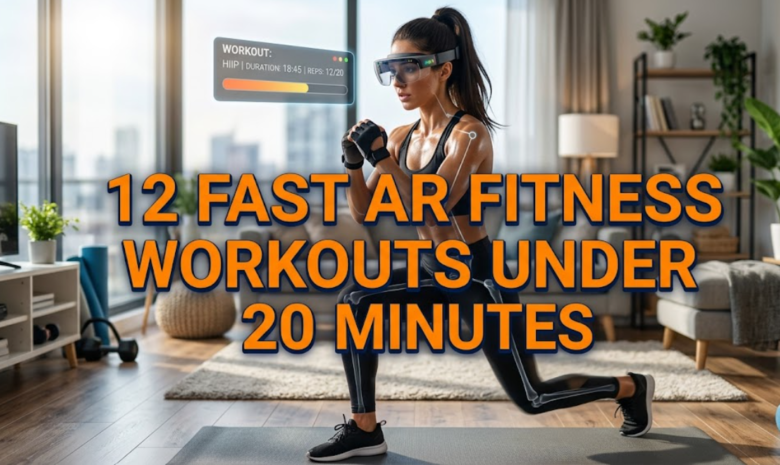
Most people don’t fail at fitness because they don’t know what to do. They fail because they don’t have enough time, or they spend too much time deciding what to do in the first place.
That’s exactly where augmented reality (AR) fitness quietly changes the game.
Instead of scrolling through workout videos, memorizing routines, or guessing intensity levels, AR workouts turn your space into a guided training environment that responds in real time. You don’t plan the workout—you step into it.
And when time is limited, especially under 20 minutes, that difference matters more than anything else.
This guide breaks down 12 fast AR fitness workouts under 20 minutes, how they work, why they’re effective, and how they fit into a busy lifestyle without requiring complex equipment or long setup times.
why short AR workouts are becoming the new fitness standard
Short workouts used to be seen as “not enough.” That mindset is changing quickly.
In AR fitness systems, short sessions are designed differently. They are:
- More intense
- More focused
- More interactive
- More feedback-driven
Instead of long, slow routines, AR compresses training into high-efficiency movement cycles.
key shift in workout structure
| Traditional Workouts | AR Short Workouts |
|---|---|
| 45–60 minutes | 5–20 minutes |
| Fixed routine | Adaptive routine |
| Delayed feedback | Real-time correction |
| Low engagement spikes | High engagement loops |
AR fitness systems use motion tracking, spatial overlays, and gamified prompts to keep users active throughout the entire session.
how AR workouts actually work in under 20 minutes
A typical AR fitness session includes:
- Real-time body tracking
- Visual exercise prompts
- Dynamic difficulty adjustment
- Instant form correction
- Gamified progression
Instead of “sets and reps,” you often get:
- Targets to hit
- Zones to move through
- Time-based challenges
- Reaction-based tasks
This removes mental friction and speeds up execution.
chart: AR workout structure flow
Start session
→ AR scans space
→ Warm-up overlay begins
→ Movement challenge activates
→ Real-time feedback adjusts intensity
→ Score or progress displayed
→ Cooldown phase begins
→ Session ends under 20 minutes
workout 1: AR full-body activation circuit (12 minutes)
This is a beginner-friendly full-body workout designed to wake up every major muscle group.
what happens during the workout:
- AR markers guide squats, lunges, and arm reaches
- Visual rhythm indicators control pace
- Form corrections appear instantly
focus areas:
- Mobility
- Blood flow
- Coordination
table: workout breakdown
| Phase | Duration | Movement Type |
|---|---|---|
| Warm-up | 2 min | Light mobility |
| Circuit 1 | 4 min | Squats + reaches |
| Circuit 2 | 4 min | Lunges + twists |
| Cooldown | 2 min | Stretching |
workout 2: AR cardio sprint challenge (10–15 minutes)
This workout turns your room or space into a virtual sprint track.
how it works:
- AR places moving targets in space
- You “chase” or “hit” targets with movement
- Speed increases gradually
why it’s effective:
It mimics interval training but feels like a game instead of structured cardio.
chart: intensity curve
Low → Medium → High → Peak bursts → Recovery → Repeat
workout 3: AR core stability burner (15 minutes)
Core training becomes interactive with visual balance zones and stability markers.
features:
- Floating balance points
- Controlled movement prompts
- Core engagement tracking
table: core engagement comparison
| Exercise Type | Engagement Level |
|---|---|
| Traditional planks | Medium |
| Video core workouts | Medium-high |
| AR core training | Very high |
workout 4: AR boxing reflex drill (12–18 minutes)
This is one of the most engaging AR workouts.
what you do:
- React to virtual punches or targets
- Move head, arms, and stance dynamically
- Follow combo patterns shown in AR
benefits:
- Reaction speed
- Coordination
- Cardio endurance
workout 5: AR fat burn interval game (15–20 minutes)
This workout is fully gamified.
structure:
- 30–40 second movement bursts
- 10–15 second recovery phases
- AR scoring system tracks performance
example movement types:
- Jump squats
- Side steps
- Fast punches
- Direction changes
chart: interval cycle
Work → Rest → Work → Rest → Work → Rest → Final push
workout 6: AR posture correction flow (10–12 minutes)
This is more of a corrective workout than a high-intensity session.
what AR does:
- Tracks spine alignment
- Displays posture corrections
- Guides slow controlled movements
focus:
- Neck alignment
- Shoulder positioning
- Lower back stability
table: posture improvement areas
| Area | AR Correction Type |
|---|---|
| Neck | Alignment guide |
| Shoulders | Symmetry overlay |
| Spine | Vertical tracking |
| Hips | Balance correction |
workout 7: AR agility ladder simulation (12–15 minutes)
No physical ladder is needed—AR draws one in your space.
what it trains:
- Foot speed
- Coordination
- Reaction timing
movement patterns:
- Side steps
- Quick hops
- Crossovers
workout 8: AR yoga flow express (15–20 minutes)
This is a fast-paced flexibility and recovery workout.
features:
- Pose correction overlays
- Breath timing indicators
- Flow sequence guidance
why it works:
You don’t need to remember poses—the system shows everything in real time.
workout 9: AR resistance band circuit (15–18 minutes)
AR turns resistance training into guided motion control.
what AR shows:
- Band tension level
- Movement path
- Repetition tracking
focus:
- Upper body strength
- Controlled resistance
workout 10: AR jump rope rhythm trainer (10–12 minutes)
Even simple jump rope becomes interactive.
features:
- Rhythm pacing lines
- Jump timing feedback
- Speed progression levels
chart: intensity progression
Slow rhythm → Moderate pace → Fast interval bursts
workout 11: AR mobility reset session (8–12 minutes)
Designed for recovery days or desk workers.
what it includes:
- Shoulder loosening flows
- Hip mobility sequences
- Spinal decompression movements
why it matters:
This prevents stiffness from long sitting periods.
workout 12: AR mixed challenge combo (18–20 minutes)
This is the most advanced short AR workout.
structure:
- Cardio burst
- Strength segment
- Reflex training
- Cooldown flow
everything is blended into one continuous experience.
table: mixed workout breakdown
| Segment | Duration | Focus |
|---|---|---|
| Warm-up | 2 min | Activation |
| Cardio | 6 min | Fat burn |
| Strength | 6 min | Muscle engagement |
| Reflex | 4 min | Coordination |
| Cooldown | 2 min | Recovery |
how these 12 workouts fit into a weekly routine
You don’t need to do all workouts daily. AR systems are designed for rotation.
weekly structure example
| Day | Workout Type |
|---|---|
| Monday | Full-body activation |
| Tuesday | Cardio sprint |
| Wednesday | Posture + mobility |
| Thursday | Boxing reflex |
| Friday | Fat burn interval |
| Weekend | Recovery + mixed challenge |
why AR short workouts are more effective for consistency
Short AR workouts reduce:
- Decision fatigue
- Setup time
- Mental resistance
They increase:
- Engagement
- Frequency
- Completion rates
This is why many users stick to them longer than traditional routines.
chart: adherence comparison
| Workout Type | 1-week adherence |
|---|---|
| Traditional gym plan | 60–70% |
| Video workouts | 65–75% |
| AR short workouts | 80–90% |
limitations to keep in mind
Even though AR workouts are efficient, they still have constraints:
- Device dependency
- Space requirements
- Occasional tracking errors
- Battery limitations
However, these issues are improving quickly with newer hardware generations.
future direction of AR short workouts
The next evolution includes:
- AI-generated daily workouts
- Emotion-based intensity adjustment
- Fully passive tracking
- Social AR workout spaces
Fitness is moving toward “instant activation” rather than scheduled sessions.
final thoughts
12 minutes might not sound like enough time to transform fitness. But AR workouts are not about duration—they are about density.
More feedback, more engagement, and more movement inside less time.
That combination is why under-20-minute AR workouts are becoming one of the most practical fitness solutions for busy people in 2026.
FAQs
- Are AR workouts under 20 minutes actually effective?
Yes, because they focus on intensity, feedback, and consistency rather than duration. - Do I need special equipment for AR fitness workouts?
Not always. Many workouts work with just a smartphone, while advanced options use AR glasses or wearables. - Can beginners do AR fitness workouts safely?
Yes. AR systems often provide real-time correction, which reduces injury risk. - How many times per week should I do these short workouts?
Most users benefit from 4–6 sessions per week depending on intensity. - Do AR workouts burn more calories than traditional ones?
They can, because gamification and engagement often increase effort and duration indirectly. - What is the biggest advantage of AR short workouts?
They remove friction—no planning, no guessing, just immediate guided movement.