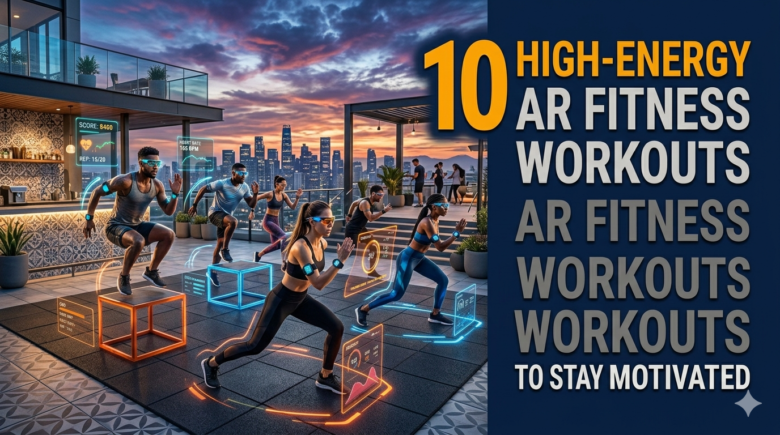
Augmented reality (AR) fitness has changed the way people think about exercise. Instead of staring at a screen or repeating the same gym routines, users now move through interactive environments, react to real-time visual cues, and train inside hybrid physical-digital spaces that feel more like games than workouts.
But here’s the real issue most people face: motivation fades quickly.
That’s where high-energy AR fitness workouts come in. These aren’t slow stretch sessions or passive tracking routines. They’re fast, immersive, reaction-based workouts designed to keep your body moving and your brain engaged at the same time.
Below are 10 high-energy AR fitness workouts that are designed to boost motivation, reduce boredom, and make consistency easier.
why AR workouts improve motivation more than traditional exercise
Before jumping into the workouts, it’s worth understanding why AR fitness feels different.
Traditional workouts rely heavily on discipline. AR workouts rely on engagement loops.
comparison:
| Factor | Traditional Workout | AR Fitness Workout |
|---|---|---|
| Motivation source | Discipline | Interaction |
| Engagement level | Medium | High |
| Mental fatigue | High | Low-medium |
| Time perception | Slow | Fast |
| Consistency rate | Moderate | High |
AR fitness systems use visual feedback, rewards, and real-time movement correction to keep users engaged longer without feeling exhausted mentally.
Apps and ecosystems like Zombies, Run! demonstrate how storytelling combined with movement increases adherence to exercise routines.
workout 1: AR sprint chase training
This workout turns running into a chase-based survival game.
how it works:
- You run in real space
- AR system projects a virtual pursuer
- Speed adjusts based on your pace
- Escaping or catching targets earns points
energy level: very high
key benefits:
| Skill | Improvement |
|---|---|
| Sprint speed | High |
| Reaction time | High |
| Cardiovascular endurance | Very high |
This type of workout is especially effective for people who struggle with treadmill boredom.
workout 2: AR combat shadow boxing
This is a fast-paced boxing workout where virtual opponents appear in your environment.
features:
- AI-generated opponents
- Real-time punch correction
- Movement-based dodging mechanics
energy level: extreme
comparison:
| Element | Traditional boxing | AR boxing |
|---|---|---|
| Feedback | Trainer-based | Instant AR feedback |
| Engagement | Medium | High |
| Solo training efficiency | Low | High |
It’s one of the most popular AR combat fitness styles because it combines intensity with game mechanics.
workout 3: AR obstacle jump circuit
In this workout, virtual obstacles appear in your physical space, and you must jump, duck, or move around them.
what it trains:
- Agility
- Lower body explosiveness
- Coordination
difficulty progression:
| Level | Speed | Complexity |
|---|---|---|
| Beginner | Slow | Simple obstacles |
| Intermediate | Moderate | Mixed patterns |
| Advanced | Fast | Randomized sequences |
This is ideal for high-energy bursts in short sessions.
workout 4: AR rhythm cardio dance
This workout syncs movement with music-based AR cues.
how it works:
- AR visual markers appear to rhythm
- Users follow beats with full-body movement
- Intensity increases with music tempo
energy level: high but fun-based
table of workout effect:
| Music tempo | Workout intensity |
|---|---|
| Slow (80–100 BPM) | Warm-up |
| Medium (100–130 BPM) | Fat burn |
| Fast (130–160 BPM) | High cardio |
This style keeps users engaged because rhythm replaces repetition.
workout 5: AR climbing simulation training
This workout simulates climbing environments like mountains or towers using AR overlays.
what it improves:
- Grip strength (if using accessories)
- Core stability
- Full-body endurance
energy demand:
| Phase | Energy level |
|---|---|
| Start | Medium |
| Mid | High |
| Peak | Very high |
It feels like an adventure instead of structured exercise.
workout 6: AR reaction speed drills
This workout focuses on quick decision-making and fast movement.
how it works:
- AR targets appear randomly
- User must touch, dodge, or strike
- Reaction time is measured in real time
benefits:
| Ability | Improvement rate |
|---|---|
| Reaction speed | High |
| Focus | High |
| Hand-eye coordination | Very high |
These drills are commonly used in competitive training environments.
workout 7: AR full-body HIIT circuits
High-Intensity Interval Training becomes more engaging with AR guidance.
structure:
| Interval | Activity |
|---|---|
| 30 sec | Jumping movement |
| 20 sec | Strength movement |
| 10 sec | Rest countdown |
| Repeat | 10–15 rounds |
what AR adds:
- Real-time rep counting
- Visual pacing guidance
- Form correction overlays
This makes HIIT more structured and less mentally exhausting.
workout 8: AR endurance mission walk-run hybrid
This workout blends walking, jogging, and light running into a mission-based system.
example structure:
- Walk to checkpoint A
- Jog to checkpoint B
- Sprint to escape zone
comparison:
| Training type | Traditional | AR mission-based |
|---|---|---|
| Engagement | Medium | High |
| Fatigue perception | High | Lower |
| Duration tolerance | Low-medium | High |
Apps like Pokémon Go helped popularize the idea that walking itself can be gamified into a mission-based experience.
workout 9: AR balance and core stability challenge
This workout focuses on controlled movements and balance correction using AR visual guides.
what it trains:
- Core muscles
- Stability
- Postural awareness
difficulty scaling:
| Level | Challenge type |
|---|---|
| Beginner | Static balance |
| Intermediate | Moving balance |
| Advanced | Reaction-based balance |
Even though it is lower impact, it plays a major role in injury prevention and long-term consistency.
workout 10: AR multiplayer fitness battles
This is one of the most engaging formats available.
how it works:
- Users connect in AR space
- Compete in real-time fitness challenges
- Score points based on movement performance
energy level: very high
comparison:
| Factor | Solo workout | Multiplayer AR |
|---|---|---|
| Motivation | Medium | Very high |
| Consistency | Moderate | High |
| Engagement | Medium | Very high |
Social competition is one of the strongest motivators in fitness psychology.
overall comparison of AR workout types
| Workout type | Energy level | Fun factor | Difficulty |
|---|---|---|---|
| Sprint chase | Very high | High | Medium |
| AR boxing | Extreme | High | Medium-high |
| Obstacle circuit | High | Very high | Medium |
| Rhythm cardio | High | Very high | Low-medium |
| Climbing simulation | Very high | Medium | High |
| Reaction drills | High | High | Medium |
| HIIT circuits | Very high | Medium | High |
| Mission walk-run | Medium-high | High | Low-medium |
| Balance challenge | Medium | Medium | Medium |
| Multiplayer battles | Very high | Very high | Medium |
why AR high-energy workouts increase motivation
The psychology behind AR fitness is simple but powerful:
- Immediate feedback reduces uncertainty
- Visual goals increase focus
- Game mechanics replace repetition fatigue
- Social or AI interaction increases accountability
Instead of “I have to work out,” the brain processes it as “I want to complete the challenge.”
common mistakes users make with AR workouts
| Mistake | Result |
|---|---|
| Starting with too high intensity | Burnout |
| Switching workouts too often | No consistency |
| Ignoring rest days | Fatigue |
| Over-relying on gamification | Reduced discipline |
weekly AR high-energy workout sample plan
| Day | Workout type | Duration |
|---|---|---|
| Monday | AR sprint chase | 15–20 min |
| Tuesday | AR boxing | 20 min |
| Wednesday | Balance + recovery | 10–15 min |
| Thursday | HIIT circuit | 20 min |
| Friday | Multiplayer battle | 20–25 min |
| Saturday | Rhythm cardio | 15–20 min |
| Sunday | Mission walk-run | 30 min light |
final thoughts
High-energy AR fitness workouts are not just about burning calories faster—they’re about changing how motivation works. Instead of forcing discipline, they build engagement loops that make movement feel automatic and interactive.
The real advantage isn’t intensity alone. It’s consistency without boredom.
As AR systems evolve, workouts will become less like scheduled tasks and more like daily interactive experiences that users naturally return to.
FAQs
- Are AR high-energy workouts suitable for beginners?
Yes, many workouts scale intensity automatically based on user performance. - Do AR workouts require special equipment?
Most can be done with a smartphone, though AR glasses enhance the experience. - Can AR high-energy workouts replace gym training?
They can replace general fitness routines but may not fully replace heavy strength training. - How long should AR high-energy workouts last?
Typically 10–25 minutes is enough for effective results. - Are these workouts safe for daily use?
Yes, if intensity is balanced with recovery days. - What makes AR workouts more motivating than traditional exercise?
Gamification, real-time feedback, and interactive environments keep users engaged longer.