There was a time when working out meant either going to a gym, following a DVD, or guessing your way through routines on YouTube. Now we’re entering a phase where exercise is no longer limited by screens or physical equipment. Augmented reality (AR) is slowly reshaping fitness into something far more immersive—almost like stepping inside a video game where your real body becomes the controller.
What makes this shift fascinating is not just convenience, but imagination. The future of AR fitness isn’t about slightly improved workouts. It’s about completely new experiences that feel unreal, almost like science fiction—but increasingly within reach.
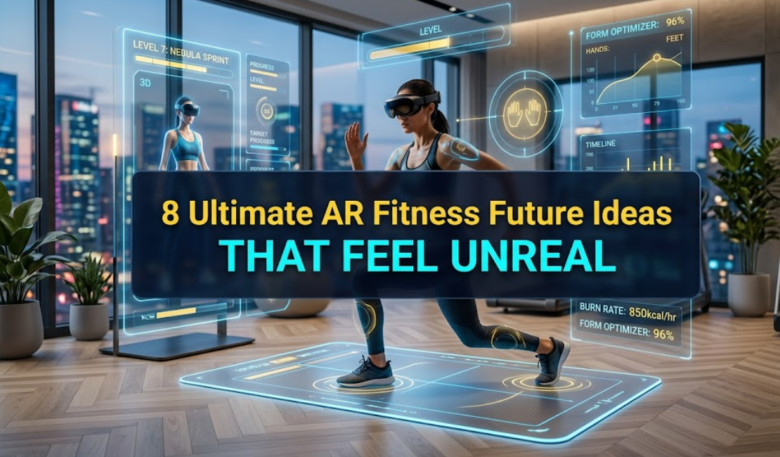
This article explores 8 ultimate AR fitness future ideas that are already emerging in prototypes, research labs, or early-stage products. These ideas show where fitness is headed in the next decade and how your living room could become a fully interactive training universe.
why AR fitness is evolving so quickly
Before diving into future ideas, it’s important to understand why AR fitness is growing so fast.
Three major forces are driving it:
- improved motion tracking
- lightweight wearable devices
- AI-powered personalization
Together, they allow fitness systems to understand your body in real time and respond instantly.
Table: evolution of fitness technology
| Era | Technology | Experience |
|---|---|---|
| 2000s | DVDs & gym machines | Static instruction |
| 2010s | Mobile fitness apps | Video-based guidance |
| 2020s | Smart wearables | Data-driven fitness |
| Future AR | Immersive environments | Real-time adaptive training |
We are shifting from “watch and copy” to “experience and interact.”
- fully immersive AR home gyms
The first unreal idea is the complete transformation of your home into a dynamic gym using AR projection systems.
Instead of buying equipment, your room adapts digitally.
Imagine:
- walls turning into climbing surfaces
- floors projecting agility ladders
- virtual trainers appearing in front of you
- obstacles shifting dynamically during workouts
Everything is generated in real time.
Table: traditional gym vs AR home gym
| Feature | Traditional Gym | AR Home Gym |
|---|---|---|
| Equipment | Required | Optional |
| Space usage | Fixed | Flexible |
| Cost | High | Moderate over time |
| Variety | Limited | Infinite |
| Experience | Physical | Immersive + physical |
Why it feels unreal:
You’re no longer exercising in a room—you’re exercising inside a constantly changing digital environment.
- AI trainers that learn your body like a coach
Future AR fitness won’t just show instructions—it will learn your body like a personal trainer who never forgets anything.
These AI systems will track:
- posture patterns
- fatigue levels
- injury risks
- muscle imbalances
Then they adjust workouts instantly.
Example scenario:
If your right leg is weaker, the AR trainer subtly modifies exercises to balance strength without you even noticing.
Table: static training vs adaptive AR training
| Factor | Static App | Adaptive AR Coach |
|---|---|---|
| Personalization | Low | High |
| Injury prevention | Basic | Advanced |
| Progress tracking | Manual | Automatic |
| Real-time adjustments | No | Yes |
Why it feels unreal:
Your workout evolves with you in real time, like a living system.
- AR fitness worlds with open environments
Instead of working out in one fixed space, future AR fitness will let users enter open digital environments.
Examples include:
- jungle obstacle courses
- futuristic city runs
- underwater resistance training
- space gravity workouts
You don’t move physically to a new place—the world appears around you.
Table: environment-based AR workouts
| Environment | Workout Type | Benefit |
|---|---|---|
| Jungle | Running + agility | Endurance |
| Ocean | Resistance training | Strength |
| Cityscape | Interval running | Speed |
| Space station | Core stability | Balance |
Why it feels unreal:
Your workout becomes a journey instead of a routine.
- holographic group workouts anywhere
One of the most exciting future ideas is holographic group fitness.
Imagine:
- joining a class with friends as 3D avatars
- seeing real-time movements of others in your room
- competing or syncing workouts together
- interacting socially during exercise
You could be in Karachi, and your workout partner could be in Tokyo—but both appear in the same virtual space.
Table: solo vs holographic group training
| Feature | Solo Workout | AR Group Workout |
|---|---|---|
| Motivation | Moderate | High |
| Social interaction | None | Real-time |
| Competition | Self-driven | Interactive |
| Engagement | Variable | Strong |
Why it feels unreal:
Distance disappears completely—you train together even when apart.
- AR fitness with real-time body scanning and correction
Future AR systems will scan your body continuously using advanced sensors and cameras.
They will detect:
- joint alignment
- muscle activation
- posture instability
- movement asymmetry
Then they will correct you instantly using visual overlays or audio cues.
Example:
If your spine bends during a lift, a glowing virtual line appears showing correction.
Table: basic vs advanced correction systems
| System Type | Feedback Speed | Accuracy |
|---|---|---|
| Video tutorials | None | Low |
| Current AR apps | Real-time | Medium |
| Future AR scanning | Instant | Very high |
Why it feels unreal:
It’s like having X-ray vision combined with a personal trainer.
- adaptive AR workouts based on emotions
One of the most futuristic ideas is emotion-aware fitness.
Using biometric sensors, AR systems will detect:
- stress levels
- motivation state
- energy levels
- focus ability
Then they adjust your workout accordingly.
Examples:
- stressed → calming yoga flow
- energetic → high-intensity workout
- tired → recovery session
Table: emotion-based workout adjustment
| Emotional State | AR Response |
|---|---|
| High stress | Slow stretching |
| Neutral | Balanced training |
| High energy | Intense cardio |
| Fatigue | Recovery mode |
Why it feels unreal:
Your workout adapts not just to your body—but your mind.
- AR fitness competitions with global ranking systems
Future AR fitness will turn exercise into global competition platforms.
You could:
- compete in virtual races
- climb global leaderboards
- participate in live AR tournaments
- earn rewards for performance
It’s like esports—but physical.
Table: traditional vs AR fitness competition
| Feature | Traditional Sports | AR Fitness Competitions |
|---|---|---|
| Location | Physical stadium | Anywhere |
| Participation | Limited | Global |
| Tracking | Manual | Automated |
| Competition scale | Local | Worldwide |
Why it feels unreal:
Your living room becomes a global arena.
- AR fitness with real-world skill simulation
The final idea is AR systems that simulate real-world skills through training.
Examples include:
- climbing mountains virtually to build endurance
- simulating combat sports movements
- practicing dance choreography in AR space
- learning parkour-style movement safely
Table: skill-based AR training examples
| Skill | AR Simulation |
|---|---|
| Climbing | Virtual cliffs |
| Martial arts | Motion sparring |
| Dance | Choreography overlays |
| Parkour | Obstacle simulation |
Why it feels unreal:
You train real-world abilities without real-world risk.
how all these ideas connect
These eight ideas are not separate—they are parts of a larger system.
Together, they form:
- intelligent fitness environments
- adaptive training systems
- global fitness communities
- emotionally aware coaching
Table: future AR fitness ecosystem
| Layer | Function |
|---|---|
| Environment | Virtual worlds |
| Intelligence | AI coaching |
| Interaction | Social workouts |
| Tracking | Body + emotion data |
what future AR fitness might look like in daily life
A typical day might look like this:
- wake up → AR system checks energy levels
- morning → light mobility workout appears in bedroom
- afternoon → virtual group cardio session
- evening → recovery yoga guided by AI coach
- night → progress summary projected on wall
Fitness becomes continuous, not scheduled.
challenges ahead
Even though these ideas feel exciting, there are real challenges:
- privacy concerns with body tracking
- high device costs
- motion sickness in AR environments
- need for reliable AI systems
But like most technologies, these will improve over time.
FAQs
- are AR fitness future ideas already real
Some are in early development, while others exist as prototypes or research concepts. - will AR fitness replace gyms completely
Not entirely, but it may reduce dependence on traditional gyms for general fitness. - is AR fitness safe for daily use
Yes, but proper calibration and rest are still important. - will I need special devices for future AR fitness
Likely yes—lightweight AR glasses or smart wearables will become common. - can AR fitness help beginners more than advanced users
Yes, beginners benefit most due to real-time guidance and correction. - what is the biggest benefit of future AR fitness
Personalization—every workout will adapt uniquely to your body and lifestyle.