Introduction: the quiet shift happening in fitness technology
Fitness is going through one of its biggest transformations in decades, but it doesn’t feel dramatic on the surface. There are no sudden revolutions in gyms or overnight replacements of personal trainers. Instead, change is happening quietly through augmented reality (AR)—layering digital intelligence onto real-world movement.
What makes AR fitness different from earlier fitness tech is that it doesn’t just track activity. It reacts, adapts, and guides movement in real time. Instead of looking at a screen after a workout, users now interact with invisible systems while they move.
Right now, most AR fitness tools are still early-stage. But the next wave of innovation—already in development—is going to change how people train at home, outside, and in gyms.
Below are five game-changing AR fitness innovations that are expected to define the near future of workouts.
Innovation 1: AI-powered AR personal trainers that correct your form in real time
The first major shift is the rise of AR personal trainers that don’t just guide workouts—they actively correct your body movement.
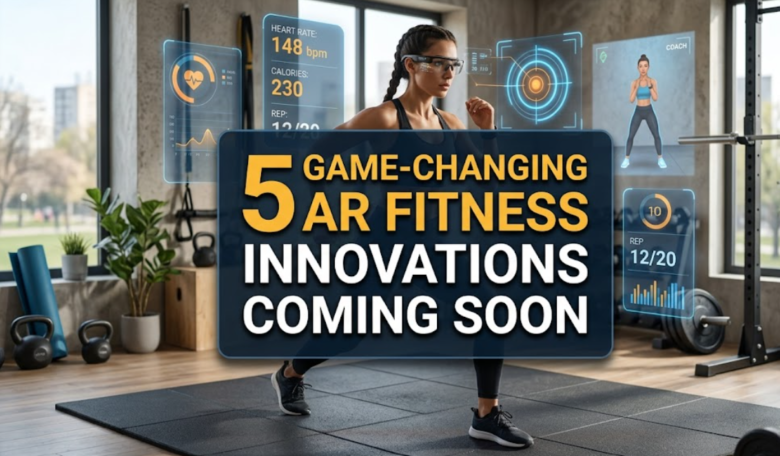
Instead of watching a video or listening to audio cues, users will see digital overlays positioned directly on their body through AR glasses or phone cameras. These overlays will show whether your posture is correct, which muscles are engaged, and how to adjust movement instantly.
This goes beyond simple tracking. It is real-time coaching.
How it works in practice:
- Camera or AR glasses detect body posture
- AI analyzes joint alignment and movement angles
- Visual overlays show corrections instantly
- Feedback adjusts dynamically during exercise
Comparison of traditional vs AR coaching:
| Feature | Traditional Fitness Coaching | AR AI Coaching |
|---|---|---|
| Feedback speed | After workout | Real-time |
| Form correction | Manual observation | Automated AI |
| Accessibility | Limited (cost/time) | High |
| Personalization | Medium | High |
Expected impact:
- Reduced injury risk
- Faster learning of proper form
- More independent training without coaches
This innovation is already being tested in early AR fitness systems, and it’s expected to become mainstream once lightweight AR glasses become common.
Innovation 2: Immersive AR workout environments that replace physical gyms
The second major innovation is fully immersive AR environments that replace traditional workout spaces.
Instead of exercising in a gym or living room, users will see layered digital worlds over real environments. A treadmill run could feel like running through a mountain trail, while a strength workout could take place inside a futuristic training arena.
This isn’t just decoration—it changes perceived effort.
Types of AR fitness environments being developed:
| Environment Type | Workout Style | Experience Goal |
|---|---|---|
| Nature simulations | Running/cardio | Relaxation + endurance |
| Sci-fi arenas | HIIT/boxing | Motivation boost |
| Game-based worlds | Mixed movement | Engagement |
| Competitive zones | Group training | Social motivation |
Why it matters:
- Reduces boredom in repetitive workouts
- Increases workout duration without mental fatigue
- Encourages consistency through novelty
Research trends in AR fitness show that gamified environments significantly improve motivation and adherence levels compared to static workouts .
Innovation 3: AR wearable glasses designed specifically for fitness tracking
A major hardware shift is coming with lightweight AR glasses designed specifically for workouts.
Instead of holding a phone or wearing heavy VR headsets, users will wear lightweight glasses that display real-time fitness data directly in their field of vision.
These glasses will show:
- Heart rate zones
- Pace and distance
- Rep counting
- Form guidance
- Workout progress overlays
Expected evolution of AR wearables:
| Generation | Device Type | Weight Range | Primary Use |
|---|---|---|---|
| Gen 1 | VR headsets | 400–600g | Gaming |
| Gen 2 | Smart glasses | 80–150g | Mixed use |
| Gen 3 | Fitness AR glasses | <80g | Daily wear |
What makes this innovation important:
- Hands-free fitness tracking
- Real-time biometric feedback
- Seamless outdoor and indoor use
Recent industry movement shows strong investment in lightweight AR glasses focused on daily use and fitness integration, including AI-enhanced wearable ecosystems .
Innovation 4: Adaptive AR workouts powered by biometric response systems
The fourth innovation is adaptive workouts that change based on your body’s real-time condition.
Instead of following a fixed routine, AR fitness systems will adjust intensity automatically based on:
- Heart rate variability
- Fatigue levels
- Sleep quality
- Previous workout load
- Stress indicators
This creates a living workout system that evolves with the user.
Example adaptive workout logic:
| Body Condition | System Response |
|---|---|
| High fatigue | Reduce intensity |
| Normal state | Maintain plan |
| High energy | Increase difficulty |
| Overtraining risk | Switch to recovery |
Why this matters:
- Prevents burnout
- Reduces overtraining injuries
- Improves long-term consistency
Industry research already highlights AI-driven personalization as a core driver of future fitness platforms .
Innovation 5: Multiplayer AR fitness ecosystems with social competition layers
The final major innovation is the rise of fully connected AR fitness ecosystems where people can train together in real time, regardless of location.
Instead of solo workouts, users will join shared AR environments where they can:
- Compete in live challenges
- Join virtual group workouts
- Track shared goals
- Participate in global fitness events
These systems will make fitness feel more like a multiplayer game than an individual activity.
Social AR fitness comparison:
| Feature | Current Fitness Apps | Future AR Ecosystems |
|---|---|---|
| Social interaction | Limited | Real-time |
| Competition mode | Static leaderboards | Live dynamic races |
| Group workouts | Video-based | Shared AR space |
| Engagement level | Medium | Very high |
Why it will work:
- Humans respond strongly to social accountability
- Competition increases consistency
- Shared environments increase engagement
AR fitness trends already show movement toward immersive multiplayer training systems as part of broader fitness gamification evolution .
Overall transformation chart: how AR fitness is evolving
Stages of AR fitness development:
| Stage | Description | Example Use Case |
|---|---|---|
| 1 | Tracking layer only | Step counting apps |
| 2 | Visual overlays | Basic AR workout apps |
| 3 | AI guidance | Form correction systems |
| 4 | Immersive environments | VR/AR fitness worlds |
| 5 | Fully adaptive ecosystems | Social + biometric AR fitness |
What these innovations mean for everyday users
These changes are not just technical upgrades—they fundamentally change how people experience exercise.
Instead of:
- “I need to work out”
People will start thinking:
- “I want to enter this experience”
The biggest shift is psychological:
- Exercise becomes engagement-driven rather than discipline-driven
Key risks and limitations
Even though AR fitness is evolving quickly, there are challenges:
- Hardware affordability
- Motion tracking accuracy limits
- Battery constraints in wearable devices
- Privacy concerns with body tracking data
- Over-reliance on gamification systems
FAQs
- What is AR fitness in simple terms?
AR fitness uses augmented reality to overlay digital guidance, tracking, or environments onto real-world exercise. - Are AR fitness innovations already available?
Some early versions exist, but most advanced features like adaptive AI trainers and full AR glasses are still in development. - Will AR fitness replace gyms?
Not completely. It will complement gyms by enhancing home and outdoor workouts rather than replacing strength training facilities. - Do I need special equipment for AR fitness?
Some features work on smartphones, but advanced systems will require AR glasses or VR headsets. - Is AR fitness safe for beginners?
Yes, especially because real-time feedback can reduce injury risk and improve form. - What is the biggest benefit of AR fitness innovation?
The biggest benefit is improved consistency through immersive, engaging, and adaptive workout experiences.