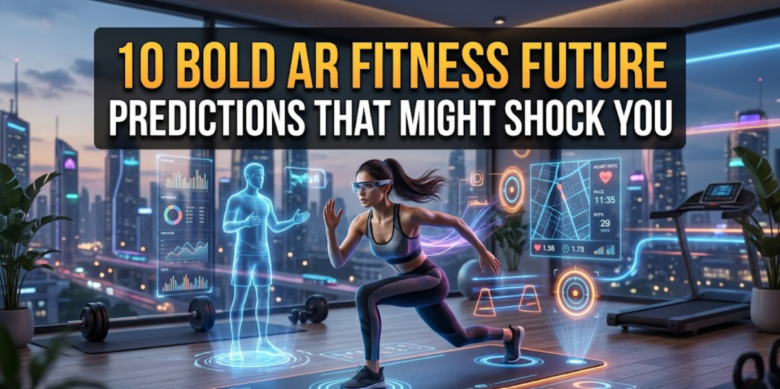
Augmented reality (AR) fitness is quietly moving from “interesting tech experiment” to something that could reshape how people exercise daily. What started with simple gamified movement apps is now evolving into full-body tracking systems, AI coaching overlays, and immersive fitness environments that blend the real and digital world.
If current trends continue, the next 5–10 years won’t just improve AR fitness—they may completely redefine what “working out” means.
Below are 10 bold predictions about the future of AR fitness that sound surprising today but are becoming increasingly realistic.
prediction 1: gyms will become optional for most people
In the near future, physical gyms may no longer be the default fitness solution. Instead, AR fitness systems will allow users to train anywhere—home, parks, offices, even hotel rooms—with equal or better guidance than traditional gyms.
Why this is likely:
- AR tracking accuracy is improving rapidly
- Home devices are becoming more powerful
- Users prefer convenience over commute-based workouts
future comparison table:
| Feature | Traditional Gym | AR Fitness Future |
|---|---|---|
| Location dependence | High | None |
| Equipment requirement | High | Low or optional |
| Cost | Monthly membership | App + device subscription |
| Flexibility | Low | Very high |
| Personalization | Medium | AI-driven high |
Within 10 years, gyms may shift into “social fitness hubs” rather than primary workout spaces.
prediction 2: AR fitness will replace personal trainers for most users
AI-driven AR coaches will likely become more accurate than human trainers for general fitness needs.
These systems will:
- Track posture in real time
- Correct movement instantly
- Adjust difficulty dynamically
- Build personalized programs automatically
future coaching comparison:
| Coaching type | Feedback speed | Cost | Personalization |
|---|---|---|---|
| Human trainer | Delayed | High | High |
| AR AI trainer | Instant | Low | Very high |
This doesn’t eliminate trainers entirely—but it shifts them toward elite coaching, rehabilitation, and sports performance.
prediction 3: workouts will become fully gamified life experiences
Fitness will no longer feel like “exercise.” Instead, it will feel like interactive storytelling, gaming, or exploration.
Imagine:
- Running through virtual zombie chases in your neighborhood
- Completing missions while walking to work
- Fighting virtual opponents using real punches
Some early versions already exist in apps like AR-based fitness games and location-based movement platforms such as Pokémon Go, which already proved that people will walk more when movement becomes part of a game.
future gamification model:
| Element | Current AR fitness | Future AR fitness |
|---|---|---|
| Story depth | Low-medium | Fully immersive |
| Real-world integration | Basic | Advanced |
| Multiplayer interaction | Limited | Global real-time |
| Reward systems | Points/badges | Dynamic economies |
Exercise will feel less like discipline and more like entertainment.
prediction 4: AR fitness will integrate directly with wearable body sensors
Future AR fitness systems won’t rely only on phones or cameras. They will connect to smart clothing, biometric sensors, and neural feedback devices.
These systems may track:
- Muscle activation
- Oxygen efficiency
- Joint stress levels
- Fatigue in real time
wearable integration forecast:
| Sensor type | Function | Expected adoption |
|---|---|---|
| Smart watches | Heart rate + steps | Already common |
| Smart clothing | Muscle tracking | Emerging |
| Neural sensors | Focus + fatigue | Experimental |
| Full-body AR suits | Complete tracking | Future stage |
This will create “closed-loop fitness systems” where workouts adjust instantly based on body condition.
prediction 5: calorie tracking will become obsolete
Instead of counting calories burned, AR systems will focus on movement quality, recovery state, and metabolic efficiency.
Why calorie tracking may disappear:
- It’s inaccurate in real-world conditions
- It doesn’t reflect performance improvement
- It creates unhealthy behavior patterns
future metrics shift:
| Old metric | New AR metric |
|---|---|
| Calories burned | Energy efficiency score |
| Steps | Movement quality index |
| Weight loss focus | Strength + mobility balance |
| Time spent | Adaptation rate |
Fitness will shift from “burn more” to “move better.”
prediction 6: AR fitness will create fully virtual outdoor environments
Even if you’re indoors, AR glasses or devices will project outdoor environments over your real space.
Examples:
- Running through mountains while on a treadmill
- Training in virtual beaches while in a small room
- Cycling through simulated cities
environment immersion comparison:
| Experience type | Current apps | Future AR systems |
|---|---|---|
| Visual realism | Medium | Ultra-realistic |
| Sensory feedback | Low | Multi-sensory |
| Weather simulation | None | Full simulation |
| Terrain adaptation | Limited | Dynamic |
This will solve one of the biggest problems in fitness: boredom.
prediction 7: social fitness will become a global AR economy
Fitness will evolve into a social ecosystem where users compete, collaborate, and even earn rewards.
Possible features:
- Global AR fitness leagues
- Real-time group workouts in shared AR spaces
- Reward-based movement challenges
social AR structure:
| Feature | Description |
|---|---|
| AR leaderboards | Compete globally |
| Team missions | Group fitness challenges |
| Reward tokens | Earnable fitness currency |
| Live events | Global AR workout events |
This creates motivation through community instead of isolation.
prediction 8: workplaces will adopt mandatory AR movement breaks
Companies may soon integrate AR fitness into daily work routines.
Instead of sitting long hours:
- Employees will complete 3–5 minute AR movement breaks
- Desk AR overlays will guide posture correction
- Group AR sessions may replace coffee breaks
workplace integration model:
| Work environment | Current state | Future AR state |
|---|---|---|
| Office breaks | Passive | Active AR sessions |
| Productivity tracking | Time-based | Energy-based |
| Health programs | Optional | Built-in |
This could significantly reduce sedentary health risks.
prediction 9: AR fitness will personalize workouts in real time using AI prediction
Future AR systems won’t just react—they will predict.
They may:
- Detect fatigue before you feel it
- Adjust workouts based on sleep quality
- Modify intensity based on emotional state
real-time personalization table:
| Input signal | AR response |
|---|---|
| Low sleep score | Reduced intensity workout |
| High stress | Recovery-focused session |
| High energy | Advanced training mode |
| Muscle fatigue | Automatic adjustment |
This makes fitness feel “alive” and adaptive.
prediction 10: AR fitness will merge with entertainment platforms completely
Eventually, the line between fitness apps, games, and streaming platforms may disappear.
Imagine:
- Watching a series where you must walk or move to unlock episodes
- Playing story-driven AR fitness games with cinematic visuals
- Fitness-based streaming subscriptions
content integration forecast:
| Platform type | Current state | Future AR model |
|---|---|---|
| Streaming apps | Passive viewing | Movement-linked viewing |
| Gaming | Separate activity | Fitness-integrated |
| Fitness apps | Isolated use | Entertainment hybrid |
Exercise becomes part of daily digital consumption, not a separate activity.
summary table: overall AR fitness transformation
| Area | Today | Future |
|---|---|---|
| Training style | Structured workouts | Adaptive experiences |
| Motivation | Discipline-based | Game + social-based |
| Tracking | Simple metrics | Multi-layer AI insights |
| Environment | Fixed | Fully immersive |
| Accessibility | Medium | Universal |
how AR fitness changes human behavior long-term
The biggest shift won’t be technological—it will be behavioral.
People will:
- Move more without noticing
- Exercise in shorter bursts
- Prefer interactive movement over static workouts
- Rely less on traditional fitness spaces
Instead of “going to work out,” fitness becomes something that happens throughout the day.
final thoughts
AR fitness is not just improving workouts—it’s redefining what fitness is. The future won’t separate gaming, movement, and daily life as clearly as we do today. Instead, they’ll blend into a continuous system of guided physical interaction.
Some predictions may take longer than others, but the direction is clear: fitness is becoming immersive, adaptive, and always available.
The most surprising part isn’t the technology itself—it’s how naturally people will adapt to it.
FAQs
- Will AR fitness completely replace traditional gyms?
Not entirely. Gyms will still exist, but AR fitness may become the primary option for most general users due to convenience. - Do AR fitness apps require expensive equipment?
Currently no, but future systems may use optional wearables for advanced tracking. - Is AR fitness suitable for beginners?
Yes. In fact, many AR systems are designed to guide beginners more effectively than traditional workouts. - Can AR fitness really improve motivation?
Yes. Gamification and real-time feedback significantly improve consistency for many users. - Will AR fitness work without internet access?
Some basic functions may work offline, but full immersive features will likely require connectivity. - What is the biggest advantage of AR fitness in the future?
The ability to make exercise automatic, adaptive, and integrated into daily life without requiring separate time blocks.