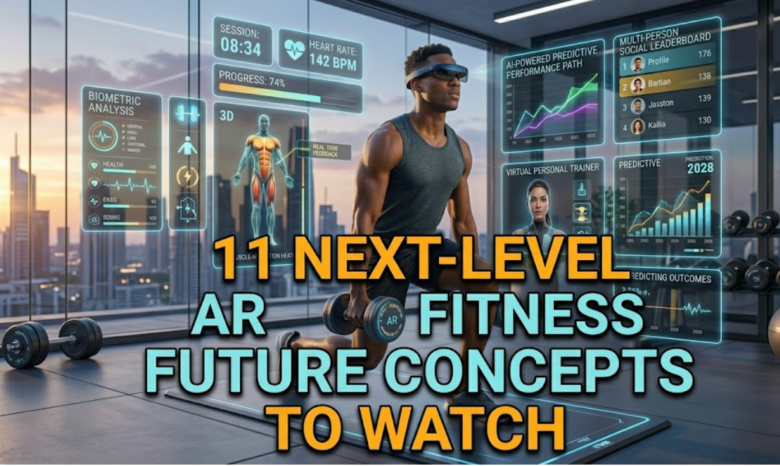
Augmented reality fitness is no longer just about overlaying virtual trainers on your phone screen. It is evolving into a full ecosystem where movement, gaming, biomechanics, artificial intelligence, and real-world environments merge into one continuous experience. What used to be “workout apps” is now slowly turning into adaptive fitness worlds that respond to your body in real time.
The direction is clear: AR fitness is shifting from “guided exercise” to “interactive physical reality.”
Below are 11 next-level AR fitness concepts that are shaping the future of how people will train, burn calories, and even think about exercise.
Before diving in, here’s a snapshot of how fast the space is evolving:
| AR Fitness Evolution Stage | Core Experience | User Role | Immersion Level |
|---|---|---|---|
| Early AR Apps | Basic overlays | Passive | Low |
| Gamified AR Fitness | Missions & points | Active gamer | Medium |
| Adaptive AR Workouts | Real-time feedback | Participant | High |
| Future AR Fitness Worlds | Full environment interaction | Co-creator | Very High |
- AI-powered adaptive AR trainers that read your body in real time
The next generation of AR fitness will not just show you what to do—it will analyze how your body responds while you move.
Using computer vision, biometric sensors, and motion tracking, these systems will:
- Detect fatigue before you feel it
- Adjust intensity automatically
- Correct posture instantly
- Modify workouts based on stress levels
Instead of following a fixed routine, your workout becomes a living system.
Projected capability comparison:
| Feature | Current AR Fitness | Future AI AR Trainers |
|---|---|---|
| Real-time correction | Basic | Advanced biomechanical |
| Fatigue detection | No | Yes |
| Auto workout adjustment | Limited | Fully dynamic |
- fully immersive AR city fitness overlays
Imagine walking through your city and seeing:
- Floating sprint tracks on sidewalks
- Strength zones on public parks
- Virtual obstacle courses between buildings
This concept transforms entire cities into fitness playgrounds.
Outdoor movement becomes structured exercise without needing gyms or equipment.
Potential use case example:
| Location Type | AR Fitness Activity |
|---|---|
| Streets | Sprint challenges |
| Parks | Strength circuits |
| Bridges | Endurance runs |
| Plazas | Group battles |
This idea aligns with broader research on AR-driven urban interaction systems that integrate physical space with digital overlays for movement and navigation .
- biometric-linked AR intensity scaling
Future AR fitness systems will connect directly with:
- Heart rate variability
- Sleep quality
- Stress levels
- Oxygen saturation
Instead of choosing difficulty manually, your body decides it.
If you are tired, the system reduces intensity. If you are fresh, it pushes harder.
This creates what experts call “adaptive physiological training loops.”
| Biomarker Input | Workout Adjustment |
|---|---|
| High stress | Reduced intensity |
| Good recovery | Increased load |
| Poor sleep | Mobility focus |
- multiplayer AR fitness ecosystems (real competition mode)
Fitness is becoming social again—but digitally enhanced.
Future AR platforms will allow users to:
- Compete in real-time virtual obstacle races
- Join global strength battles
- Form AR fitness teams
- Earn rankings across cities or countries
Instead of solo workouts, users enter shared fitness worlds.
Comparison:
| Mode | Engagement Level | Motivation Source |
|---|---|---|
| Solo AR workout | Medium | Self-driven |
| Multiplayer AR | Very High | Competition |
- holographic personal trainers in your room
Instead of watching a screen, future AR systems will project full-scale holographic trainers into your space.
These trainers will:
- Walk around your environment
- Demonstrate movements in 3D scale
- Physically “gesture” corrections
- Adjust positioning based on your space
This makes coaching feel physically present rather than digital.
This aligns with industry movement toward immersive AI coaching environments that integrate spatial awareness and real-time feedback systems .
- AR resistance training using digital force simulation
One of the most futuristic ideas is “invisible resistance.”
Using haptic feedback wearables and motion tracking, AR systems will simulate:
- Weighted punches
- Resistance bands in mid-air
- Gravity shifts during squats
- Variable load lifting without equipment
You could literally do strength training in an empty room.
| Exercise Type | Traditional | AR Resistance Simulation |
|---|---|---|
| Squats | Bodyweight | Adjustable virtual load |
| Punching | Air boxing | Resistance impact zones |
- environment-responsive AR workouts
Your surroundings will influence your workout.
For example:
- Small room → compact HIIT mode
- Outdoor park → endurance mode
- Gym → hybrid strength mode
AR systems will scan your space and design workouts automatically.
This concept is tied to advances in spatial mapping and SLAM technology used in AR systems .
| Environment Type | AR Adaptation Style |
|---|---|
| Indoor small | Stationary HIIT |
| Indoor large | Mixed circuit |
| Outdoor open | Cardio endurance |
- AR fitness storytelling workouts (game-based narratives)
Instead of “doing reps,” you’ll be:
- Escaping collapsing cities
- Climbing digital mountains
- Fighting virtual opponents
- Completing story-driven missions
Your workout becomes a narrative experience.
This increases duration because users are emotionally invested in the storyline rather than the exercise itself.
| Format | Engagement Factor |
|---|---|
| Traditional HIIT | Medium |
| Story AR workout | Very High |
- real-world object integration training
Future AR systems will use objects around you as workout tools:
- Chairs become squat supports
- Walls become resistance push zones
- Tables become agility markers
Your environment becomes adaptive gym equipment.
Example mapping:
| Household Object | AR Fitness Function |
|---|---|
| Chair | Step platform |
| Wall | Push resistance |
| Floor space | Movement grid |
- neural-feedback AR training (brain-linked fitness)
Early-stage research suggests AR fitness may eventually integrate with neural or cognitive signals.
This would allow:
- Focus-based difficulty scaling
- Mental fatigue detection
- Reaction speed optimization
- Cognitive load balancing
While still experimental, it represents a major leap toward mind-body synchronized training systems.
- persistent AR fitness worlds (your workout never resets)
Instead of isolated sessions, future AR fitness will create persistent environments:
- Your progress stays in the world
- Your avatar evolves physically
- Your environment upgrades based on fitness level
- Other users interact with your “fitness space”
This turns fitness into a long-term evolving digital ecosystem.
Think of it as combining gaming progression systems with real-world physical transformation.
Future ecosystem comparison:
| Feature | Current Apps | Persistent AR Worlds |
|---|---|---|
| Progress tracking | Linear | Evolution-based |
| Environment | Static | Dynamic |
| Social layer | Optional | Core feature |
overall transformation of AR fitness
When all these concepts converge, fitness stops being an activity and becomes an integrated life layer.
| Category | Today’s Fitness | Future AR Fitness |
|---|---|---|
| Motivation | Discipline | Immersion |
| Environment | Gym/home | Entire world |
| Feedback | Delayed | Instant + predictive |
| Personalization | Basic | Fully adaptive |
what this future really means
The biggest shift isn’t technological—it’s behavioral. AR fitness removes the friction between intention and action. Instead of “going to work out,” movement becomes embedded in daily life, environments, and even entertainment systems.
That’s why these 11 concepts matter. They aren’t isolated innovations—they are building blocks of a system where physical activity becomes continuous, adaptive, and almost invisible as “exercise.”
faqs
- are AR fitness concepts actually being developed right now
Yes, many concepts like AI coaching, gamified AR workouts, and spatial tracking already exist in early forms, while others are in active research and prototype stages. - will AR fitness replace gyms in the future
Not entirely. Gyms will still exist, but AR fitness will reduce dependency on them by bringing structured training into everyday environments. - what is the biggest barrier to AR fitness becoming mainstream
Hardware limitations such as lightweight AR glasses, battery life, and real-time spatial processing still need improvement. - is AR fitness safe for long-term use
Yes, but future systems will also include fatigue detection and posture correction to reduce injury risk even further. - how will AR fitness change motivation to exercise
It replaces discipline-based motivation with immersive engagement, making workouts feel like games or experiences rather than obligations. - which concept will arrive first in real life
AI adaptive trainers, gamified AR workouts, and real-time biometric integration are likely to become mainstream before more advanced neural or persistent AR worlds.