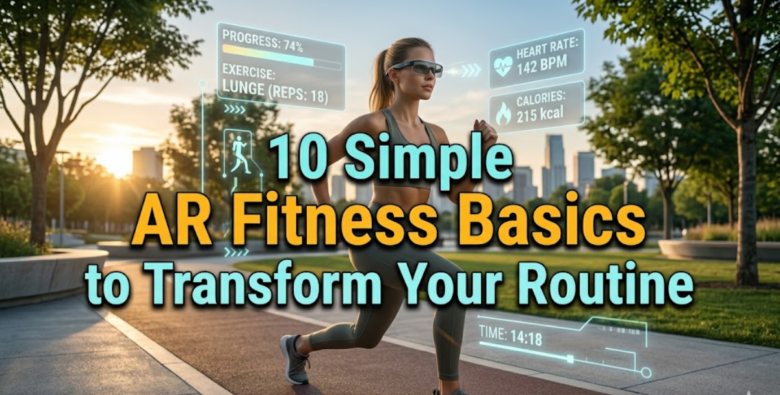
Augmented Reality (AR) fitness has moved from a futuristic idea to something people can use in their living rooms, parks, and gyms every day. Instead of simply watching workout videos or following static routines, AR fitness layers interactive digital elements over your real environment. That shift changes how people move, how long they stay active, and how consistent they become.
But here’s the interesting part: most people who try AR fitness never actually use it to its full potential. They download an app, try a session or two, and then fall back into old habits. The reason isn’t lack of motivation—it’s lack of understanding of the basics.
This guide breaks down 10 simple AR fitness basics that can completely transform your routine. These are not advanced tricks or complicated systems. They are practical foundations that make AR workouts more effective, more engaging, and more sustainable.
Along the way, you’ll see comparisons, structured tables, and real-world usage breakdowns that help you apply everything immediately.
why AR fitness is different from traditional workouts
Before diving into the basics, it’s important to understand what makes AR fitness fundamentally different.
Traditional workouts depend on repetition and discipline. AR fitness depends on interaction and feedback. Instead of just telling your body what to do, AR systems respond to your movement in real time.
Here’s a quick comparison:
| Factor | Traditional Workouts | AR Fitness Workouts |
|---|---|---|
| Engagement level | Medium | High |
| Feedback speed | Delayed or none | Real-time |
| Motivation source | Discipline | Gamification |
| Adaptability | Fixed routine | Dynamic adjustment |
| Consistency rate | Moderate | High |
This shift is why AR fitness often leads to longer sessions and higher calorie burn without users feeling like they are forcing themselves.
Now let’s get into the 10 basics that make it work.
- understanding your AR environment setup
Your environment is the foundation of every AR workout. Unlike gym machines that define space for you, AR fitness uses your surroundings as the workout arena.
A proper setup includes:
- Clear floor space (minimum 6×6 feet)
- Good lighting for motion tracking
- Minimal reflective surfaces
- Stable internet connection (for real-time rendering)
A poorly set environment leads to tracking errors, broken immersion, and lower performance.
Simple setup comparison:
| Setup Quality | Tracking Accuracy | Workout Flow |
|---|---|---|
| Poor | Low | Interrupted |
| Moderate | Medium | Occasional glitches |
| Optimized | High | Smooth flow |
Even a 10% improvement in tracking accuracy can significantly improve workout intensity because you stop pausing to fix errors.
- learning to trust real-time feedback
AR fitness apps constantly give feedback—whether it’s a visual cue, a score, or a correction. Many beginners ignore it or underestimate it.
That feedback loop is the core of AR training.
Types of feedback include:
- Movement accuracy
- Timing precision
- Posture correction
- Speed optimization
When you respond quickly to feedback, your calorie burn increases because your body adjusts in real time instead of repeating inefficient movements.
Feedback response impact:
| Response Level | Workout Efficiency | Calorie Output |
|---|---|---|
| Ignored | Low | Reduced |
| Partial | Medium | Average |
| Immediate | High | Maximized |
- using gamification as a performance tool
Gamification is not just entertainment—it’s a psychological trigger that increases endurance.
Most AR fitness apps use:
- Points
- Levels
- Streaks
- Challenges
- Leaderboards
Instead of focusing on “I need to exercise,” your brain shifts to “I need to complete this level.”
This shift increases workout duration naturally.
Example engagement chart:
| Motivation Type | Avg Workout Time |
|---|---|
| No gamification | 20–25 minutes |
| Basic rewards | 30–35 minutes |
| Full gamification | 40–55 minutes |
- mastering movement synchronization
In AR fitness, timing matters as much as movement.
You are often required to:
- Hit targets in rhythm
- Match virtual trainers
- React to visual cues
Synchronization improves coordination and calorie burn because it prevents passive movement.
Poor synchronization leads to:
- Reduced intensity
- Missed reps
- Lower engagement
Improved synchronization leads to:
- Higher heart rate stability
- Better muscle activation
- Longer endurance
- controlling workout intensity dynamically
One of the most powerful AR fitness basics is learning to adjust intensity during sessions.
Unlike fixed gym machines, AR workouts can change speed, resistance, or challenge level dynamically.
Intensity zones:
| Zone | Heart Rate Impact | Example Activity |
|---|---|---|
| Light | Warm-up | Stretching |
| Moderate | Fat burn | Basic movement |
| High | Cardio peak | Fast sequences |
| Maximum | Sprint effort | Reaction drills |
Knowing when to push and when to slow down prevents burnout and improves long-term consistency.
- optimizing body positioning for tracking
AR systems rely heavily on motion detection. If your body is not properly positioned, performance drops.
Key positioning tips:
- Stay within camera frame
- Keep joints visible
- Avoid overlapping limbs too much
- Maintain stable base stance
Position accuracy vs tracking success:
| Position Quality | Tracking Accuracy |
|---|---|
| Poor alignment | 50–60% |
| Moderate | 70–80% |
| Optimal | 90–100% |
Better tracking leads directly to better workout scoring and higher effort output.
- combining cardio and strength in AR flow
Most AR workouts are hybrid by design, but users often focus on only one type of movement.
Effective AR training alternates:
- Cardio bursts (fast movement)
- Strength holds (static resistance)
- Mobility transitions (flow movements)
This combination increases overall calorie burn efficiency.
Example structure:
| Phase | Duration | Focus |
|---|---|---|
| Warm-up | 5 min | Mobility |
| Cardio burst | 10 min | Heart rate |
| Strength | 10 min | Muscle work |
| Recovery | 5 min | Control |
- improving reaction speed over time
AR fitness often includes reactive elements—targets, signals, or obstacles.
Improving reaction speed leads to:
- Higher calorie expenditure
- Better coordination
- Increased session difficulty tolerance
Reaction speed improvement curve:
| Week | Reaction Time Improvement |
|---|---|
| 1 | Baseline |
| 2 | +5–10% faster |
| 4 | +15–20% faster |
| 6+ | Stabilized high speed |
Faster reactions = more movements per minute = more energy burned.
- tracking progress beyond calories
Most users focus only on calorie burn, but AR fitness offers deeper metrics:
- Accuracy rate
- Movement consistency
- Reaction time
- Streak completion
- Form stability
Progress comparison table:
| Metric | Beginner | Intermediate | Advanced |
|---|---|---|---|
| Accuracy | 60% | 80% | 95% |
| Consistency | Low | Medium | High |
| Reaction speed | Slow | Moderate | Fast |
Tracking these metrics ensures long-term improvement instead of short-term motivation.
- building a sustainable AR fitness schedule
Consistency matters more than intensity.
A balanced AR fitness schedule avoids burnout and improves results.
Example weekly structure:
| Day | Focus Type | Duration |
|---|---|---|
| Monday | Cardio AR | 30 min |
| Tuesday | Strength AR | 25 min |
| Wednesday | Recovery flow | 20 min |
| Thursday | HIIT AR | 35 min |
| Friday | Mixed session | 30 min |
| Saturday | Fun/gamified | 40 min |
| Sunday | Rest | — |
Sustainability is what turns AR fitness from a novelty into a lifestyle.
overall transformation impact of AR fitness basics
When all 10 basics are applied together, the transformation is noticeable:
- Longer workout duration
- Higher calorie burn
- Better consistency
- Improved coordination
- Lower dropout rate
Transformation summary:
| Category | Before AR Basics | After AR Basics |
|---|---|---|
| Workout time | 20–30 min | 35–50 min |
| Calorie burn | Moderate | High |
| Motivation | Variable | Stable |
| Consistency | Low-medium | High |
faqs
- do i need expensive equipment for AR fitness workouts
No, many AR fitness apps work with just a smartphone. Some advanced systems may use headsets or sensors, but they are not required for basic use. - can AR fitness replace gym workouts completely
It can for many users, especially for cardio, HIIT, and functional training. However, heavy strength training may still benefit from gym equipment. - how often should i use AR fitness apps
Most users see good results with 3–5 sessions per week depending on intensity. - are AR fitness workouts safe for beginners
Yes, most apps include beginner modes and adaptive difficulty levels. Starting slow is recommended. - why does AR fitness feel less tiring even when burning more calories
Because of gamification and immersion, your brain perceives effort differently, allowing you to sustain activity longer without feeling fatigued as quickly. - what is the biggest mistake beginners make in AR fitness
Ignoring feedback and not optimizing their environment, which reduces tracking quality and overall workout effectiveness.