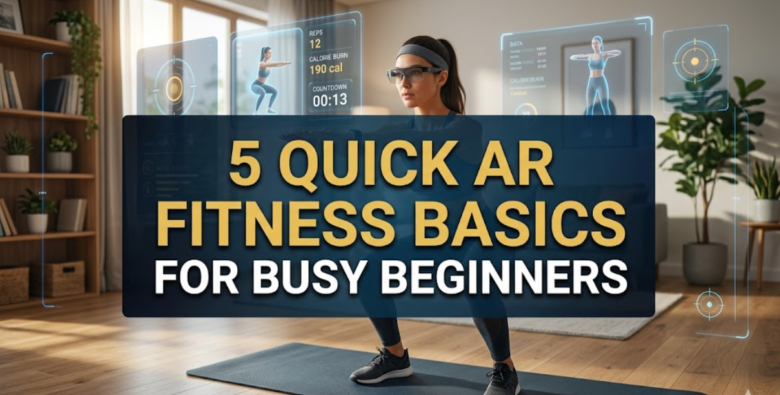
Most people don’t struggle with fitness because they lack motivation. They struggle because they lack time, structure, and clarity on what actually works. That’s exactly where augmented reality (AR) fitness quietly steps in.
Unlike traditional workouts that demand planning, memorizing routines, or watching long videos, AR fitness simplifies everything into visual, real-time guidance. It blends your physical space with digital instructions so you can move, train, and adjust without constantly thinking, “Am I doing this right?”
For busy beginners, this matters more than anything else. Because the biggest barrier isn’t effort—it’s friction.
This guide breaks down five practical AR fitness basics that actually fit into a busy lifestyle, along with real-world tables, structured comparisons, and simple systems you can use immediately.
why AR fitness is becoming a beginner-friendly shortcut
Before getting into the basics, it helps to understand why AR fitness is even relevant right now.
Traditional fitness setups usually require:
- Learning exercise form from videos or trainers
- Planning workouts in advance
- Tracking reps manually
- Guessing intensity levels
AR fitness removes most of that mental workload.
Instead, it gives you:
- Visual overlays showing correct movement
- Real-time corrections
- Automated tracking
- Interactive feedback
In simple terms: it reduces thinking and increases doing.
That’s a powerful shift for beginners who are already overwhelmed.
quick overview table: traditional vs AR fitness experience
| Element | Traditional Fitness | AR Fitness Basics |
|---|---|---|
| Learning curve | Moderate to high | Low |
| Setup time | 10–20 minutes | 1–3 minutes |
| Feedback speed | Delayed | Instant |
| Motivation style | Self-driven | Interactive |
| Consistency support | Weak | Strong |
basic 1: start with AR-guided micro workouts
If there is one mistake beginners make, it’s trying to do too much too soon. AR fitness solves this by breaking workouts into micro sessions.
A micro workout usually lasts:
- 5 to 12 minutes
- Focuses on 1–2 movement types
- Uses visual cues instead of instructions
AR apps and tools often display:
- Floating targets
- Movement paths
- Step-by-step motion prompts
Instead of remembering “3 sets of 12 squats,” you just follow what appears in front of you.
why this works for busy people
Because time is fragmented. You might have:
- 7 minutes before work
- 10 minutes during lunch
- 8 minutes before bed
AR micro workouts fit into these gaps without preparation.
example breakdown
| Time Slot | AR Micro Workout Type | Focus Area |
|---|---|---|
| Morning (5–7 min) | Energy activation | Full body mobility |
| Lunch (8–10 min) | Cardio burst | Fat burn |
| Evening (6–10 min) | Recovery flow | Stretching |
basic 2: use visual form correction instead of guessing
One of the biggest hidden problems in beginner fitness is incorrect form. People often think they are doing an exercise correctly when they are not.
AR fitness tools solve this by overlaying your body with:
- Alignment lines
- Joint positioning guides
- Depth indicators
- Movement boundaries
Instead of a trainer saying “lower your hips,” you see a visual cue showing exactly how far to go.
what changes with AR correction
| Movement Issue | Without AR | With AR Guidance |
|---|---|---|
| Squat depth | Guesswork | Visual target line |
| Back posture | Hard to detect | Spine overlay guide |
| Arm alignment | Inconsistent | Real-time correction |
| Repetition quality | Variable | Standardized feedback |
This removes uncertainty, which is one of the biggest reasons beginners quit early.
why it matters psychologically
When people are unsure, they slow down or stop altogether. AR reduces that uncertainty loop by making “correct” visible instead of abstract.
basic 3: build consistency using AR habit loops
Consistency is not about discipline alone. It’s about system design.
AR fitness tools are increasingly built around habit loops:
- Cue → Action → Reward
Instead of forcing motivation, they trigger behavior through interaction.
example AR habit loop
- Cue: A reminder appears on your device
- Action: You enter a 5-minute AR session
- Reward: Visual feedback, scores, progress animation
Over time, your brain starts associating movement with instant reward.
weekly consistency chart example
| Day | AR Session Type | Completion Probability |
|---|---|---|
| Monday | Micro workout | High |
| Tuesday | Rest + light AR stretch | Medium |
| Wednesday | Cardio AR game | High |
| Thursday | Missed / low energy day | Low |
| Friday | Full body AR session | High |
| Weekend | Flexible AR activity | Medium–High |
Notice something important: AR doesn’t demand perfection. It builds rhythm.
basic 4: turn your space into a workout environment
One of the most powerful features of AR fitness is spatial transformation.
Instead of going to a gym or clearing mental space for exercise, AR turns your environment into a training zone.
Your living room becomes:
- A movement arena
- A tracking grid
- A feedback space
Your hallway becomes:
- A running lane simulation
- A reaction training path
Your bedroom becomes:
- A stretching and recovery zone
This removes the need for “perfect conditions,” which is a major excuse for beginners.
simple spatial mapping example
| Room Area | AR Function | Exercise Type |
|---|---|---|
| Living room center | Core zone | Squats, lunges |
| Wall space | Posture tracking | Push-ups |
| Open corridor | Movement path | Cardio drills |
| Small corner | Recovery zone | Stretching |
Even small spaces become usable.
basic 5: use gamification to stay engaged
Beginners don’t usually quit because workouts are hard. They quit because workouts feel repetitive.
AR solves this with gamification.
Instead of:
- “Do 20 squats”
You get:
- “Hit 20 moving targets in 60 seconds”
- “Complete the balance challenge”
- “Unlock level 2 movement zone”
This shifts your focus from effort → objective.
engagement comparison chart
| Workout Style | Engagement Level (1–10) |
|---|---|
| Traditional reps | 5 |
| Video workouts | 6 |
| Gym training | 7 |
| AR gamified fitness | 8–9 |
why gamification works
It triggers:
- Competition (even with yourself)
- Progress tracking
- Instant reward feedback
- Curiosity (“what’s next?”)
For beginners, curiosity is more powerful than discipline.
how these 5 basics work together
Each AR fitness basic is useful alone, but together they form a system:
- Micro workouts reduce time barrier
- Form correction reduces injury risk
- Habit loops improve consistency
- Spatial training removes location limits
- Gamification improves engagement
When combined, they create a beginner-friendly ecosystem that requires less thinking and more doing.
system flow chart
Start → AR Cue appears
→ Micro workout begins
→ Real-time form correction activates
→ Progress tracked automatically
→ Gamified reward displayed
→ Habit loop reinforced
→ Repeat next day
This is why AR fitness feels easier than traditional routines—it removes decision fatigue.
realistic weekly AR fitness plan for beginners
Here’s a simple structure someone can actually follow:
| Day | Focus | Duration | AR Feature Used |
|---|---|---|---|
| Monday | Full body intro | 10 min | Micro workout + guidance |
| Tuesday | Light movement | 6 min | Stretch overlay |
| Wednesday | Cardio game | 10–12 min | Gamification mode |
| Thursday | Recovery | 5–8 min | Form correction + slow flow |
| Friday | Strength basics | 10–15 min | Spatial training |
| Weekend | Flexible play | 10 min | Free AR mode |
Notice how nothing feels overwhelming. That’s intentional.
common beginner mistakes in AR fitness
Even with AR tools, beginners can still struggle if they:
- Try to do long sessions too early
- Ignore rest days
- Focus only on score, not form
- Use too many features at once
- Expect instant transformation
AR helps, but it doesn’t replace pacing.
benefits most beginners notice within 2–3 weeks
When used consistently, beginners often report:
- Better posture awareness
- Higher workout consistency
- Less confusion during exercises
- Improved motivation
- Faster learning of movements
These aren’t dramatic transformations—but they are foundational changes that stick.
limitations you should be aware of
AR fitness is not perfect yet.
Some limitations include:
- Device dependency
- Occasional tracking errors
- Space requirements for movement
- Learning curve for setup
But for beginners, the benefits usually outweigh these drawbacks.
future of AR fitness for beginners
The direction is clear: simpler, lighter, and more personalized.
Future systems may include:
- AI-driven workout adaptation
- Voice-controlled AR guidance
- Fully passive tracking (no setup needed)
- Social AR workout spaces
The goal is not to make fitness more complex—but more invisible and integrated into daily life.
final thoughts
AR fitness isn’t about replacing traditional exercise. It’s about lowering the barrier to start.
For beginners, especially those with busy schedules, the biggest win is not intensity—it’s consistency.
And AR tools are quietly becoming one of the most effective ways to build that consistency without overwhelming your day.
FAQs
- Do I need expensive equipment to start AR fitness as a beginner?
No. Many AR fitness apps work on smartphones, so you can start without special hardware. - Is AR fitness good for people who are completely new to exercise?
Yes. In fact, beginners benefit the most because AR reduces confusion and provides real-time guidance. - How long should I use AR fitness daily as a beginner?
Start with 5–12 minutes per session. Consistency matters more than duration. - Can AR fitness replace gym workouts completely?
Not entirely, but it can cover a large portion of beginner and intermediate fitness needs. - Is AR fitness safe for people with no training experience?
Yes, because it provides visual corrections, but beginners should still avoid overexertion. - What is the biggest advantage of AR fitness for busy people?
It removes planning and decision-making, allowing workouts to fit into very short time gaps.