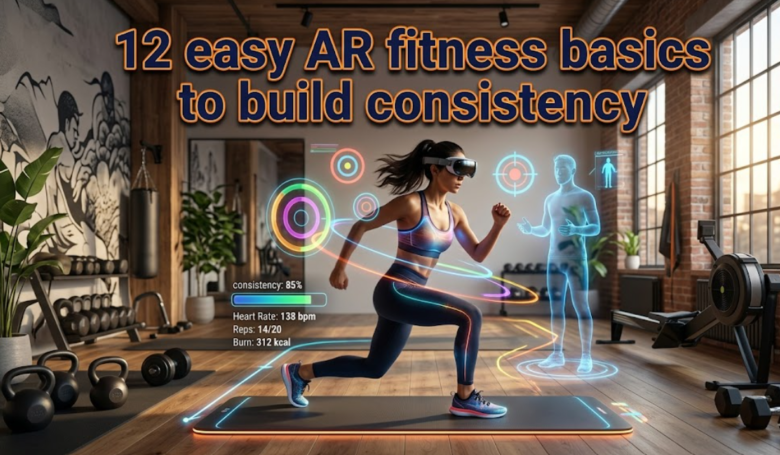
Augmented reality (AR) fitness isn’t just a tech trend anymore—it’s becoming a practical way for people with busy schedules to stay active without needing a gym, long routines, or complicated planning. But most people don’t fail at fitness because they lack tools. They fail because they lack consistency.
AR fitness apps solve part of that problem by turning movement into something interactive, short, and easier to repeat daily. Still, using them effectively requires understanding a few fundamentals. This guide breaks down 12 practical AR fitness basics that help you build consistency in a realistic, sustainable way.
Along the way, you’ll find tables, habit charts, and comparison frameworks to help you structure your routine—not just read about it.
why consistency matters more than intensity in AR fitness
Before diving into the basics, it’s important to understand a key truth: intensity doesn’t build fitness alone—consistency does.
A 20-minute AR workout done five times a week will outperform a 90-minute session done once in a while. AR fitness systems are designed around this idea by lowering friction and increasing engagement.
Typical inconsistency pattern vs AR consistency pattern:
| Approach | Week 1 | Week 2 | Week 3 | Week 4 |
|---|---|---|---|---|
| Traditional gym | High effort | Drop in attendance | Irregular | Stop |
| AR fitness apps | Moderate effort | Repeat sessions | Habit forming | Stable routine |
AR fitness tools like Pokémon Go even demonstrate how movement-based interaction can increase daily activity simply by making users engage repeatedly without feeling like they’re “working out.”
basic 1: start with short sessions, not perfect workouts
One of the biggest mistakes beginners make is trying to do too much too soon. AR fitness works best when sessions are short and frequent.
Ideal session lengths:
| Experience level | Session duration | Frequency |
|---|---|---|
| Beginner | 8–12 minutes | Daily |
| Intermediate | 15–25 minutes | 4–5 times/week |
| Advanced | 25–40 minutes | 4–6 times/week |
Apps like Zombies, Run! are built around short bursts of activity, proving that even narrative-driven movement sessions can build long-term fitness habits.
Rule of consistency:
If it feels too long to start, it’s too long to sustain.
basic 2: choose AR apps that reduce decision fatigue
Decision fatigue is one of the biggest hidden barriers to fitness. If you need to decide what workout to do every day, you’re more likely to skip it.
AR fitness apps solve this by offering structured or gamified experiences.
Comparison of app types:
| Type | Decision required | Motivation style | Consistency impact |
|---|---|---|---|
| Gamified AR apps | Low | Fun-based | High |
| Trainer-based AR apps | Medium | Instructional | Medium-high |
| Free-form workout apps | High | Self-driven | Low-medium |
Examples of AR-style structured platforms include apps like Active Arcade, which eliminate planning by turning workouts into ready-to-play movement games.
basic 3: use environmental triggers for habit formation
AR fitness works best when tied to physical surroundings. Instead of going somewhere new, you use your existing space.
Habit trigger mapping:
| Trigger | Action | Result |
|---|---|---|
| After waking up | 10-minute AR session | Morning activation |
| After work | Light AR workout | Stress release |
| Before dinner | Short game-based movement | Energy balance |
| Before bed | Stretch-based AR routine | Relaxation |
The goal is to attach AR fitness to something you already do daily, not create a new routine from scratch.
basic 4: treat AR workouts like “micro-games”
One reason AR fitness works psychologically is because it mimics gaming loops: challenge, feedback, reward.
When using apps like Pokémon Go, users naturally walk more because the activity is framed as exploration, not exercise.
AR fitness gamification loop:
| Stage | User action | Psychological effect |
|---|---|---|
| Challenge | Start workout game | Engagement |
| Action | Move, jump, react | Focus |
| Reward | Score/feedback | Satisfaction |
| Repeat | Next session | Habit formation |
This loop is critical. Without reward feedback, consistency drops quickly.
basic 5: don’t rely on motivation—use structure instead
Motivation fluctuates. Structure doesn’t.
AR fitness apps work best when scheduled, not “whenever you feel like it.”
Simple weekly structure:
| Day | Type | Duration |
|---|---|---|
| Monday | Cardio AR game | 15 min |
| Tuesday | Strength AR session | 20 min |
| Wednesday | Recovery movement | 10 min |
| Thursday | HIIT AR workout | 15–20 min |
| Friday | Mixed activity | 20 min |
| Saturday | Fun AR session | 15 min |
| Sunday | Light mobility | 10 min |
The goal is repetition, not intensity spikes.
basic 6: focus on movement quality over quantity
AR apps often track motion, but users sometimes chase numbers instead of form.
Good vs bad AR movement focus:
| Focus | Outcome |
|---|---|
| Speed only | Poor form, fatigue |
| Repetitions only | Injury risk |
| Controlled movement | Long-term consistency |
| Balanced effort | Sustainable progress |
Apps like Active Arcade encourage natural movement, which helps beginners avoid overtraining.
basic 7: build a “minimum workout rule”
This is one of the most powerful consistency tools.
The rule:
Even on low-energy days, you must do at least 5 minutes.
Why it works:
| Day type | Action | Psychological result |
|---|---|---|
| High energy | Full workout | Progress |
| Medium energy | Short workout | Maintenance |
| Low energy | Minimum session | Habit protection |
The habit stays alive even when performance drops.
basic 8: use AR fitness as a distraction shield
One major advantage of AR fitness is that it replaces passive screen time.
Instead of scrolling, you move.
Screen time replacement chart:
| Activity | Time spent | AR replacement |
|---|---|---|
| Social media scrolling | 30–60 min | 15–20 min AR workout |
| Video watching | 1–2 hours | Split AR sessions |
| Idle phone use | Frequent | Micro AR breaks |
Over time, this shift increases daily movement without adding “extra time.”
basic 9: track progress visually, not just numerically
Traditional fitness focuses on numbers: calories, steps, reps.
AR fitness adds visual progress—maps, avatars, scores, environments.
Progress tracking comparison:
| Tracking type | User engagement | Long-term effect |
|---|---|---|
| Numbers only | Low | Medium |
| Visual AR feedback | High | Strong |
| Game progression | Very high | Very strong |
Apps like Zombies, Run! use storytelling progression, which keeps users emotionally invested.
basic 10: reduce friction in setup time
If setup takes more than 2 minutes, consistency drops.
Friction breakdown:
| Setup task | Time cost | Risk |
|---|---|---|
| Changing clothes | Medium | Delay |
| Finding space | Low | Minor delay |
| Opening app | Very low | Minimal |
| Calibrating AR | Medium-high | Drop-off risk |
Best practice: keep a dedicated “AR fitness space” ready if possible.
basic 11: mix gaming and real fitness goals
AR fitness becomes sustainable when it blends fun and structure.
Balance model:
| Component | Percentage |
|---|---|
| Fun/gaming | 50% |
| Structured training | 30% |
| Recovery/mobility | 20% |
Apps like Active Arcade lean toward gamification, while others focus more on structured training.
The mix prevents burnout.
basic 12: measure consistency, not perfection
Most people quit because they miss a few days. AR fitness reframes success differently.
Consistency score system:
| Weekly sessions | Score |
|---|---|
| 1–2 | Low |
| 3–4 | Moderate |
| 5–6 | High |
| 7 | Excellent |
Even imperfect weeks still count.
The goal is streak preservation, not perfection.
weekly AR fitness consistency chart
| Week | Planned sessions | Actual sessions | Consistency level |
|---|---|---|---|
| Week 1 | 5 | 3 | Building |
| Week 2 | 5 | 4 | Improving |
| Week 3 | 5 | 5 | Stable |
| Week 4 | 5 | 6 | Strong habit |
common mistakes in AR fitness adoption
| Mistake | Result | Fix |
|---|---|---|
| Overtraining early | Burnout | Start small |
| Changing apps frequently | No habit formation | Stick to one app |
| Ignoring rest days | Fatigue | Schedule recovery |
| Focusing on intensity only | Dropout | Balance sessions |
how AR fitness builds long-term consistency
AR fitness works because it changes behavior loops:
- It reduces boredom
- It removes planning effort
- It adds instant feedback
- It gamifies repetition
When these elements combine, exercise stops feeling like a task and becomes a default action.
final thoughts
Building consistency with AR fitness isn’t about finding the perfect app or the hardest workout. It’s about designing a system that fits into real life.
Short sessions, simple routines, gamified feedback, and low setup effort are the core pillars. Once those are in place, consistency becomes less about discipline and more about environment design.
The goal isn’t to work out harder—it’s to make movement unavoidable in small, repeatable ways.
FAQs
- Are AR fitness apps suitable for complete beginners?
Yes. Most AR fitness apps are designed to guide movement visually, making them easier than traditional workouts. - How long should I use AR fitness apps daily?
Even 10–20 minutes per day is enough to build consistency and see benefits over time. - Do I need special equipment for AR fitness apps?
No, most apps only require a smartphone and enough space to move safely. - Can AR fitness replace the gym completely?
For general fitness, yes. For advanced strength training, gym equipment may still be useful. - What is the biggest benefit of AR fitness compared to traditional workouts?
Engagement. AR makes workouts interactive, which improves consistency. - Why do people quit fitness routines even with apps?
Usually due to complexity, boredom, or lack of structure—issues AR fitness tries to solve.