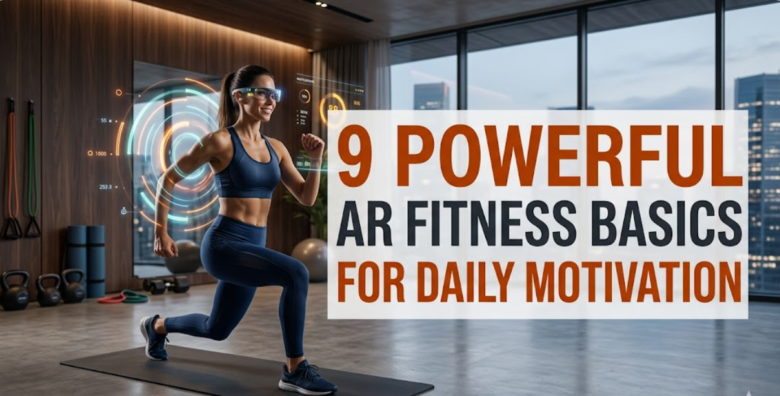
Augmented Reality (AR) is no longer just a gaming gimmick or futuristic experiment. It has quietly become one of the most practical ways to stay active, especially for people who struggle with consistency. Unlike traditional fitness apps that rely on static instructions or generic timers, AR fitness systems blend your real environment with interactive digital cues that respond to your movement in real time.
What makes this interesting is not just the technology itself, but how it subtly changes behavior. Instead of forcing motivation, AR tools create an environment where movement feels guided, structured, and even rewarding.
This article breaks down nine foundational AR fitness basics that are shaping how people stay active daily. These are not advanced “trainer secrets” or complicated systems—these are simple principles anyone can apply to build consistency, energy, and long-term fitness habits.
Understanding AR Fitness Motivation
Before diving into the basics, it helps to understand why AR changes motivation patterns.
Traditional fitness relies heavily on discipline:
- “You must start the workout”
- “You must stay consistent”
- “You must track progress manually”
AR fitness flips this structure by embedding motivation into the environment itself:
- Visual cues guide movement
- Real-time feedback reduces uncertainty
- Game-like elements reduce mental resistance
Motivation becomes less about effort and more about interaction.
Table: Motivation Shift in Fitness Models
| Factor | Traditional Fitness | AR Fitness Systems |
|---|---|---|
| Starting effort | High | Low |
| Engagement style | Passive | Interactive |
| Feedback timing | Delayed | Instant |
| Habit formation | Slow | Faster |
- Visual Cue Training for Daily Movement
One of the simplest AR fitness basics is visual cue training. Instead of reading instructions or following a timer, you follow moving shapes, arrows, or outlines placed in your real environment.
This works because the brain responds faster to visual signals than written instructions.
Example:
A floating circle appears at knee height → you squat to match it → it shifts upward → you adjust movement accordingly.
This continuous adaptation creates a natural flow state.
Benefits:
- Improves reaction speed
- Reduces confusion during workouts
- Builds rhythm and consistency
Chart: Effect of Visual Cue Training Over Time
| Week | Coordination Improvement |
|---|---|
| 1 | Low awareness |
| 2 | Basic adaptation |
| 3 | Noticeable fluidity |
| 4+ | Automatic response |
- AR Step-Based Progress Mapping
Step-based AR mapping turns your workout into a physical progression path. Instead of completing abstract sets, you “move through” stages in your space.
Your room becomes a mapped fitness route.
How it works:
- Floor markers guide movement
- Each zone represents a stage (warm-up, intensity, cooldown)
- Progress is visual, not just numerical
Why it boosts motivation:
People naturally respond to “progression paths.” Seeing movement forward reduces mental fatigue.
Table: Traditional vs AR Progress Tracking
| Feature | Traditional Tracking | AR Step Mapping |
|---|---|---|
| Progress view | Numbers | Spatial journey |
| Motivation | Moderate | High |
| Engagement | Low | High |
- Real-Time Posture Feedback Basics
Posture correction is one of the most valuable AR fitness basics. Using your phone or AR glasses, your body is tracked and compared to ideal movement alignment.
Instead of guessing if your form is correct, you see immediate correction signals.
Example:
If your back tilts during a deadlift motion, a red line appears showing deviation.
Benefits:
- Reduces injury risk
- Improves exercise effectiveness
- Builds long-term muscle memory
Chart: Posture Accuracy Improvement
| Sessions Completed | Accuracy Level |
|---|---|
| 1–3 | Low |
| 4–8 | Moderate |
| 9–15 | High |
| 15+ | Stable form |
- Gamified Repetition Systems
Repetition is essential in fitness, but it often becomes mentally boring. AR systems solve this by turning reps into interactive challenges.
Instead of “do 20 squats,” you might:
- Chase moving targets
- Fill virtual energy bars
- Unlock visual rewards
Why it works:
The brain treats completion as achievement, not repetition.
Benefits:
- Reduces workout boredom
- Increases consistency
- Improves endurance
Table: Motivation Comparison
| Workout Type | Mental Engagement |
|---|---|
| Standard reps | Low |
| AR gamified reps | High |
- Environmental Workout Layering
This AR basic transforms your physical space into a layered workout environment.
Walls, floors, and open space become interactive zones.
Example:
- Wall = push-up target zone
- Floor = movement markers
- Air space = reach and stretch cues
Why it matters:
It removes the need for gym equipment by redefining your surroundings.
Benefits:
- Makes small spaces effective
- Encourages full-body movement
- Enhances spatial awareness
Chart: Space Utilization Efficiency
| Environment Type | Efficiency Score |
|---|---|
| Traditional gym | High |
| Home (no AR) | Low |
| AR-enhanced home | Very high |
- Adaptive Intensity Scaling
One underrated AR fitness basic is adaptive intensity scaling. The system automatically adjusts difficulty based on your performance.
If you’re struggling:
- Movements slow down
- Targets get closer
If you’re performing well:
- Speed increases
- Range expands
This creates a personalized workout without manual programming.
Benefits:
- Prevents burnout
- Encourages progression
- Keeps workouts balanced
Table: Adaptive Scaling Behavior
| Performance Level | System Response |
|---|---|
| Low | Easier intensity |
| Moderate | Stable intensity |
| High | Increased challenge |
- AR Breathing Rhythm Guidance
Breathing is often ignored in workouts, but AR systems now visually guide breath timing.
Example:
- Expanding circle = inhale
- Contracting circle = exhale
This helps align breathing with movement naturally.
Benefits:
- Improves oxygen efficiency
- Reduces fatigue
- Enhances focus
Chart: Breathing Efficiency Impact
| Practice Duration | Control Level |
|---|---|
| 1 week | Basic control |
| 2–3 weeks | Improved flow |
| 4+ weeks | Automatic rhythm |
- Micro-Workout Trigger System
This AR basic focuses on short, frequent movement bursts instead of long sessions.
AR reminders appear in your environment prompting:
- 2-minute stretches
- 10 squats
- Quick mobility flows
Why it works:
Small actions reduce psychological resistance.
Benefits:
- Builds consistency
- Improves daily activity levels
- Reduces sedentary behavior
Table: Long vs Micro Workouts
| Factor | Long Workout | Micro AR Workout |
|---|---|---|
| Duration | High | Low |
| Consistency | Variable | High |
| Fatigue | Higher | Lower |
- AR Reward Visualization System
The final basic is reward visualization. Instead of abstract progress tracking, AR shows your progress as evolving visuals in your environment.
Example:
- Completed workouts grow a virtual tree
- Progress fills a glowing structure
- Streaks appear as expanding patterns
Why it matters:
Humans respond strongly to visible progress.
Benefits:
- Reinforces habit loops
- Increases satisfaction
- Encourages long-term consistency
Chart: Motivation Retention Over Time
| Week | Without AR Rewards | With AR Rewards |
|---|---|---|
| 1 | High | Very high |
| 2 | Medium | High |
| 3 | Low | Medium-high |
| 4+ | Low | Stable |
How These AR Basics Work Together
Individually, each AR fitness basic improves one aspect of training. But combined, they create a full motivational ecosystem.
Together they provide:
- Structure (mapping + cues)
- Feedback (posture + intensity)
- Engagement (gamification + rewards)
- Consistency (micro-workouts + breathing)
This is what transforms fitness from effort-based discipline into an interactive daily system.
Weekly AR Fitness Integration Example
| Day | Focus Area | AR Basic Used |
|---|---|---|
| Monday | Strength | Posture + adaptive scaling |
| Tuesday | Cardio | Gamified reps |
| Wednesday | Recovery | Breathing guidance |
| Thursday | Full body | Environmental layering |
| Friday | Core + balance | Visual cue training |
| Saturday | Light activity | Micro-workouts |
| Sunday | Reflection + stretch | Reward visualization |
Common Mistakes with AR Fitness Tools
Even simple AR systems can be misused.
Mistakes:
- Overloading with too many AR features at once
- Ignoring real physical fatigue signals
- Treating AR as a game only
- Skipping recovery guidance
Solution:
Use AR as a guide, not a replacement for body awareness.
Conclusion
AR fitness basics are not about replacing traditional exercise—they are about reshaping how consistency is built. By combining visual feedback, spatial awareness, and interactive motivation, these systems make daily movement feel less like a task and more like a guided experience.
The real advantage is not technology itself, but behavior change. When the environment starts encouraging movement naturally, motivation becomes less fragile and more automatic.
FAQs
- Do I need special equipment for AR fitness basics?
Not necessarily. Many AR fitness tools work on smartphones or tablets, without requiring advanced hardware. - Are AR fitness systems good for beginners?
Yes. Beginners often benefit the most because AR provides visual guidance and reduces confusion. - Can AR fitness replace gym workouts?
It can complement gym workouts, but it may not fully replace heavy resistance training for advanced goals. - How often should I use AR fitness tools?
Daily short sessions work best, especially when using micro-workouts and visual cues. - Is AR fitness effective for weight loss?
Yes, indirectly. It improves consistency, movement frequency, and workout engagement, which support weight loss. - What is the biggest benefit of AR fitness basics?
The biggest benefit is habit formation—AR makes consistency easier by reducing mental resistance to starting workouts.