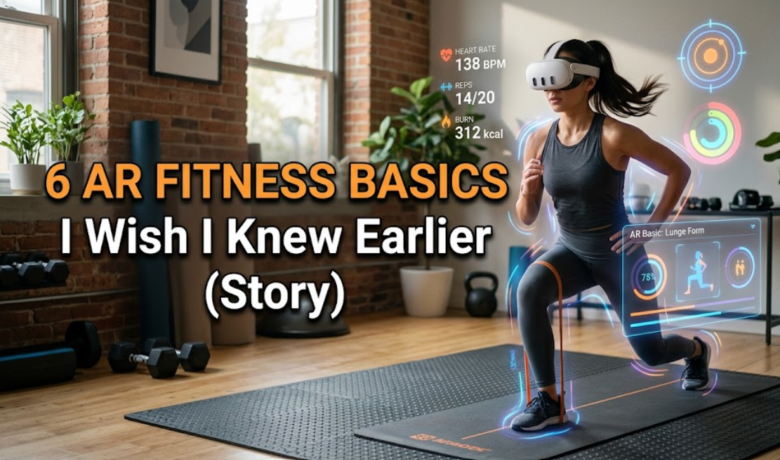
There’s a strange thing that happens when you first get into AR fitness. You assume it’s going to be complicated—something futuristic, maybe even overwhelming. Headsets, sensors, calibration issues, technical setup. At least that’s what I thought before I actually tried it consistently.
The reality was different. The tech wasn’t the hard part. The hard part was understanding how to actually use it in a way that sticks.
This isn’t a guide written from a distance. It’s more like a collection of things I wish someone had told me before I wasted weeks overthinking instead of training properly.
These are the 6 AR fitness basics I wish I knew earlier—learned through trial, error, missed streaks, and eventually, consistency.
why AR fitness felt harder than it should have been at first
At the beginning, AR fitness felt like a novelty. Something fun, but not serious. I treated it like a game instead of a system.
That was mistake number one.
The second mistake was thinking the technology would “automatically” fix my motivation. It didn’t. What it did was amplify whatever habits I already had—good or bad.
To make it clearer, here’s what I expected versus what actually happened:
Table 1: Expectations vs Reality of AR Fitness
| Expectation | Reality |
|---|---|
| AR will motivate me automatically | Motivation still fluctuates |
| Workouts will feel effortless | Some still feel hard |
| Tech replaces discipline | Discipline still required |
| Consistency comes from novelty | Consistency comes from structure |
Once I understood this gap, everything started to change.
basic 1: starting too complex kills consistency
The first AR fitness app I tried had everything—advanced tracking, multiple modes, customization, leaderboards. I spent more time exploring settings than actually working out.
That was the problem.
Complexity creates hesitation. And hesitation kills consistency faster than lack of motivation ever will.
What worked instead was deliberately simplifying everything:
- One workout type only
- One time of day
- One environment (same room)
- One goal (just showing up)
Table 2: Complexity Impact on Habit Formation
| Setup Type | Start Difficulty | Consistency Rate |
| Multi-mode AR setup | High | Low |
| Single-mode focus | Low | High |
The lesson was simple: AR fitness works best when it removes decisions, not adds them.
basic 2: your environment matters more than the app
I used to think the app was the main factor. But AR fitness depends heavily on physical space.
If your environment is cluttered, distracting, or inconsistent, your workouts feel the same way.
Once I cleaned a small corner of my room and dedicated it as a “movement space,” everything changed.
Not because the app improved, but because my brain associated that space with action.
Table 3: Environment Setup Impact
| Environment | Workout Quality | Mental Resistance |
| Random living space | Inconsistent | High |
| Dedicated workout zone | Stable | Low |
Even something as simple as lighting made a difference. Brighter space = more energy. Dim space = more hesitation.
basic 3: short sessions beat long intentions
I used to plan 45-minute AR workouts and end up skipping them entirely.
Then I accidentally discovered something: I was more consistent with 10-minute sessions than 45-minute plans.
Not because shorter workouts are better—but because they are easier to start.
And starting is the real challenge.
Table 4: Session Length vs Completion Rate
| Planned Duration | Completion Rate |
| 45 minutes | Low |
| 20 minutes | Medium |
| 10 minutes | High |
Once I stopped aiming for “perfect workouts” and started aiming for “daily movement,” everything became easier.
basic 4: AR feedback only works if you pay attention to it
One of the biggest advantages of AR fitness is real-time feedback—form correction, movement tracking, visual cues.
But I ignored it at first.
I treated AR like a background visual instead of an active coach.
That’s a mistake many beginners make.
Once I started actually responding to feedback—adjusting posture, correcting movement, slowing down when needed—the results improved quickly.
Table 5: Feedback Utilization Impact
| Usage Level | Injury Risk | Progress Rate |
| Ignored feedback | High | Slow |
| Partial attention | Medium | Moderate |
| Active correction | Low | Fast |
AR fitness is not passive entertainment. It’s interactive correction.
basic 5: gamification only works when you care about streaks
At first, I didn’t care about streaks, badges, or points. They felt meaningless.
But then I missed a few days and noticed something interesting—I started overthinking skipping again.
That’s when I understood: gamification isn’t about rewards. It’s about identity.
Once you see yourself as “someone who doesn’t break streaks,” behavior shifts.
Table 6: Gamification Psychology Effect
| Element | Surface Effect | Real Effect |
| Points | Motivation | Habit reinforcement |
| Badges | Rewards | Identity building |
| Streaks | Tracking | Behavioral pressure |
The key is not chasing rewards—it’s protecting momentum.
basic 6: consistency beats intensity every time
This was the hardest lesson to accept.
I used to believe harder workouts meant better results. So I pushed intensity, got tired, and took breaks.
AR fitness taught me something different: moderate daily movement beats occasional intense sessions.
Table 7: Consistency vs Intensity Outcomes
| Approach | Short-Term Result | Long-Term Result |
| High intensity bursts | Fast fatigue | Drop-off risk |
| Daily moderate AR workouts | Steady progress | Sustainable fitness |
Once I shifted mindset, I stopped trying to “win workouts” and started trying to “repeat workouts.”
That changed everything.
how my weekly AR routine eventually stabilized
After months of trial and error, I stopped switching apps constantly and built a simple structure.
Table 8: My Stable AR Routine
| Day | Activity Type | Duration |
| Monday | Cardio AR session | 15 min |
| Tuesday | Strength AR training | 20 min |
| Wednesday | Light movement game | 10 min |
| Thursday | Guided AR workout | 20 min |
| Friday | Mixed session | 25 min |
| Saturday | Fun AR activity | 15 min |
| Sunday | Rest or walk | – |
The structure wasn’t perfect—but it was repeatable. That was the goal.
common mistakes I kept repeating before it clicked
- Treating AR fitness like a game instead of training system
- Overcomplicating workout setups
- Ignoring recovery days
- Switching apps too frequently
- Chasing motivation instead of structure
Each mistake slowed progress more than lack of fitness ever did.
what actually made AR fitness work long-term
It wasn’t the technology.
It was the simplicity.
AR fitness works best when it removes friction, not when it adds excitement.
Once I stopped trying to optimize everything and focused on showing up daily—even for short sessions—the results became predictable.
faqs
- are AR fitness apps enough for staying in shape? Yes, for general fitness and consistency, AR fitness apps can be enough if used regularly.
- how long should beginners use AR fitness apps daily? Start with 10–15 minutes daily to build habit before increasing intensity.
- do I need expensive equipment for AR fitness? No, most AR fitness apps work with just a smartphone.
- why do people stop using AR fitness apps? Usually because they overcomplicate routines or expect instant motivation.
- is AR fitness better than gym workouts? It depends on goals. AR fitness is better for consistency; gyms are better for heavy strength training.
- what is the most important AR fitness habit? Consistency. Not intensity, not duration—just showing up daily.