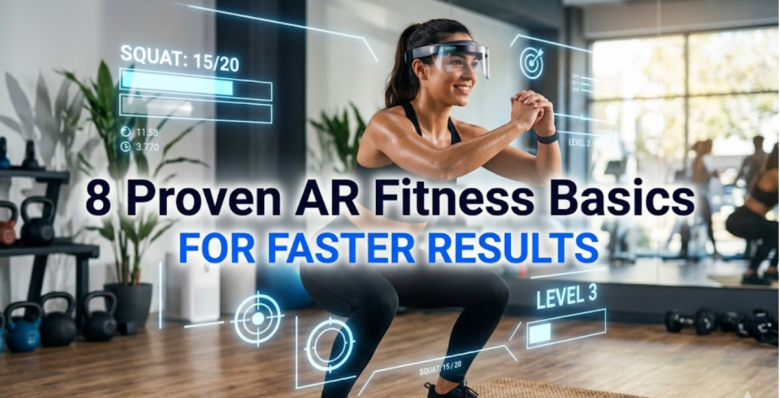
Augmented reality fitness is quietly changing how people train at home, in gyms, and even outdoors. Instead of following flat videos or guessing your form in a mirror, AR fitness places digital guidance directly into your real environment. That means your workout space becomes interactive, responsive, and surprisingly intuitive.
But here’s something most beginners miss: AR fitness only works well if you understand the basics behind it. The technology is powerful, but results depend on how you use it.
This guide breaks down 8 proven AR fitness basics that help you get faster, safer, and more consistent results. These are not advanced tricks or complicated systems—they are practical foundations anyone can follow, even with a smartphone.
why AR fitness actually speeds up results
Before going into the basics, it’s worth understanding why AR fitness works faster than traditional home workouts.
At its core, AR fitness improves three key areas:
- form accuracy
- consistency
- engagement
When those three improve, results naturally come faster.
Table: traditional fitness vs AR fitness outcomes
| Factor | Traditional Home Workouts | AR Fitness Workouts |
|---|---|---|
| Learning speed | Slow | Fast |
| Form correction | Delayed or none | Real-time |
| Motivation | Often drops | More stable |
| Injury risk | Moderate | Lower |
| Progress tracking | Manual | Automated |
The biggest advantage is feedback. Instead of wondering if you’re doing an exercise correctly, AR systems show you instantly.
- master real-time form correction first
The most important AR fitness basic is learning to trust real-time correction.
Most AR fitness systems use your phone camera or headset to track movement. They then overlay visual cues like:
- body alignment lines
- angle indicators
- posture highlights
- movement corrections
For example, during a squat, you might see:
- knees highlighted in red if they cave inward
- a virtual spine line showing posture
- depth markers for proper squat range
Why this matters:
If your form is wrong, AR will correct it immediately instead of letting you build bad habits.
Beginner rule:
Do not increase intensity until your form feedback is consistently green or “correct.”
- start with low-complexity AR workouts
A common mistake beginners make is jumping into advanced AR training modes too early.
AR workouts come in different complexity levels:
Table: AR workout difficulty levels
| Level | Description | Example |
|---|---|---|
| Beginner | Basic movement guidance | Squats, walking, stretching |
| Intermediate | Combined movements | HIIT circuits, dance workouts |
| Advanced | Fast transitions + resistance | Boxing combos, agility drills |
Why starting simple matters:
Your brain needs time to adjust to processing visual overlays while moving.
Best starting point:
Bodyweight exercises with slow pacing and clear instructions.
- treat AR feedback as a coach, not decoration
One of the biggest mindset shifts in AR fitness is understanding that overlays are not just visuals—they are instructions.
Many beginners ignore feedback icons because they assume they are optional.
They are not.
Common AR feedback signals:
- green = correct form
- yellow = adjust slightly
- red = incorrect movement
If you ignore these signals, you lose most of AR’s benefits.
Simple rule:
Always fix red signals before continuing reps.
- keep your environment AR-ready
AR fitness depends heavily on your surroundings. Unlike gym machines, AR systems rely on clear physical space and visible tracking points.
Ideal setup includes:
- good lighting
- plain background if possible
- stable camera angle
- minimal moving objects
Table: ideal home AR workout space setup
| Factor | Ideal Condition | Why It Matters |
|---|---|---|
| Lighting | Bright, even | Improves motion tracking |
| Floor space | 6–10 feet clear | Allows full movement |
| Camera angle | Eye-level | Accurate body detection |
| Background | Simple | Reduces tracking errors |
If your environment is messy or poorly lit, AR systems may misread your movements.
- focus on consistency over intensity
AR fitness makes workouts more engaging, which often leads beginners to overdo it.
But faster results come from repetition, not exhaustion.
Recommended beginner structure:
Table: weekly AR fitness consistency plan
| Day | Activity Type | Duration |
|---|---|---|
| Monday | Light full-body AR workout | 20–30 min |
| Tuesday | Mobility / stretching | 15–20 min |
| Wednesday | Strength basics | 25–30 min |
| Thursday | Rest or light AR walk | 15 min |
| Friday | Cardio AR session | 20–30 min |
| Saturday | Mixed AR workout | 25–35 min |
| Sunday | Recovery session | 10–20 min |
Why this works:
AR keeps you engaged, but your body still needs recovery time to grow stronger.
- use gamification to build consistency
AR fitness often includes game-like features such as:
- scoring systems
- missions or challenges
- streak tracking
- virtual rewards
These are not just entertainment—they are behavioral tools.
Why gamification works:
Your brain responds strongly to progress markers, even small ones.
Example AR gamified loop:
- complete workout → earn points
- maintain streak → unlock new level
- improve form → increase score multiplier
Over time, this builds habit without relying on motivation alone.
- combine AR fitness with wearable tracking
AR becomes significantly more powerful when paired with wearables like fitness bands or smartwatches.
Wearables track:
- heart rate
- calories burned
- movement intensity
- recovery time
When synced with AR apps, you get a full performance picture.
Table: AR + wearable integration benefits
| Metric | AR Alone | AR + Wearable |
|---|---|---|
| Form tracking | High | High |
| Heart rate data | None | Accurate |
| Calorie tracking | Estimated | Precise |
| Recovery insight | Low | High |
Beginner takeaway:
Use wearables to avoid overtraining and undertraining at the same time.
- review performance data weekly, not daily
Many beginners make the mistake of checking progress after every workout. AR systems often provide detailed analytics, but too much focus on daily fluctuations can be misleading.
Instead, focus on weekly trends.
Key metrics to review:
- consistency score
- average form accuracy
- workout completion rate
- intensity progression
Table: ideal review frequency
| Metric Type | How Often to Check |
|---|---|
| Daily performance | During workout only |
| Form corrections | Immediate |
| Weekly progress | Every 7 days |
| Monthly progress | Full review |
Why this works:
Fitness improvements are gradual, not instant.
how these 8 basics work together
Each of these basics supports the others:
- form correction improves safety
- environment setup improves tracking accuracy
- consistency builds results
- gamification keeps motivation stable
- wearable data improves decision-making
When combined, they create a system instead of random workouts.
sample AR beginner progression plan
Here’s how a beginner might apply all 8 basics over 4 weeks:
Table: 4-week AR fitness progression
| Week | Focus | Goal |
|---|---|---|
| Week 1 | Form learning | Understand movements |
| Week 2 | Consistency | 4–5 sessions completed |
| Week 3 | Intensity increase | Slightly harder workouts |
| Week 4 | Performance tracking | Review progress data |
This gradual approach reduces injury risk and improves long-term success.
common mistakes beginners should avoid
Even with AR tools, mistakes happen:
- ignoring correction signals
- training in poor lighting
- skipping rest days
- focusing only on calories burned
- switching workouts too often
Fixing these alone can significantly improve results.
future of AR fitness basics
As AR technology evolves, these basics will become even more important:
- AI-driven personalized corrections
- fully immersive home gyms
- adaptive workout environments
- real-time injury prevention systems
The fundamentals, however, will remain the same: form, consistency, feedback, and recovery.
FAQs
- do I need expensive equipment for AR fitness basics
No, most AR fitness systems work with a smartphone and enough space to move. - how quickly can I see results with AR fitness
Most beginners notice improved consistency and form within 2–4 weeks. - is AR fitness suitable for beginners with no experience
Yes, it is actually one of the easiest ways to start because it provides real-time guidance. - can AR fitness replace a gym completely
For general fitness, yes. For advanced bodybuilding, it may still be complementary. - what is the most important AR fitness basic
Real-time form correction is the foundation of all results. - do AR workouts burn more calories
They don’t inherently burn more calories, but they improve consistency, which leads to better long-term results.