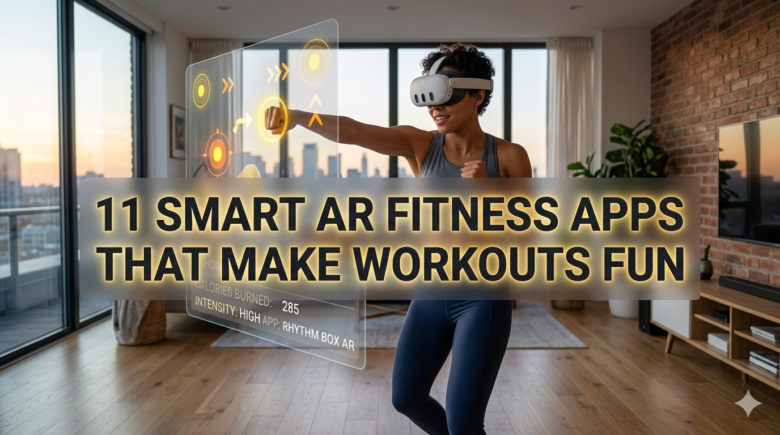
Fitness has always had one major problem: consistency. Most people don’t quit because they don’t know what to do—they quit because it feels repetitive, isolating, or boring. That’s exactly where augmented reality (AR) fitness apps are changing the game.
Instead of staring at a flat screen or following static instructions, AR fitness apps turn your real environment into an interactive workout space. Virtual trainers appear in your living room, game-like challenges push you to move more, and real-time feedback helps correct your form instantly. Research shows that AR-based exercise platforms significantly increase user engagement because they combine cognitive focus, emotional motivation, and physical movement into one loop of interaction .
Below are 11 smart AR fitness apps that are making home workouts more engaging, more interactive, and surprisingly more fun.
- Active Arcade
Active Arcade transforms your body into the controller. Instead of pressing buttons, you move, jump, and dodge to play mini fitness games.
It uses your phone camera to track movement and turns exercise into arcade-style challenges. Games like reaction drills and jumping targets make cardio feel less like training and more like play.
Informational Table: Active Arcade Overview
| Feature | Description | Benefit |
|---|---|---|
| Motion tracking | Full-body camera detection | No equipment needed |
| Mini-games | Reflex + cardio challenges | Improves endurance |
| Multiplayer mode | Compete with friends | Social motivation |
This app is especially useful for people who struggle with traditional cardio routines.
- Pokémon GO (Fitness Mode)
While not originally a fitness app, Pokémon GO became one of the earliest mainstream AR movement tools. Walking in real environments is required to progress in the game.
It blends exploration with light exercise, encouraging users to walk longer distances than they normally would.
Chart: Motivation Comparison
| Activity Type | Motivation Level |
|---|---|
| Walking without app | Low |
| Step tracking apps | Medium |
| Pokémon GO AR gameplay | High |
Its success proved that gamification is one of the strongest drivers of physical activity.
- FitXR
FitXR brings boxing, dance, and HIIT workouts into a virtual AR-style studio environment.
Instead of following boring reps, you punch targets or follow choreographed movement patterns with immersive visual feedback.
Informational Table: FitXR Features
| Workout Type | Experience Style | Intensity |
|---|---|---|
| Boxing | Target striking | High |
| Dance | Rhythm-based movement | Medium |
| HIIT | Timed challenges | High |
It feels like a fitness class without the physical gym.
- Zombies, Run!
This app turns running into a survival story. You are placed in a zombie apocalypse and must run in real life to complete missions.
Audio storytelling and AR-style immersion make it feel like you are part of a game narrative.
Chart: Running Engagement
| Format | Engagement |
|---|---|
| Normal running | Low |
| Music-based running | Medium |
| Zombies, Run! | Very High |
It’s especially popular among beginners who struggle with running motivation.
- Nike Training Club (AR-enhanced sessions)
Nike Training Club has integrated more interactive elements over time, including guided movement overlays and adaptive training.
While not fully AR-based in all features, its visual coaching and real-time guidance make it feel closer to an AR-assisted experience.
Informational Table
| Feature | Value |
|---|---|
| Guided workouts | Structured training plans |
| Adaptive difficulty | Beginner to advanced |
| Visual coaching | Better form understanding |
It remains one of the most accessible premium fitness ecosystems.
- Fit Reality
Fit Reality focuses on AR-based resistance training using minimal equipment.
It overlays instructions and form corrections in real time while you perform strength exercises.
Chart: Strength Training Comparison
| Method | Feedback Type |
|---|---|
| YouTube workouts | Delayed visual |
| Personal trainer | Live correction |
| Fit Reality AR | Instant digital correction |
This real-time correction helps reduce injury risk and improve technique consistency.
- Holofit
Holofit transforms cardio machines like bikes and rowers into virtual environments.
Instead of staring at a wall, you cycle through cities, oceans, or fantasy landscapes.
Informational Table
| Feature | Description |
|---|---|
| Virtual environments | Immersive cardio worlds |
| Machine integration | Works with existing equipment |
| Performance tracking | Calories + speed metrics |
It is particularly effective for long cardio sessions that usually feel monotonous.
- JAXJOX Interactive Studio
JAXJOX offers connected fitness equipment with AR-style feedback.
It tracks weights, reps, and performance in real time and displays results visually.
Chart: Smart Training Feedback
| Feature | Traditional Gym | JAXJOX System |
|---|---|---|
| Rep tracking | Manual | Automatic |
| Progress tracking | Notebook/app | Digital dashboard |
| Feedback speed | Delayed | Instant |
This creates a more structured and data-driven workout environment.
- Gymnotize
Gymnotize uses AR avatars that demonstrate exercises in your real space.
You can see exactly how movements should look from different angles.
Informational Table
| Feature | Benefit |
|---|---|
| 3D avatars | Visual clarity |
| Exercise library | Wide variety |
| Real-time guidance | Better form |
It’s especially useful for beginners learning proper technique.
- Supernatural
Meta Supernatural is a VR/AR hybrid fitness platform offering full-body workouts in immersive environments.
It combines music, movement, and visual coaching in scenic virtual locations.
Chart: Engagement Level
| Workout Type | Engagement |
|---|---|
| Home workout video | Medium |
| Gym session | Medium-high |
| Supernatural AR/VR | Very high |
It turns exercise into a guided immersive experience.
- Kayyo
Kayyo focuses on martial arts training using AR feedback.
It tracks punches, kicks, and stance positioning while guiding users through structured fighting drills.
Informational Table
| Feature | Benefit |
|---|---|
| AI movement tracking | Technique correction |
| MMA training modes | Boxing, kickboxing, MMA |
| Punch analysis | Speed + accuracy feedback |
It effectively turns any room into a virtual dojo.
How AR Fitness Apps Change Home Workouts
AR fitness apps are not just entertainment tools—they change behavior. The key difference is engagement. Instead of passively following instructions, users actively interact with digital elements layered into their physical environment.
Studies show AR-based exercise systems significantly increase cognitive and emotional engagement, leading to longer workout sessions and better consistency .
Key improvements include:
- Higher motivation through gamification
- Real-time correction of movement
- Personalized workout adaptation
- Stronger habit formation
Chart: Traditional vs AR Fitness Experience
| Factor | Traditional Apps | AR Fitness Apps |
|---|---|---|
| Engagement | Medium | High |
| Feedback | Delayed | Instant |
| Motivation | Low-medium | High |
| Fun factor | Low | Very high |
Challenges of AR Fitness Apps
Despite their advantages, AR fitness apps also face limitations:
- Some require strong internet or hardware
- Battery usage can be high
- Not all workouts are fully AR-integrated yet
- Subscription costs for premium platforms
However, as hardware improves, these barriers are gradually decreasing.
Future of AR Fitness
The next stage of AR fitness will likely include:
- Smart glasses replacing phone screens
- Full-body motion capture without cameras
- AI coaches that adapt in real time
- Shared virtual workout spaces
AR fitness is moving toward fully immersive, always-connected training ecosystems.
FAQs
- What are AR fitness apps?
AR fitness apps use augmented reality to overlay digital workout guidance, games, or trainers onto real-world environments. - Do I need special equipment for AR fitness apps?
Most apps only require a smartphone, though some advanced platforms use VR headsets or smart equipment. - Are AR fitness apps effective for weight loss?
Yes, because they improve engagement and consistency, which are key factors in long-term fitness success. - Can beginners use AR fitness apps?
Absolutely. Many AR apps are designed specifically to guide beginners with real-time instructions. - Do AR fitness apps replace gyms?
Not completely, but they offer a strong alternative for home workouts and convenience-based training. - Are AR fitness apps safe?
Yes, as long as users maintain proper space awareness and follow guided form corrections.