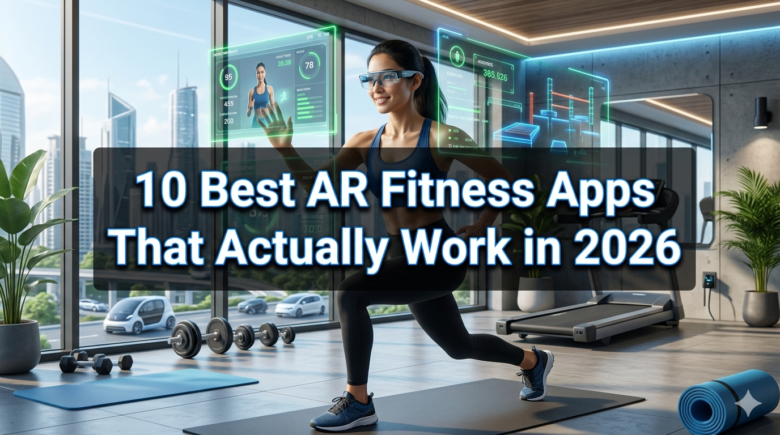
The idea of exercising alongside digital objects floating in your living room used to sound like science fiction. In 2026, it’s just… Tuesday. Augmented reality (AR) has quietly reshaped how people train, making workouts more interactive, measurable, and—most importantly—less boring.
Instead of staring at a timer or following a flat video, AR fitness apps overlay guidance, challenges, and feedback directly into your environment. Think virtual trainers correcting your posture, animated targets pushing you to move faster, or even zombies chasing you during a run.
The global AR ecosystem is massive now, with billions of devices capable of running AR experiences and adoption rising rapidly across industries, including fitness . But here’s the problem: not every app that claims to be “AR fitness” actually delivers results.
So instead of listing hype-driven apps, this guide focuses on AR fitness apps that people actually use consistently—and that genuinely improve fitness outcomes.
what makes an AR fitness app actually work
Before diving into the list, it’s worth understanding why some AR fitness apps succeed while others get deleted after two workouts.
The best-performing AR fitness apps in 2026 typically share these traits:
- real-time feedback using camera or motion tracking
- gamification that increases adherence (not distraction)
- progressive difficulty or adaptive AI coaching
- integration with wearables or health data
- short, repeatable workouts that fit daily routines
In short: they don’t just look cool—they make you move more, and move better.
quick comparison table
| App | Best For | AR Type | Skill Level | Platform |
|---|---|---|---|---|
| Zombies, Run! | Cardio motivation | Audio + AR storytelling | Beginner | iOS / Android |
| Active Arcade | Full-body movement | Camera tracking AR | Beginner | iOS |
| Kayyo | Combat training | AI + AR form tracking | Intermediate | iOS / Android |
| Pokémon GO | Casual activity | Location-based AR | Beginner | iOS / Android |
| AR Runner | Sprint training | Real-time AR targets | Intermediate | Android |
| Ghost Pacer | Running competition | AR racing overlay | Intermediate | iOS |
| Fitness AR | Outdoor tracking | Visual route AR | Beginner | iOS |
| AR Fitclub | Home workouts | Trainer overlay AR | Beginner | iOS / Android |
| Wokamon | Walking motivation | Gamified AR pet | Beginner | iOS / Android |
| Just Dance Now (AR mode) | Cardio fun | Camera-assisted AR | Beginner | iOS / Android |
- Zombies, Run! — the storytelling cardio revolution
This app turns your jog into a survival mission. You’re not just running—you’re escaping a zombie outbreak, collecting supplies, and progressing through a narrative.
Why it works:
- psychological immersion increases workout duration
- unpredictable chases boost intensity
- long-term story keeps users coming back
It blends light AR concepts with audio immersion, which is often more effective than visual AR for outdoor use.
- Active Arcade — your body becomes the controller
Active Arcade is one of the purest AR fitness experiences. Using your phone camera, it tracks your entire body and turns workouts into games.
You’ll be dodging objects, hitting virtual targets, and performing cardio drills—all without equipment.
Key strengths:
- instant accessibility (no wearables needed)
- great for families and beginners
- strong calorie-burning potential
Research-backed observation: full-body motion tracking significantly increases engagement compared to static workouts.
- Kayyo — AI-powered AR combat trainer
If you’ve ever wanted a personal MMA coach without paying gym fees, Kayyo delivers a surprisingly advanced experience.
The app uses AR and AI to:
- track your punches and movements
- give real-time corrections
- simulate combat drills
It supports boxing, kickboxing, wrestling, and more, offering structured training plans with difficulty scaling .
- Pokémon GO — still one of the most effective fitness apps
It may not look like a fitness app at first glance, but it quietly gets millions of people walking daily.
Why it still works in 2026:
- location-based AR encourages real-world exploration
- reward loops (catching Pokémon) drive consistency
- social features increase accountability
It remains one of the most successful AR behavior-change tools ever built .
- AR Runner — sprint training reimagined
AR Runner overlays checkpoints and targets into your environment, turning sprints into interactive challenges.
Best use cases:
- interval training
- speed development
- outdoor agility drills
Unlike traditional running apps, it focuses on performance bursts rather than distance tracking.
- Ghost Pacer — race your virtual self
Imagine running against your previous best time—or a competitor—visualized as a moving AR target.
That’s Ghost Pacer.
Why it’s powerful:
- immediate pacing feedback
- competitive motivation
- measurable progress
This taps into one of the strongest psychological motivators in fitness: racing.
- Fitness AR — visualizing your workouts
Fitness AR enhances your running or cycling routes by overlaying metrics like pace, distance, and elevation directly into your field of view.
Benefits:
- improved spatial awareness
- better pacing decisions
- reduced need to check your phone
It blends data and environment seamlessly.
- AR Fitclub — bringing the trainer into your room
This app projects a virtual trainer into your space, guiding you through workouts as if someone were physically present.
Key features:
- posture correction
- guided routines
- adaptive difficulty
It’s especially useful for home workouts where motivation tends to drop.
- Wokamon — fitness meets virtual pets
This app rewards your movement by growing a digital creature.
Simple concept, surprisingly effective:
- more steps = stronger pet
- inactivity slows progress
- emotional attachment boosts consistency
Gamification like this is particularly effective for beginners.
- Just Dance Now (AR mode) — fitness disguised as fun
Dance-based AR workouts are underrated. They combine cardio, coordination, and entertainment.
Why it works:
- high calorie burn
- low perceived effort
- social play
For many users, it doesn’t feel like exercise—which is exactly why they stick with it.
engagement vs results chart
Below is a simplified comparison of how different AR fitness approaches impact engagement and physical results:
| App Type | Engagement Level | Fitness Impact |
|---|---|---|
| Story-driven (Zombies Run) | Very High | Moderate–High |
| Gamified (Wokamon) | High | Moderate |
| Competitive (Ghost Pacer) | High | High |
| Trainer-based (Kayyo, AR Fitclub) | Medium | Very High |
| Casual (Pokémon GO) | Very High | Moderate |
Insight: Apps with higher engagement often lead to better long-term adherence—even if intensity is lower.
how AR fitness is changing workouts in 2026
AR fitness isn’t just a gimmick anymore. It’s solving real problems:
- boredom
Traditional workouts fail because they’re repetitive. AR introduces variety and unpredictability. - lack of feedback
Many people quit because they don’t know if they’re doing exercises correctly. AR fixes that with real-time correction. - motivation
Gamification, storytelling, and competition increase consistency—arguably the most important factor in fitness. - accessibility
No gym? No problem. AR turns your living room into a training space.
limitations you should know
Despite the hype, AR fitness still has some drawbacks:
- battery drain on smartphones
- limited accuracy compared to professional equipment
- dependency on lighting and space
- not all apps are truly “AR” (some are just gamified fitness)
That said, the gap is closing quickly as AI and computer vision improve.
future trends in AR fitness
Looking ahead, here’s where things are going:
- full-body tracking without wearables
- mixed reality workouts using AR glasses
- AI coaches that adapt in real time
- multiplayer AR fitness experiences
The line between gaming and fitness will continue to blur.
practical tips to choose the right AR fitness app
If you’re deciding where to start:
- choose gamified apps if you struggle with motivation
- choose AI trainer apps if you want real progress
- choose outdoor AR apps if you enjoy running or walking
- avoid apps that rely only on novelty without progression
Consistency beats intensity. Always.
FAQs
- Are AR fitness apps actually effective?
Yes, especially for consistency. They increase engagement, which leads to more frequent workouts—one of the biggest predictors of fitness success. - Do AR fitness apps require special equipment?
Most work with just a smartphone. Some advanced features may integrate with wearables, but they’re optional. - Are AR workouts better than traditional workouts?
Not inherently better—but often easier to stick with, which makes them more effective over time. - Can beginners use AR fitness apps?
Absolutely. Many apps are designed specifically for beginners with guided instructions and adaptive difficulty. - Do AR fitness apps burn real calories?
Yes. Many involve full-body movement, cardio, or strength exercises comparable to traditional workouts. - What is the biggest advantage of AR fitness?
Engagement. When workouts feel like games or experiences, people are far more likely to stay consistent.
final thoughts
AR fitness apps in 2026 aren’t just flashy tech—they’re practical tools for building sustainable fitness habits. The best ones don’t try to replace exercise; they enhance it.
If there’s one takeaway here, it’s this: the most effective workout isn’t the most intense one—it’s the one you actually keep doing.
And AR, more than anything else right now, makes that easier.