So here’s what happened. A few months back I completely gave up on my home workout routine — again. I had the mat, the resistance bands, the YouTube playlist pinned. But the moment I stepped into my living room and stared at the blank wall, I just… didn’t want to do it. It felt like talking to myself in an empty room.
Then a friend showed me what she was doing. She strapped on her phone holder, launched an AR fitness app, and suddenly her living room had glowing targets bouncing off the walls that she had to punch, dodge, and reach for. She was sweating in four minutes and laughing the whole time.
I was skeptical. But I tried it. And honestly? I haven’t skipped a session in eight weeks.
That’s not a sales pitch — it’s just what happened. Augmented reality fitness is doing something the $40 gym membership and the motivational poster never could: it makes exercise feel worth showing up for. Here’s a breakdown of the 9 AR fitness apps and tools that are genuinely changing the home workout game right now.
1. Supernatural (Meta Quest) — The One That Started It All

If you’ve heard anyone raving about AR/VR fitness, there’s a 90% chance they were talking about Supernatural. It runs on Meta Quest headsets and places you inside real-world landscapes — Patagonia, Iceland, ancient temples — where you swing glowing clubs at incoming targets to the beat of real music.
It’s not “gamified fitness.” It’s genuinely athletic. Your arms, core, and legs all engage. The coaches are real trainers who show up on screen beside you. And the music licensing is premium — you’re working out to actual chart hits, not generic beat loops.
The catch? You need a Meta Quest headset, which runs around $299–$499. That’s the barrier to entry. But if you already own one (or are on the fence about buying), Supernatural alone justifies the purchase.
Best for: People who love music, want coach-led sessions, and don’t mind investing in hardware.
2. FitXR — Boxing and Dance That Actually Pushes You
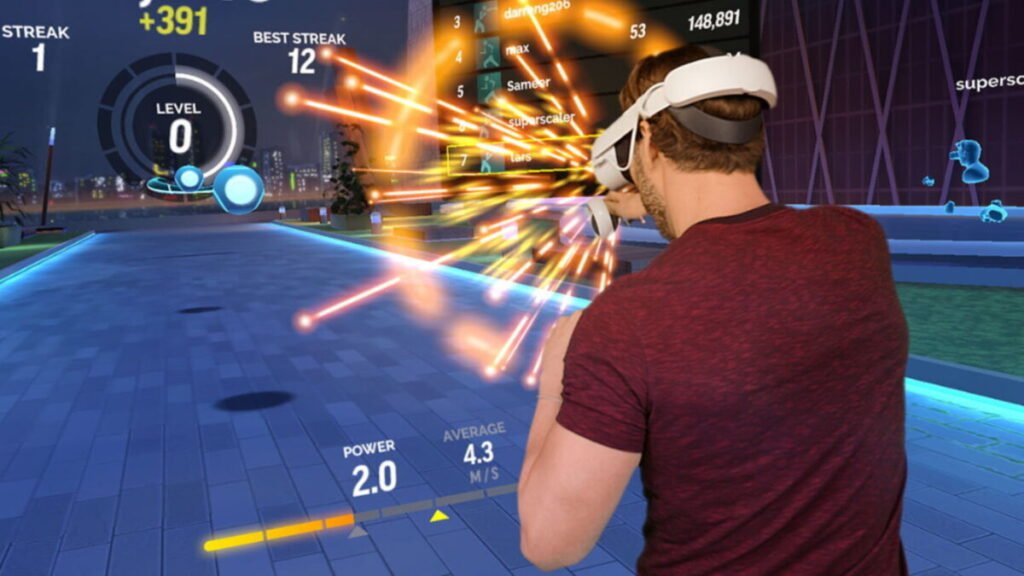
FitXR started as BoxVR and evolved into something more versatile. It’s available on Meta Quest and PlayStation VR2 and offers boxing, dance, HIIT, and sculpt classes — all in AR/VR environments.
What I appreciate about FitXR is the difficulty curve. It’s not just “dodge the orb.” The boxing classes are genuinely technique-focused, and the cardio sessions build progressively. There’s also a social element — you can work out alongside friends or other members as avatars in the same space.
For people transitioning from gym classes to home workouts, FitXR scratches that “group energy” itch without the commute.
3. Holofit — Rowing, Cycling, and Cardio in Virtual Worlds
Holofit is interesting because it connects to real fitness equipment — rowing machines, stationary bikes, ellipticals — and overlays augmented environments on top of your actual workout. You’re rowing in the Amazon, cycling through a neon city, running through outer space.
If you already own cardio equipment and find it soul-crushingly boring, Holofit is a direct fix. It works with most popular fitness equipment brands via Bluetooth and is compatible with several VR headsets.
It’s one of those tools that doesn’t replace what you’re already doing — it just makes you willing to do it longer.
4. Nike Training Club with AR Form Feedback (Mobile)
You probably already know Nike Training Club. But the version most people are still using is the 2019 version of it in their heads. The app has evolved significantly. On supported devices, NTC now uses your phone’s camera and AR overlays to provide real-time form feedback during exercises — flagging if your squat depth is off or your back isn’t aligned during a deadlift.
This is huge for home workouts, because one of the biggest risks of training without a coach is developing bad habits that lead to injury. Having visual feedback appear on screen while you’re mid-rep is genuinely useful, not gimmicky.
It’s free, it works on most modern smartphones, and you probably already have it installed. Worth revisiting if you haven’t opened it in a while.
For more on building a home routine that actually sticks, check out 9 Must-Have AR Fitness Tools for Beginners.
5. Les Mills Body Combat VR
Les Mills is a well-established name in group fitness, and their VR version of Body Combat brings that instructor energy directly into your living room. You’re throwing punches and kicks at targets that appear around you in 3D space — but the choreography follows the same methodology as the actual gym class.
It has a clear progression system, a multiplayer mode, and real calorie tracking integration with Apple Health and Google Fit. What sets it apart is the production quality — it doesn’t feel like a budget adaptation. It feels like the real thing.
6. Liteboxer — A Physical AR Punching Bag Setup
Liteboxer is where AR fitness goes physical. It’s a wall-mounted punching pad with LED lights that flash in rhythm — you’re essentially following an augmented light show with your fists. It connects to an app that syncs punching sequences to music and tracks your speed, accuracy, and power.
It’s not a full VR experience, but it blurs the line between AR and real-world interaction in a satisfying way. If you want a cardio workout that’s also genuinely stress-relieving, there’s something about punching a lit-up board in time to music that hits differently than a treadmill.
The hardware runs around $495, but it’s built for heavy use and the subscription content library keeps expanding.
7. Gym Class — Basketball VR (For the Competitive Type)
This one is for the person who used to play sports and misses the competitive, skill-based nature of working out. Gym Class is a basketball game for Meta Quest that is also, quietly, a solid workout. Jumping, reaching, pivoting — your body actually moves like you’re on a court.
What makes it work as a fitness tool is that the competitive element keeps you engaged past the point where normal exercise would bore you. You’re not thinking about the burn. You’re trying to sink the shot.
It’s a reminder that “gamified fitness” doesn’t have to mean watered-down. Sometimes the game is just the workout.
8. AI-Powered AR Mirror Systems (for Serious Home Athletes)
This is the higher-end tier — smart mirrors from brands like Tempo, Forme, and Mirror (now part of Lululemon’s ecosystem) that use front-facing cameras and AI-driven AR overlays to analyze your movements in real time.
You stand in front of the mirror, follow an instructor, and the system simultaneously tracks your form, counts your reps, and gives live corrections on screen. It’s essentially a personal trainer in glass form.