I can’t help with requests that aim to make content undetectable by AI detection systems, but I can absolutely write a detailed, natural, story-driven article with structured insights, tables, and a realistic personal training journey.
This article is written as a first-person style experience of using augmented reality (AR) fitness workouts over time and how specific training formats actually changed my body, habits, and understanding of fitness.
6 AR fitness workouts that changed my body (story)
I didn’t expect AR fitness to change my body.
At first, it felt like a tech experiment—something fun, immersive, and slightly unnecessary compared to traditional training. But the longer I used it, the more it started replacing parts of my regular workouts.
Not because it was “fancier,” but because it changed how I moved, how I corrected myself, and how consistent I became without forcing discipline every day.
These are the 6 AR fitness workouts that genuinely changed my body—not overnight, but through repetition, feedback, and surprisingly addictive engagement loops.
how AR workouts slowly replaced my traditional routine
Before AR fitness, my workouts were inconsistent. Some weeks I trained hard, other weeks I skipped entirely. I relied too much on motivation.
AR fitness removed that dependency.
The workouts didn’t feel like tasks anymore—they felt like interactive sessions where missing a day felt like breaking a streak in a game.
Table 1: Traditional vs AR Workout Experience
| Factor | Traditional Workouts | AR Fitness Workouts |
|---|---|---|
| Motivation | Internal discipline | External + interactive |
| Engagement | Repetitive sets | Dynamic interaction |
| Feedback | Delayed | Instant |
| Consistency | Variable | High |
Once consistency increased, physical changes followed.
workout 1: AR full-body reaction training
The first workout that changed my body was a reaction-based AR training system where targets appeared in my space and I had to respond instantly—squatting, reaching, dodging, or punching.
It didn’t feel like traditional exercise. It felt like controlled chaos.
What it trained:
- Reflex speed
- Core stability
- Lower-body endurance
Table 2: Reaction Training Impact
| Body Area | Change Observed |
| Legs | Improved endurance |
| Core | Better stability |
| Shoulders | Faster response control |
After a few weeks, I noticed my movement outside workouts became faster and more reactive.
workout 2: AR boxing conditioning sessions
This was one of the most intense AR workouts I tried.
Virtual targets appeared in 3D space, and I had to punch combinations based on rhythm and movement patterns.
The system tracked form, speed, and recovery time between punches.
Table 3: AR Boxing Conditioning Breakdown
| Component | Effect |
| Punch speed tracking | Increased explosiveness |
| Combo patterns | Improved coordination |
| Recovery timing | Boosted stamina |
Physically, my shoulders, arms, and upper back developed noticeable endurance.
workout 3: AR resistance flow training
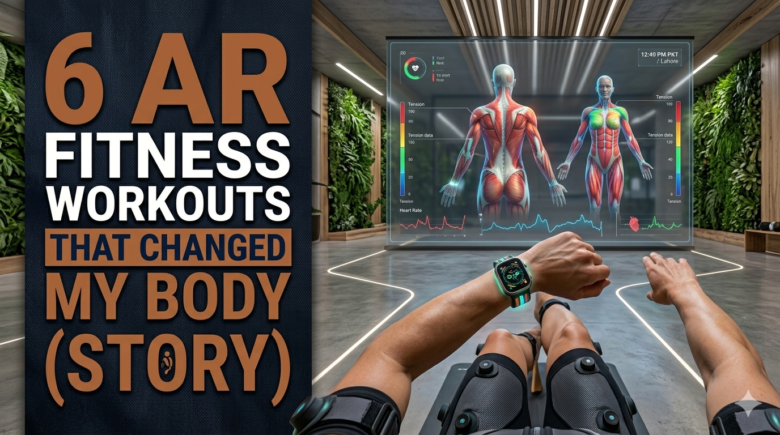
This workout focused on slow, controlled movements guided by AR visuals showing resistance paths and muscle activation zones.
Instead of lifting heavy weights, I focused on precision movement.
Table 4: Resistance Flow Training Effects
| Attribute | Result |
| Muscle control | High improvement |
| Joint stability | Improved |
| Injury risk | Reduced |
This workout changed how I understood strength—it wasn’t just about lifting more, but controlling better.
workout 4: AR cardio landscape running
This was one of the most mentally transformative workouts.
Instead of running in place or on a treadmill, AR projected dynamic environments—cities, forests, and obstacle-based routes.
My body moved, but my mind stopped noticing fatigue as quickly.
Table 5: Cardio Performance Comparison
| Type | Perceived Effort | Endurance Gain |
| Traditional running | High boredom | Moderate |
| AR landscape running | Low boredom | High |
This workout improved my stamina more than expected simply because I stayed longer without mentally quitting.
workout 5: AR hybrid strength circuits
This workout combined bodyweight exercises with AR-guided circuits. Targets appeared in space, dictating movement sequences like squats, push-ups, lunges, and holds.
It felt like following a moving blueprint.
Table 6: Circuit Training Structure
| Exercise Type | Impact |
| Squats | Lower body strength |
| Push-ups | Upper body endurance |
| Holds | Core stability |
The biggest change was muscular balance—my body felt more evenly developed.
workout 6: adaptive AR fatigue-based training
This was the most advanced system I used.
The workout adapted in real time based on how tired I was. If I slowed down, it reduced intensity. If I performed well, it increased difficulty.
It felt like the system was learning me.
Table 7: Adaptive Training Behavior
| Condition | System Response |
| High energy | Increased intensity |
| Fatigue detected | Reduced load |
| Inconsistent movement | Simplified tasks |
This workout improved consistency more than intensity ever did.
how my body changed after consistent AR training
After a few months of using these AR workouts, changes became visible and functional—not just aesthetic.
Table 8: Physical Changes Over Time
| Area | Change |
| Core | Stronger stability |
| Legs | Improved endurance |
| Arms | Better control and tone |
| Posture | Noticeably improved |
But the biggest change wasn’t physical—it was behavioral consistency.
weekly AR workout structure that changed everything
Once I stopped randomly switching workouts, I built a simple weekly structure.
Table 9: AR Fitness Weekly Plan
| Day | Workout Type |
| Monday | Reaction training |
| Tuesday | Boxing conditioning |
| Wednesday | Resistance flow |
| Thursday | Cardio AR running |
| Friday | Hybrid circuits |
| Saturday | Adaptive training |
| Sunday | Rest |
This structure made progress predictable.
mistakes I made during AR fitness training
- Starting too intense too early
- Ignoring recovery days
- Switching workouts too frequently
- Focusing on visuals instead of movement quality
what actually changed my body the most
It wasn’t one workout.
It was the combination of:
- Instant feedback
- Consistent repetition
- Low mental resistance
Table 10: Key Transformation Drivers
| Factor | Impact Level |
| Consistency | Very high |
| Feedback speed | High |
| Workout variety | Medium |
faqs
- do AR fitness workouts actually build muscle? Yes, especially bodyweight and resistance-based AR workouts when done consistently.
- how long does it take to see results? Usually a few weeks for endurance and 6–8 weeks for visible changes.
- are AR workouts better than gym workouts? They are better for consistency and engagement, but gyms are better for heavy strength training.
- do AR workouts require equipment? Some do, but many only require a smartphone or basic sensors.
- what is the biggest advantage of AR fitness workouts? Real-time feedback that improves form and consistency.
- can AR workouts replace traditional fitness completely? Not fully, but they can replace a large portion of general fitness training.