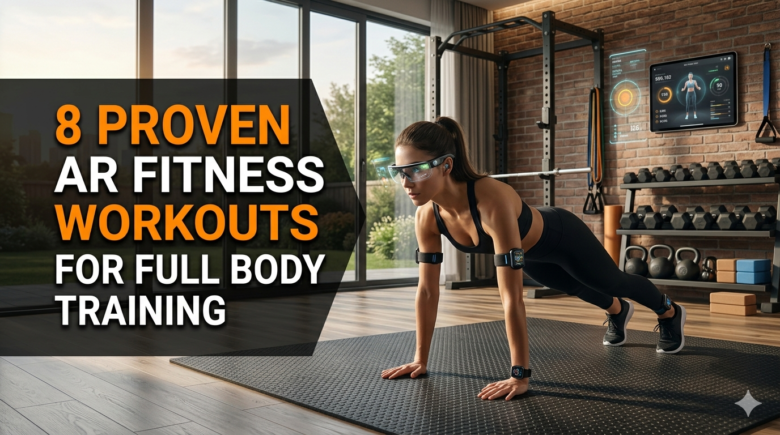
Full-body training has always been one of the most efficient ways to stay fit. Instead of isolating one muscle group per session, you train multiple areas at once—saving time while improving overall strength, endurance, and coordination.
Now, with augmented reality (AR), full-body training has become more interactive and easier to follow at home. Instead of guessing your form or switching between videos, AR workouts guide you in real time using visual overlays, movement tracking, and instant feedback.
This combination of physical movement and digital guidance makes training more structured, especially for beginners who struggle with consistency or proper technique.
This article explores 8 proven AR fitness workouts for full-body training, how they work, what they target, and how to combine them into a balanced routine.
why AR works so well for full-body workouts
Full-body training requires coordination between multiple muscle groups. The challenge is not effort—it’s control and form.
AR helps by:
- showing correct movement paths
- correcting posture instantly
- tracking symmetry between left and right sides
- improving timing and rhythm
Table: traditional vs AR full-body training
| Factor | Traditional Workouts | AR Workouts |
|---|---|---|
| Form guidance | Manual or none | Real-time visual feedback |
| Learning speed | Moderate | Fast |
| Injury risk | Medium | Lower |
| Engagement | Variable | High |
| Tracking accuracy | Low–medium | High |
AR essentially acts like a virtual coach that watches every rep.
- AR guided squat + upper body activation workout
This is one of the most fundamental AR full-body workouts.
It combines:
- squats (lower body)
- arm raises (upper body)
- core engagement
AR systems show:
- squat depth indicators
- knee alignment guides
- posture correction lines
Table: muscle engagement
| Muscle Group | Activation Level |
|---|---|
| Quadriceps | High |
| Glutes | High |
| Core | Medium–High |
| Shoulders | Medium |
Why it works:
It trains strength and stability simultaneously while AR ensures correct posture.
- AR plank flow training
Plank-based AR workouts focus on core stability while adding dynamic movement.
Typical AR-guided sequence:
- standard plank
- shoulder taps
- leg lifts
- side plank transitions
AR overlays highlight:
- hip alignment
- shoulder positioning
- core stability levels
Table: core activation comparison
| Variation | Core Activation |
|---|---|
| Standard plank | High |
| AR plank flow | Very high |
| Dynamic plank transitions | Maximum |
Why it works:
It improves core strength while engaging upper and lower body coordination.
- AR full-body HIIT circuit
High-Intensity Interval Training (HIIT) becomes more structured with AR guidance.
A typical AR HIIT circuit includes:
- jumping jacks
- mountain climbers
- squat jumps
- push-up variations
AR system shows:
- countdown timers
- movement correction
- intensity zones
Table: HIIT structure example
| Interval | Activity | Duration |
|---|---|---|
| 1 | Jumping jacks | 40 sec |
| Rest | Recovery | 20 sec |
| 2 | Squat jumps | 40 sec |
| Rest | Recovery | 20 sec |
| 3 | Mountain climbers | 40 sec |
Why it works:
AR keeps intensity high while preventing form breakdown.
- AR push-up + mobility combo workout
Push-ups alone focus on upper body, but AR adds mobility transitions to turn it into a full-body workout.
Sequence includes:
- push-ups
- shoulder mobility stretches
- plank transitions
- arm reach extensions
AR highlights:
- elbow angle correction
- spine alignment
- depth markers
Table: muscle involvement
| Area | Engagement |
|---|---|
| Chest | High |
| Arms | High |
| Core | Medium–High |
| Back | Medium |
Why it works:
It balances strength with flexibility in one flow.
- AR cardio + strength hybrid workout
This workout blends cardio bursts with strength movements.
Typical pattern:
- running in place
- squat holds
- arm punches
- knee lifts
AR systems create:
- virtual pacing guides
- movement targets
- rhythm indicators
Table: energy system usage
| Activity Type | Energy Demand |
|---|---|
| Cardio bursts | High |
| Strength holds | Medium |
| Hybrid flow | Very high |
Why it works:
It improves both endurance and muscle conditioning at the same time.
- AR dance-based full-body workout
Dance workouts are naturally full-body, and AR enhances them with timing correction and movement tracking.
Includes:
- rhythm-based steps
- arm coordination patterns
- hip movement sequences
- directional changes
AR provides:
- beat timing overlays
- step accuracy scoring
- posture correction cues
Table: fitness benefits
| Element | Benefit |
|---|---|
| Cardio | High |
| Coordination | Very high |
| Flexibility | Medium–High |
| Balance | High |
Why it works:
It disguises exercise as movement-based entertainment.
- AR resistance band training
Resistance bands combined with AR guidance create controlled strength training.
Exercises include:
- band squats
- shoulder presses
- rows
- lateral walks
AR shows:
- tension levels
- movement range
- symmetry tracking
Table: resistance training comparison
| Feature | Without AR | With AR |
|---|---|---|
| Form control | Low | High |
| Tension awareness | Medium | High |
| Injury prevention | Moderate | Strong |
Why it works:
It ensures proper muscle engagement throughout movement.
- AR yoga flow full-body training
Yoga is one of the most effective AR-enhanced full-body workouts.
Sequences include:
- sun salutations
- warrior poses
- balance transitions
- stretching flows
AR overlays show:
- body alignment guides
- breathing timing
- posture correction lines
Table: yoga AR benefits
| Area | Improvement |
|---|---|
| Flexibility | High |
| Balance | High |
| Strength | Medium |
| Stress reduction | Very high |
Why it works:
It combines mental focus with physical alignment.
how to combine all 8 AR workouts into a weekly plan
A structured routine ensures balanced full-body development.
Table: weekly AR full-body training plan
| Day | Workout Type | Focus |
|---|---|---|
| Monday | Squat + upper body | Strength |
| Tuesday | AR yoga flow | Flexibility |
| Wednesday | HIIT circuit | Endurance |
| Thursday | Recovery mobility | Light activity |
| Friday | Push-up combo | Upper body |
| Saturday | Dance workout | Cardio |
| Sunday | Resistance training | Full-body strength |
common mistakes in AR full-body training
Even with AR guidance, users often make mistakes:
- ignoring correction signals
- rushing through exercises
- skipping warm-ups
- overtraining due to gamification
- poor posture outside guided zones
Fixing these dramatically improves results.
why AR improves full-body training results faster
AR accelerates results because it combines:
- real-time correction
- structured progression
- visual learning
- instant feedback
Table: improvement timeline comparison
| Week | Traditional Training | AR Training |
|---|---|---|
| 1–2 | Learning phase | Faster adaptation |
| 3–4 | Moderate progress | Noticeable improvement |
| 5–6 | Gradual strength gain | Faster consistency |
| 6+ | Plateau risk | Continuous adjustment |
future of AR full-body workouts
Future systems may include:
- AI-generated adaptive workouts
- emotion-based intensity adjustments
- holographic trainers
- fully immersive AR fitness rooms
The direction is clear: workouts will become more personalized and interactive.
FAQs
- can beginners do AR full-body workouts
Yes, AR workouts are especially helpful for beginners because they provide real-time guidance. - do I need equipment for AR fitness training
Most workouts require only space and a smartphone or AR-enabled device. - how often should I do AR full-body workouts
3–5 times per week is ideal for balanced progress and recovery. - are AR workouts better than gym workouts
They are different—AR workouts are great for convenience and guidance, while gyms offer heavier resistance training. - can AR workouts help with weight loss
Yes, especially HIIT and cardio-based AR sessions, which improve calorie burn and consistency. - is AR fitness safe for daily use
Yes, as long as users follow proper form corrections and avoid overtraining.