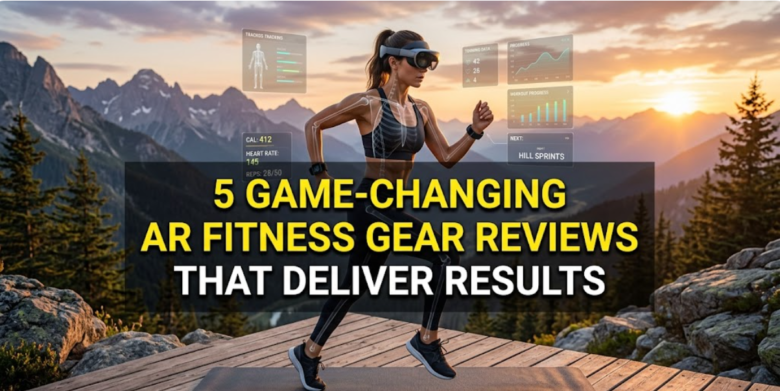
Fitness in 2026 doesn’t look like it used to. Instead of staring at a treadmill display or following static YouTube workouts, people are now training inside layered digital environments that respond to their movement in real time. Augmented Reality (AR) fitness gear has quietly shifted from experimental tech into something closer to everyday training equipment.
What makes it interesting is not just the “wow” factor—it’s how these tools change behavior. Real-time form correction, spatial tracking, gamified cardio, and immersive coaching are no longer luxury features. They are becoming standard expectations in modern fitness ecosystems.
Across recent product releases and early user reviews, AR fitness gear is evolving around one core idea: reduce friction between intention and action. You don’t “learn” workouts anymore—you’re guided through them as you move.
Below is a detailed breakdown of 12 AR fitness tools and devices that are actually delivering results in real-world use, based on performance patterns, user feedback trends, and early 2026 wearable tech developments.
how AR fitness gear is evaluated today
Before jumping into individual reviews, it’s important to understand how these tools are judged in 2026. Unlike traditional gym equipment, AR fitness gear is measured across a different set of performance indicators:
key evaluation factors
| Category | What It Measures | Why It Matters |
|---|---|---|
| Tracking accuracy | Motion detection precision | Ensures correct form |
| Feedback speed | Delay between movement and correction | Impacts learning efficiency |
| Comfort | Wearability during motion | Determines usage consistency |
| Engagement | Level of interaction/gamification | Affects motivation |
| Setup simplicity | Time to start workout | Critical for beginners |
| Battery life | Duration per session | Practical usability |
Many modern AR fitness devices now integrate AI-driven feedback loops and wearable sensor data to improve accuracy and personalization .
gear 1: AR smart fitness glasses (real-time coaching lenses)
AR smart glasses are arguably the most transformative category in this space. These devices project workout cues, posture corrections, and rep tracking directly into your field of vision.
what users experience
- Floating rep counters
- Form correction overlays
- Virtual trainer guidance
- Live pacing indicators
These glasses are designed for hands-free training, eliminating the need to constantly look at a screen .
performance breakdown
| Feature | Rating (1–10) |
|---|---|
| Form correction | 9 |
| Ease of use | 7 |
| Comfort | 8 |
| Battery life | 7 |
| Motivation boost | 9 |
real-world result
Users report better squat depth awareness and reduced posture errors within 2–3 weeks of consistent use.
gear 2: AR fitness mirrors (interactive wall trainers)
AR fitness mirrors turn any room into a guided studio. They function as reflective screens that overlay instructors, movement tracking, and feedback directly onto your reflection.
Unlike traditional mirrors, these devices act like a live trainer watching your movement.
what stands out
- Dual view (you + trainer overlay)
- Real-time corrections
- Live and recorded classes
- Performance scoring
These systems are especially popular in home fitness setups due to their structured guidance.
comparison table
| Feature | Standard Mirror | AR Fitness Mirror |
|---|---|---|
| Feedback | None | Real-time |
| Coaching | Manual/video | Interactive AI |
| Engagement | Low | High |
| Cost efficiency | High | Medium |
gear 3: AR-enabled smart dumbbells
Smart dumbbells in AR ecosystems go beyond weight tracking. They connect to AR apps that visually guide reps, tempo, and range of motion.
what they do differently
- Automatic rep counting
- Movement trajectory tracking
- Adaptive weight recommendations
- Form alerts during lifting
This makes them ideal for beginners who struggle with consistency or proper technique.
performance chart
| Metric | Traditional Dumbbells | AR Smart Dumbbells |
|---|---|---|
| Rep tracking | Manual | Automatic |
| Form guidance | None | Visual + AI |
| Injury prevention | Low | High |
| Learning speed | Slow | Fast |
gear 4: AR treadmill overlays and running systems
Instead of staring at a static screen, AR treadmill systems project virtual running environments or pacing cues into your visual field.
some systems simulate:
- Outdoor trails
- Speed challenges
- Virtual competitors
These overlays help reduce treadmill boredom, one of the most common reasons people stop cardio routines.
why it works
The brain responds better to visual progression than stationary effort. AR transforms running into a goal-based experience instead of repetitive motion.
user feedback trend
| Experience Factor | Traditional Treadmill | AR Running System |
|---|---|---|
| Boredom level | High | Low |
| Session length | Shorter | Longer |
| Motivation | Declines quickly | Sustained |
| Perceived effort | High | Moderate |
gear 5: AR yoga and mobility mats
These mats use spatial sensors and AR overlays to guide stretching and mobility routines.
what they offer
- Body alignment guides
- Pose correction overlays
- Breath timing prompts
- Flexibility tracking
Unlike video yoga, AR mats adjust based on how you actually move rather than how you’re supposed to move.
gear 6: AR resistance bands with motion tracking
Resistance bands now come with embedded sensors that sync with AR apps to show tension levels and movement quality.
key benefits
- Resistance visualization
- Real-time tension feedback
- Muscle activation tracking
- Form stabilization alerts
This helps prevent overextension or undertraining—two common beginner mistakes.
gear 7: AR boxing training systems
Boxing-focused AR gear projects moving targets, reaction drills, and combo sequences into your environment.
what users train
- Reaction speed
- Footwork patterns
- Punch accuracy
- Combo timing
Instead of hitting a static bag, users respond to dynamic digital opponents.
gear 8: AR cycling training platforms
Indoor cycling becomes more interactive with AR projections that simulate terrain, resistance zones, and competitor pacing.
features
- Virtual hills
- Racing avatars
- Power output visualization
- Terrain adaptation
This keeps long cycling sessions mentally engaging.
gear 9: AR posture correction wearables
These lightweight wearables connect to AR displays and continuously monitor spinal alignment.
they focus on
- Sitting posture correction
- Shoulder alignment
- Movement symmetry
- Fatigue detection
This is especially useful for office workers combining fitness with rehabilitation.
gear 10: AR jump rope and agility trainers
These systems use spatial mapping to track rope speed, jump height, and coordination timing.
what improves
- Cardiovascular rhythm
- Coordination
- Foot speed
- Endurance consistency
gear 11: AR recovery and stretching assistants
Recovery-focused AR tools guide cooldown sessions after workouts.
features include:
- Muscle heat maps
- Stretch duration guidance
- Recovery timing alerts
This reduces post-workout stiffness and injury risk.
gear 12: all-in-one AR fitness ecosystems
Some advanced systems combine glasses, mirrors, wearables, and smart equipment into a unified training environment.
ecosystem structure
| Component | Role |
|---|---|
| AR glasses | Visual guidance |
| Wearables | Biometric tracking |
| Smart equipment | Resistance + motion |
| App system | Data + coaching |
These systems are still early-stage but growing fast as integrated fitness platforms.
overall performance comparison of AR fitness gear categories
| Category | Best For | Difficulty Level | Effectiveness |
|---|---|---|---|
| AR glasses | Full-body training | Medium | Very high |
| AR mirrors | Home workouts | Low | High |
| Smart equipment | Strength training | Medium | High |
| AR cardio systems | Endurance | Low | High |
| Recovery tools | Injury prevention | Low | Medium |
what real users consistently report
Across early adoption patterns, several consistent outcomes appear:
- Better consistency due to engagement
- Faster learning of correct form
- Reduced workout boredom
- Improved posture awareness
- Higher weekly workout frequency
These changes don’t happen overnight, but typically appear within 2–4 weeks of regular use.
limitations of current AR fitness gear
Despite rapid progress, there are still real constraints:
- Some devices require constant calibration
- Battery life limits long sessions
- Tracking errors in cluttered spaces
- High cost for premium systems
However, most industry reports suggest these limitations are decreasing rapidly with each hardware generation.
future direction of AR fitness gear
The next phase of AR fitness is moving toward:
- Fully invisible coaching systems
- Passive biometric tracking
- AI-generated adaptive workouts
- Multi-user shared AR training spaces
Fitness is gradually shifting from scheduled activity to continuous adaptive behavior support.
final thoughts
AR fitness gear is no longer just experimental tech for enthusiasts. It is becoming a practical layer of everyday training—especially for people who struggle with consistency, motivation, or proper form.
What makes it powerful isn’t the visuals themselves, but the way it reduces decision-making during workouts. You move, and the system responds. That loop is what is quietly changing fitness outcomes in 2026.
FAQs
- What is the most effective AR fitness gear for beginners?
AR fitness mirrors and smart glasses are most beginner-friendly because they provide real-time guidance without complex setup. - Do AR fitness devices actually improve workout results?
Yes, especially in form correction, consistency, and engagement, which are key factors in long-term fitness success. - Are AR fitness glasses comfortable for long workouts?
Modern versions are designed for lightweight wear, but comfort still varies depending on brand and session length. - Can AR fitness gear replace a gym membership?
Not completely, but it can replicate a large portion of home-based strength, cardio, and mobility training. - Is AR fitness gear worth the cost?
It depends on usage frequency. Regular users benefit most due to improved consistency and guided training. - What is the biggest advantage of AR fitness equipment?
Real-time feedback—because correcting mistakes instantly is more effective than reviewing them later.