The gym industry is standing at a strange intersection right now. On one side, traditional fitness equipment still dominates most spaces—treadmills, dumbbells, resistance machines, and mirrored walls that haven’t changed much in decades. On the other side, a new layer of fitness is quietly emerging: augmented reality (AR), blending digital environments with physical movement.
What makes this shift important is not just technology for its own sake. It’s behavior. Gym members are no longer satisfied with repetitive routines. They want feedback, engagement, and something that feels alive. AR is starting to fill that gap by turning workouts into interactive experiences instead of mechanical repetition.
But most gyms today are only scratching the surface. Installing a screen or offering a virtual class isn’t enough. The real transformation comes from structured AR upgrades that reshape how training, motivation, tracking, and coaching actually work.
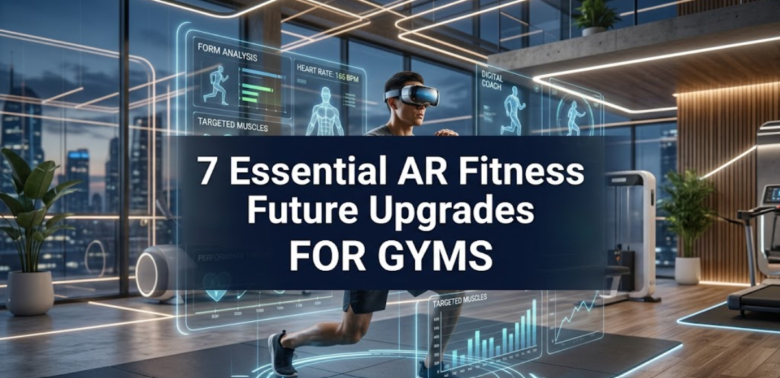
This article breaks down 7 essential AR fitness future upgrades that gyms will need to stay relevant in the next wave of fitness evolution. It also includes practical tables, system comparisons, and implementation frameworks.
why AR is becoming a gym necessity, not a luxury
For years, gyms competed on equipment quality and location. Now, competition is shifting toward experience quality.
Members want:
- Real-time feedback
- Personalized training
- Gamified motivation
- Hybrid physical + digital coaching
AR delivers all of these in one system.
market direction snapshot:
| Trend Factor | Impact on Gyms |
|---|---|
| Digital fitness adoption | Rapid growth |
| Member retention issues | Increasing |
| Demand for personalization | High priority |
| Wearable integration | Becoming standard |
| AR + AI convergence | Emerging core trend |
The gyms that ignore this shift risk becoming “equipment-only spaces” in a world where experience matters more than machines.
upgrade 1: AR interactive training zones
Traditional gym floors are static. AR transforms them into adaptive training environments.
Instead of fixed machines defining space, AR training zones create flexible digital overlays that change based on workouts.
how it works:
- Floor markers or sensors define zones
- AR glasses or screens project exercise instructions
- Members see real-time guidance on movement areas
example AR zone types:
| Zone Type | Function |
|---|---|
| Cardio Zone | Interval-based AR running challenges |
| Strength Zone | Form-corrected AR lifting guidance |
| Agility Zone | Obstacle-based movement training |
| Recovery Zone | Stretching + breathing overlays |
why it matters:
It allows gyms to maximize space usage without physical restructuring.
A single area can function as multiple training environments throughout the day.
upgrade 2: real-time AR form correction systems
One of the biggest problems in gyms is incorrect form. Trainers cannot watch everyone simultaneously, and members often repeat mistakes for months.
AR changes that by offering instant visual correction.
how it works:
- Cameras or wearables track movement
- AR overlays show alignment errors
- Visual guides correct posture in real time
form correction comparison:
| Method | Feedback Speed | Accuracy | Scalability |
|---|---|---|---|
| Human trainer | Moderate | High | Low |
| Video tutorials | None | Medium | High |
| AR correction system | Instant | High | High |
key advantage:
Members no longer wait for mistakes to become habits. Correction happens instantly during movement.
upgrade 3: gamified AR fitness competitions
Gyms traditionally rely on motivation through community or personal goals. AR introduces structured competition that feels like gaming but produces real physical results.
types of AR competitions:
| Competition Type | Description |
|---|---|
| Speed challenges | Complete reps faster than opponents |
| Endurance battles | Last longest in AR-based workouts |
| Accuracy scoring | Hit movement targets precisely |
| Team missions | Group-based fitness objectives |
what changes psychologically:
Instead of “I should work out,” members think “I want to beat my score.”
motivation shift:
| Traditional Motivation | AR Motivation |
|---|---|
| Discipline-based | Reward-based |
| Internal pressure | External challenge |
| Routine-focused | Goal-driven |
This shift significantly improves retention rates in gyms using AR systems.
upgrade 4: personalized AR AI fitness coaching
Generic workout plans are becoming outdated. AR combined with AI allows hyper-personalized coaching systems that adjust in real time.
how it works:
- AI analyzes user performance history
- AR system displays customized workout instructions
- Difficulty adjusts dynamically during session
personalization variables:
| Factor | Adjustment Type |
|---|---|
| Heart rate | Intensity scaling |
| Fatigue level | Rest interval modification |
| Movement accuracy | Exercise complexity |
| Progress history | Goal recalibration |
why it matters:
No two gym members experience the same workout anymore. Each session becomes uniquely tailored.
This reduces burnout and increases long-term adherence.
upgrade 5: AR-integrated strength machines
Instead of replacing machines, AR enhances them.
Imagine a treadmill or weight machine that displays real-time digital overlays showing speed targets, posture cues, or performance stats directly in your field of view.
features:
- Live performance dashboards
- AR-based resistance guidance
- Movement visualization overlays
machine upgrade comparison:
| Feature | Traditional Machine | AR-Enhanced Machine |
|---|---|---|
| Feedback | Post-workout | Real-time |
| Motivation | Low | High |
| Tracking | Basic | Advanced |
| Engagement | Static | Interactive |
impact:
Machines become interactive trainers rather than passive tools.
upgrade 6: immersive group AR fitness classes
Group fitness classes already exist, but AR turns them into synchronized immersive experiences.
Instead of following an instructor at the front of a room, members see shared AR environments.
how it works:
- Each participant sees the same AR environment
- Instructor guides through digital overlays
- Group challenges appear in real time
class transformation example:
| Traditional Class | AR Group Class |
|---|---|
| Visual instruction | Immersive environment |
| Physical repetition | Interactive challenges |
| Static pacing | Dynamic group adaptation |
why it works:
Humans respond strongly to shared experiences. AR amplifies that by making the entire group part of a single interactive system.
upgrade 7: full-body motion analytics dashboards
Gyms collect data today, but it’s usually fragmented—step counts, machine usage, or basic heart rate tracking.
AR enables full-body motion analytics displayed in real time.
what is tracked:
- Joint angles
- Movement speed
- Range of motion
- Balance stability
- Repetition quality
data visualization table:
| Metric | Beginner Focus | Advanced Focus |
|---|---|---|
| Movement accuracy | Basic correction | Optimization |
| Speed control | Moderate pacing | Performance tuning |
| Balance score | Stability building | Precision training |
| Efficiency | General improvement | Peak optimization |
why it matters:
Members can actually see their movement quality improving, not just weight or time metrics.
This creates deeper awareness of physical performance.
how AR upgrades transform gym structure
When all seven upgrades are combined, gyms stop functioning like traditional spaces and start behaving like adaptive fitness ecosystems.
transformation comparison:
| Gym Type | Structure | Experience |
|---|---|---|
| Traditional gym | Fixed equipment layout | Repetitive training |
| Modern gym | Mixed equipment + classes | Semi-dynamic |
| AR-enabled gym | Adaptive digital environment | Fully interactive |
The biggest change is flexibility. A single room can become multiple training environments within minutes.
implementation roadmap for gyms
Not every gym can adopt full AR systems immediately. A phased approach works best.
step-by-step roadmap:
| Phase | Upgrade Focus |
|---|---|
| Phase 1 | Basic AR tracking + apps |
| Phase 2 | Form correction systems |
| Phase 3 | Gamified challenges |
| Phase 4 | AI coaching integration |
| Phase 5 | Full immersive zones |
This staged approach reduces cost and operational disruption.
business impact of AR fitness upgrades
For gym owners, AR is not just a tech upgrade—it’s a business model shift.
key benefits:
- Higher member retention
- Increased class engagement
- Premium pricing opportunities
- Data-driven training services
business impact table:
| Metric | Before AR | After AR |
|---|---|---|
| Member retention | Medium | High |
| Engagement rate | Moderate | Very high |
| Revenue per member | Stable | Increased |
| Churn rate | Higher | Reduced |
AR doesn’t just improve workouts—it improves business stability.
challenges gyms must consider
Despite its benefits, AR adoption comes with challenges:
| Challenge | Impact |
|---|---|
| High initial cost | Slower adoption |
| Training staff | Required |
| Hardware dependency | Maintenance needs |
| Privacy concerns | Data handling issues |
These challenges are real, but manageable with phased implementation.
future outlook of AR gyms
The future gym will likely not be defined by equipment alone but by digital intelligence layered over physical space.
emerging trends:
- AI-generated workouts inside AR environments
- Real-time biometric feedback loops
- Fully virtual personal trainers
- Mixed reality competitive leagues
- Adaptive gym layouts based on crowd flow
In the long term, gyms may function more like interactive fitness platforms than physical locations.
final thoughts
AR fitness upgrades are not about replacing gyms—they are about redefining them.
The seven upgrades outlined here show a clear direction: gyms are moving from static environments to dynamic systems that adapt, respond, and evolve with each member.
The gyms that embrace this shift early will not only improve member experience but also secure long-term relevance in a rapidly changing fitness landscape.
FAQs
- Do gyms need expensive equipment to adopt AR fitness upgrades?
Not necessarily. Many AR systems can run on existing devices like tablets, smartphones, or basic camera setups before upgrading to advanced hardware. - Are AR fitness systems suitable for small gyms?
Yes. Small gyms can adopt phased AR upgrades starting with tracking apps and form correction tools before scaling further. - Will AR replace personal trainers in gyms?
No. AR supports trainers by handling repetitive correction and tracking, allowing trainers to focus more on strategy and motivation. - How does AR improve gym member retention?
It increases engagement through gamification, personalization, and real-time feedback, making workouts more enjoyable and consistent. - Is AR fitness safe for beginners?
Yes. In fact, beginners benefit the most because AR systems guide movement and reduce the risk of incorrect form. - What is the biggest long-term benefit of AR in gyms?
The biggest benefit is transformation from static workout spaces into adaptive, interactive fitness ecosystems that evolve with users.