There’s a quiet shift happening in fitness right now that most people don’t fully notice until they try it. Workouts are no longer just about lifting weights, running on treadmills, or following videos on a screen. In 2026, exercise is becoming something you step into rather than something you simply do.
Augmented Reality (AR) is at the center of that change. Instead of replacing reality like VR, AR layers digital guidance, coaching, and game-like elements onto your real environment. That subtle difference is exactly why it’s spreading so fast in fitness.
Recent industry analysis shows AR fitness is part of a broader wave of immersive and AI-driven training systems that are reshaping how people work out at home and in gyms, with strong growth expected through the decade .
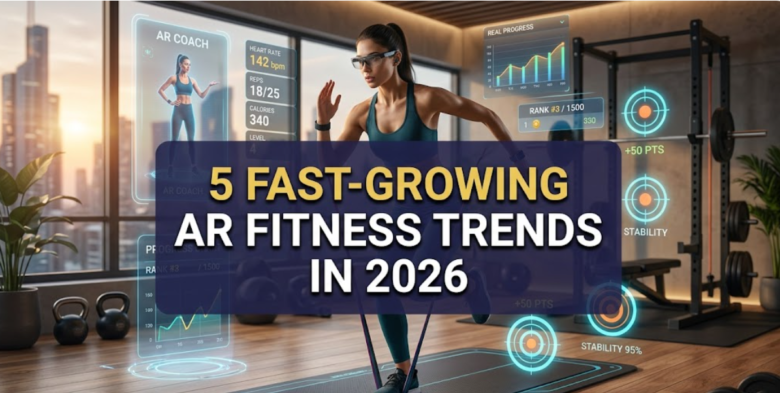
What matters most now is not just the technology itself—but how it’s evolving. Below are five fast-growing AR fitness trends shaping 2026, along with practical breakdowns, comparisons, and real-world patterns you can actually recognize in today’s fitness tools.
trend 1: hyper-personalized AR coaching powered by AI
One of the biggest changes in 2026 is that AR fitness is no longer “one program fits all.” Instead, workouts adjust in real time based on how you move, breathe, and perform.
AI-driven AR coaching now analyzes:
- Movement accuracy
- Heart rate (when connected to wearables)
- Fatigue level
- Exercise consistency
- Recovery speed
This creates a training system that adapts while you’re still exercising.
For example, if your squat depth decreases due to fatigue, AR overlays can immediately reduce intensity or shift you into a recovery movement instead of letting you continue with poor form.
AI is increasingly used in fitness platforms to adjust workouts dynamically based on user performance and recovery signals .
simple breakdown of AR coaching evolution
| Stage | Coaching Style | Feedback Type | Personalization Level |
|---|---|---|---|
| 2020–2022 | Static workout apps | None or delayed | Low |
| 2023–2024 | Video + trackers | Post-workout | Medium |
| 2025 | AI suggestions | Semi-real-time | High |
| 2026 | AR + AI live coaching | Instant during movement | Very high |
why it’s growing fast
Because beginners no longer want guesswork. They want correction in real time, not after an injury or bad habit forms.
trend 2: AR gamified fitness replacing traditional cardio boredom
Cardio used to be the hardest part of fitness—not physically, but mentally. Running on a treadmill or cycling in place gets repetitive quickly.
AR fitness changes this by turning cardio into interactive experiences:
- Chasing virtual targets
- Dodging obstacles in real space
- Completing timed movement missions
- Scoring points through physical motion
This is not just “fun design.” It directly impacts effort levels.
When your brain is focused on a game objective, perceived effort drops, and people tend to move longer without noticing fatigue.
growth pattern chart (estimated engagement shift)
| Workout Style | Average Engagement Level |
|---|---|
| Traditional cardio | 5/10 |
| Music-based workouts | 6/10 |
| Video-guided fitness | 7/10 |
| AR gamified fitness | 8.5–9/10 |
why this trend is exploding in 2026
- Short attention spans
- Rise of home workouts
- Demand for entertainment-based fitness
- Social sharing of workout “scores”
Even industry reports show fitness gamification becoming a mainstream driver of engagement in 2026 wellness ecosystems .
trend 3: spatial-aware workouts that turn any room into a gym
One of the most practical AR fitness shifts is spatial mapping—where your environment becomes part of your workout system.
Instead of going to a gym or using fixed equipment, AR systems scan your space and assign workout zones:
- Floor area = movement zone
- Wall space = strength or push zone
- Hallway = cardio lane
- Corner space = recovery/stretch zone
This removes one of the biggest barriers to exercise: location dependency.
real-world example setup
| Home Area | AR Function | Exercise Type |
|---|---|---|
| Living room center | Main workout zone | Squats, lunges, HIIT |
| Wall area | Resistance tracking | Push-ups, planks |
| Open corridor | Movement tracking | Running drills |
| Small corner | Cooldown zone | Stretching & breathing |
why this matters
Most people don’t fail at fitness because of laziness—they fail because they feel they “don’t have space.” AR removes that excuse entirely.
Recent AR system design research shows that spatial interaction and environmental mapping are becoming core parts of immersive AR fitness experiences .
trend 4: wearable-integrated AR fitness ecosystems
In 2026, AR fitness no longer exists alone. It is deeply connected to wearable devices like:
- Smartwatches
- Fitness bands
- Smart rings
- Biometric sensors
These devices feed live data into AR systems, which then adjust workouts instantly.
For example:
- High stress → AR reduces intensity
- Poor sleep → AR suggests mobility instead of strength
- Elevated heart rate → AR slows pacing
Wearables are evolving into intelligent systems that provide real-time recommendations rather than just tracking data .
data flow structure
Wearable → Data collection → AI analysis → AR response → Workout adjustment
comparison table
| Feature | Without AR Integration | With AR + Wearables |
|---|---|---|
| Feedback speed | After workout | During workout |
| Injury prevention | Low | High |
| Training accuracy | Moderate | High |
| Personalization | Static | Adaptive |
why this trend is accelerating
Because people don’t want “data anymore.” They want decisions made for them in real time.
trend 5: social AR fitness and shared virtual workout spaces
Fitness used to be either solo or in a gym. Now it’s becoming hybrid social—without requiring physical presence.
AR fitness platforms in 2026 allow users to:
- Work out with friends in shared AR spaces
- Compete in real-time challenges
- Join global fitness events
- See avatars of others training beside them
This brings accountability and competition back into fitness—without logistics.
emerging social AR formats
| Format | Description | Engagement Impact |
|---|---|---|
| Solo AR training | Personal coaching overlays | Medium |
| Friends AR sessions | Shared virtual space | High |
| Global challenges | Ranked competitions | Very high |
| Mixed reality gyms | Hybrid physical + AR groups | Very high |
why it matters psychologically
People stick longer to habits when there is:
- Social visibility
- Friendly competition
- Shared progress tracking
AR simply digitizes that environment.
how these 5 trends connect into one ecosystem
These trends are not separate—they are converging.
Modern AR fitness in 2026 usually combines:
- AI personalization (what to do)
- Gamification (why it feels fun)
- Spatial mapping (where to do it)
- Wearable data (how hard to push)
- Social systems (why to keep going)
ecosystem flow
User enters space
→ AR scans environment
→ Wearable data syncs
→ AI selects workout
→ Gamified AR session begins
→ Social or solo mode activates
→ Performance feedback updates live
→ System adapts next session
This is what makes AR fitness different from older digital workouts—it’s not linear anymore.
key challenges slowing adoption (but not stopping growth)
Even though AR fitness is growing fast, it still faces limitations:
- Hardware cost for advanced systems
- Battery life constraints
- Tracking errors in cluttered spaces
- Learning curve for setup
However, trends show devices are becoming lighter, cheaper, and more practical every year.
Recent AR hardware developments point toward lighter, more wearable smart glasses designed specifically for active use .
future direction beyond 2026
Looking forward, AR fitness is moving toward:
- Fully passive tracking (no setup needed)
- Emotion-based workout adjustment
- Predictive coaching before fatigue occurs
- Fully immersive mixed-reality fitness worlds
Fitness is slowly shifting from “scheduled activity” to “embedded behavior.”
final thoughts
The biggest shift in 2026 AR fitness isn’t just technology—it’s psychology.
People no longer want to “follow workouts.” They want workouts that respond to them, adapt to them, and engage them without constant decision-making.
AR makes that possible by blending physical movement with digital intelligence in real time.
And as these five trends continue to evolve, fitness becomes less about discipline alone—and more about systems that quietly keep you moving.
FAQs
- What is the biggest AR fitness trend in 2026?
AI-powered personalized AR coaching is the fastest-growing trend because it adjusts workouts in real time based on user performance and wearable data. - Do I need special equipment for AR fitness?
Not always. Many AR fitness systems now work with smartphones, while advanced features may use smart glasses or wearables. - Is AR fitness better than traditional workouts?
It’s not a replacement but an enhancement. It improves engagement, feedback speed, and consistency. - How does AR fitness make workouts more engaging?
Through gamification, real-time feedback, and interactive environments that turn exercise into a goal-based experience. - Can AR fitness work in small spaces?
Yes. Spatial mapping technology allows AR systems to adapt workouts to very small or irregular spaces. - Will AR fitness replace gyms in the future?
Unlikely. Instead, gyms will integrate AR systems, creating hybrid physical + digital training environments.