Augmented Reality (AR) fitness is moving from a novelty idea to a serious pillar of digital health. What started as simple motion-tracking games and smartphone overlays is now evolving into immersive training systems that can analyze biomechanics, correct posture in real time, and simulate entire environments for exercise.
The next phase is even more interesting. AR fitness is not just improving workouts—it is changing the definition of what a “workout” actually is. Instead of going to a gym, users may soon step into adaptive digital environments that respond to their movement, health data, and goals instantly.
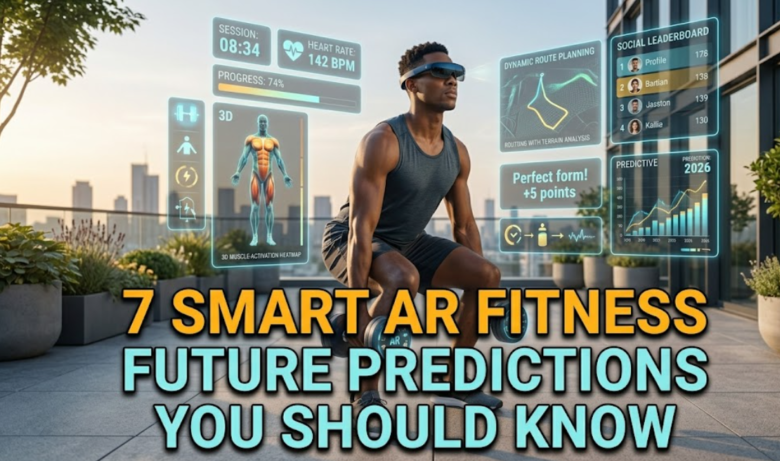
This article explores 7 smart AR fitness future predictions that are likely to shape how people train in the coming years. Each prediction is based on current technology trends, emerging research in immersive training systems, and the direction of wearable computing.
- Fully Immersive AR Workout Environments Will Replace Static Screens
One of the strongest future shifts in AR fitness is the move from screen-based interaction to full environmental immersion. Instead of looking at a phone or tablet, users will experience workouts layered directly into their surroundings through AR glasses or lightweight headsets.
Imagine your living room transforming into:
- A mountain trail for cardio training
- A boxing arena with adaptive opponents
- A yoga studio with calming virtual environments
The key difference is spatial integration. The digital world will no longer sit inside a screen—it will occupy physical space.
Informational Table: Evolution of Workout Environments
| Stage | Environment Type | User Experience |
|---|---|---|
| Traditional | Gym or home floor | Static |
| Mobile fitness apps | Screen-based guidance | Semi-interactive |
| AR fitness today | Overlay on real space | Interactive |
| Future AR fitness | Fully immersive environment | Adaptive reality |
This shift will make workouts feel less like structured exercise and more like lived experiences.
- AI Personal Trainers Will Become Hyper-Adaptive
Today’s fitness apps offer general guidance. In the future, AR fitness systems will include AI trainers that continuously adapt based on your body’s response.
These AI trainers will analyze:
- Heart rate variability
- Muscle fatigue patterns
- Movement efficiency
- Recovery speed
They will then adjust your workout in real time without requiring user input.
Chart: Training Adaptation Levels
| System Type | Adaptation Speed | Personalization |
|---|---|---|
| Static workout plan | None | Low |
| App-based fitness | Daily updates | Medium |
| AR AI trainers | Real-time | Very High |
Instead of following a fixed program, users will experience workouts that evolve dynamically during the session itself.
- AR Fitness Will Merge with Health Monitoring Systems
The future of AR fitness is not just exercise—it is health intelligence. AR systems will integrate directly with wearable health devices, smart clothing, and biometric sensors.
This integration will allow real-time health-driven workouts.
For example:
- If stress levels are high → system shifts to calming exercises
- If recovery is low → intensity automatically reduces
- If performance improves → difficulty increases
Informational Table: Health Data Integration
| Health Metric | AR Fitness Response |
|---|---|
| Heart rate | Adjust intensity |
| Sleep quality | Modify workout load |
| Stress levels | Switch to recovery mode |
| Muscle fatigue | Reduce resistance |
This creates a closed-loop system where fitness adapts to your body rather than forcing your body to adapt to fitness.
- Social AR Fitness Worlds Will Replace Solo Workouts
Currently, most home workouts are isolated experiences. The future will introduce shared AR fitness spaces where users can train together in real time regardless of physical location.
These virtual fitness worlds may include:
- Group yoga sessions in virtual parks
- Multiplayer boxing challenges
- Cooperative fitness missions
- Global leaderboard competitions
Chart: Workout Experience Shift
| Experience Type | Social Interaction |
|---|---|
| Solo home workout | None |
| Live online class | Low |
| AR shared environment | High |
| Global fitness metaverse | Very High |
This shift addresses one of the biggest issues in fitness: motivation through social engagement.
- Exercise Gamification Will Become Fully Narrative-Based
Gamification already exists in fitness apps, but the next stage is deeper storytelling. Instead of simple points or badges, AR fitness will offer full narrative experiences.
Workouts will become missions inside evolving story worlds.
Examples include:
- Surviving post-apocalyptic fitness missions
- Completing space exploration training programs
- Fighting virtual enemies through movement-based combat
- Unlocking story chapters through physical progress
Informational Table: Gamification Evolution
| Level | Gamification Type | Engagement Level |
|---|---|---|
| Basic | Points and badges | Low |
| Intermediate | Challenges and levels | Medium |
| Advanced | Narrative missions | High |
| Future AR fitness | Interactive story worlds | Very High |
This creates emotional investment in fitness, making consistency much easier.
- Real-Time Biomechanical Correction Will Reach Clinical Accuracy
One of the most powerful future predictions is the rise of AR systems capable of near-clinical movement analysis.
Instead of simple posture correction, systems will analyze:
- Joint load distribution
- Muscle activation patterns
- Balance symmetry
- Movement efficiency ratios
This level of analysis is currently found in sports science labs, but AR will bring it into homes.
Chart: Accuracy of Movement Analysis
| System Type | Accuracy Level |
|---|---|
| Basic fitness apps | Low |
| Advanced AR apps | Medium |
| Wearable sensors | High |
| Future AR biomechanical systems | Very High |
This will reduce injury risk and improve rehabilitation training significantly.
- AR Fitness Will Become Fully Invisible Technology
The final prediction is perhaps the most transformative: AR fitness will disappear into everyday life.
Instead of consciously starting a “workout session,” users will move through augmented environments throughout the day.
Examples:
- Walking through AR-guided posture correction paths
- Doing micro-exercises triggered by environmental cues
- Receiving movement suggestions while performing daily tasks
- Turning commuting or house chores into active fitness time
Informational Table: Fitness Integration Levels
| Mode | Fitness Awareness |
|---|---|
| Scheduled workouts | High awareness |
| App-based fitness | Medium awareness |
| AR sessions | Blended awareness |
| Invisible AR fitness | Low awareness (continuous) |
This will fundamentally change how people think about exercise—it becomes part of life rather than a separate activity.
How These Predictions Connect Together
Each of these future developments does not exist in isolation. They form a layered ecosystem:
- Immersive environments provide context
- AI trainers provide intelligence
- Health systems provide adaptation
- Social worlds provide motivation
- Gamification provides engagement
- Biomechanics provides precision
- Invisible fitness provides continuity
Together, they form a complete AR fitness ecosystem.
Chart: Future AR Fitness Ecosystem
| Layer | Function |
|---|---|
| Environment | Immersion |
| AI system | Decision-making |
| Health integration | Adaptation |
| Social layer | Motivation |
| Gamification layer | Engagement |
| Biomechanics layer | Safety |
| Invisible layer | Continuity |
Challenges Ahead
Despite rapid progress, several challenges remain:
- High cost of advanced AR hardware
- Privacy concerns with body tracking
- Data security for health metrics
- Accessibility in low-income regions
- Risk of over-reliance on automated systems
These issues will need to be addressed before full adoption becomes global.
Why AR Fitness Will Grow Rapidly
Several forces are pushing AR fitness forward:
- Increasing demand for home-based workouts
- Growth in wearable technology
- Advancements in AI-driven coaching
- Rising interest in gamified health experiences
Chart: Adoption Drivers
| Factor | Impact Level |
|---|---|
| Convenience | Very High |
| Technology growth | High |
| Health awareness | High |
| Entertainment value | Very High |
Final Thoughts
AR fitness is not just an upgrade to current workout apps—it is a complete rethinking of physical training. The future is moving toward systems that are immersive, adaptive, social, and deeply integrated into daily life.
What makes this transformation unique is that it blends physical movement with digital intelligence in real time. Instead of separating technology from exercise, AR fitness merges them into a unified experience.
The next decade will likely determine how quickly this shift becomes mainstream, but the direction is already clear: fitness is becoming interactive, intelligent, and invisible all at once.
FAQs
- What is AR fitness in simple terms?
AR fitness uses augmented reality to overlay digital trainers, instructions, or environments onto real-world workouts. - Will AR fitness replace gyms in the future?
Not completely, but it will significantly reduce dependence on physical gyms by offering immersive home alternatives. - How will AI improve AR fitness systems?
AI will personalize workouts in real time based on health data, movement quality, and performance feedback. - Are AR fitness systems safe to use daily?
Yes, and future systems will be even safer due to biomechanical tracking and injury prevention features. - Do AR fitness tools require expensive equipment?
Currently some do, but future versions will become more affordable and accessible through smartphones and lightweight wearables. - What is the biggest benefit of future AR fitness?
The biggest benefit is continuous, adaptive fitness that integrates seamlessly into everyday life without rigid workout schedules.