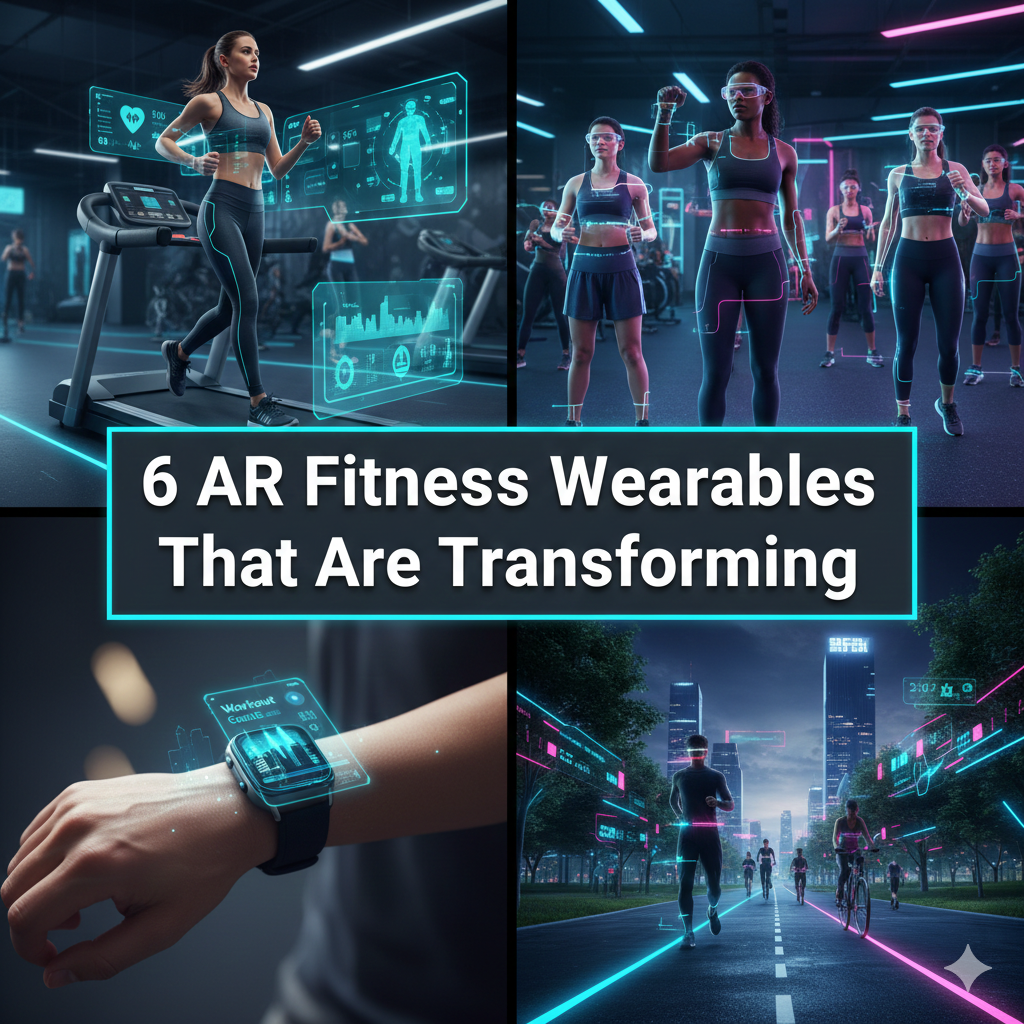
Imagine literally going for a run, and there’s the pace, heart rate, even your own virtual coach right in front of you. No phone. You don’t look down at your wrist. Just you, your workout and a heads-up display directing every step.
That’s precisely what AR fitness wearables are enabling today.
Augmented reality (AR) overlays digital content on the real world. When integrated into fitness gear, it gives ordinary workouts the potential to be interactive, data-rich experiences. You don’t just monitor your performance — you observe it instantaneously, superimposed onto your surroundings.
The fitness wearable sector is exploding. AR-driven devices, however, are a different ball game. They don’t merely tally steps or track sleep. They coach you, challenge you and push your limits like no traditional wearables can.
This article will discuss 6 powerful AR fitness wearables that are making waves in 2025. We’ll explain what each one does, who it’s best suited for and why it stands out from the pack.
Why Augmented Reality and Fitness Go Hand in Hand
Fitness is all about feedback. The sooner you receive feedback about what your body is doing, the better your workout becomes. Traditional wearables provide you with data after the fact — you check your watch, open an app or scroll through stats later on.
AR changes this completely.
With AR fitness wearables, your data is literally in your field of view. Your cadence, your pace, your calories burned, your target — all in view as you move. No pauses. No distractions. Just seamless, real-time coaching.
There’s a lot more at stake than most people know. Research suggests you perform and improve faster with real-time feedback during exercise. AR accomplishes this better than any other available technology today.
What to Look for in an AR Fitness Wearable
Not all devices with a fancy screen deserve to be called an AR fitness wearable. Before we get to the list, here’s what distinguishes the greats from the gimmicks:
| Feature | Why It Matters |
|---|---|
| Real-Time Data Overlay | Displays stats as you move, not after |
| Accurate Sensors | Heart rate, GPS and motion tracking must be precise |
| Comfortable Fit | Heavy or awkward device will go unused |
| Battery Life | Needs to last as long as your full workout |
| App Integration | Syncs with your fitness goals and history |
| Durability | Must withstand sweat, drops and outdoor use |
Keep those in mind as we run through each device below.
6 Proven AR Fitness Wearables You Must Know About
1. FORM Swim Goggles — Best-Rated AR Wearable for Swimmers
Who it’s for: Lap swimmers, triathletes, competitive swimmers
Swimming is one of the most difficult sports to track. You can’t check your phone in the middle of a stroke. You don’t have the luxury of stopping to glance at a watch between laps. For years, swimmers had no way to know their stats until they got out of the pool.
FORM Swim Goggles solved this problem in a big way.
They feature transparent displays embedded right into the lens. As you swim, your lap count, split times, stroke rate, heart rate (with the compatible chest strap) and calories burned appear in your view — floating like a heads-up display.
What makes them stand out:
Reading the display under water is very easy. The metrics are bright and clear, and they’re positioned so they don’t obstruct your view. You can change what stats are listed and the order they appear in.
FORM goggles also sync to the FORM app, which you can use to review complete workout breakdowns, set goals and track progress over time. The goggles feature AI-powered stroke detection that continuously recognizes freestyle, backstroke, breaststroke and butterfly.
Real-world performance:
Normal mode battery life is around 16 hours, or up to 7 hours for active display. The goggles are waterproof (of course), fog-resistant and can be fitted with prescription lenses — a major plus for swimmers who typically require corrective eyewear.
Price range: Around $199–$249
2. Everysight Raptor — Designed for Cyclists Seeking an Edge
Who it’s for: Road bikers, mountain bikers, competitive riders
Cycling already has a data culture. Cyclists enjoy tracking watts, cadence, speed and elevation. But it’s dangerous and disruptive to be looking down at a handlebar-mounted computer mid-ride.
The Everysight Raptor puts all of that data in your field of view.
These AR cycling glasses include a waveguide optical display on the right lens. They pair with popular cycling apps such as Strava, TrainingPeaks and Wahoo. You can see your speed, power output, heart rate, navigation arrows and interval timers — all while keeping your eyes on the road.
Why cyclists love it:
The Raptor features voice control, so you can start/stop recordings, mark laps, or take photos with a simple command. No hands required. The integrated camera also allows you to record footage while riding.
The display is readable in bright sunlight and low-light tunnels. It pairs with sensors via Bluetooth and ANT+, so it’s compatible with most existing bike gear.
Battery life: Up to 8 hours — plenty for most long rides
Bonus feature: Real-time navigation overlay — ideal for new roadways
Price range: Around $649
3. Vuzix Blade — The All-Rounder for Active Lifestyles
Who it’s for: Gym goers, runners, cross trainers
The Vuzix Blade looks like a regular pair of sunglasses. But inside is a full AR display, courtesy of a waveguide lens. It runs on Android, so it can run thousands of apps — including fitness ones.
The reason the Vuzix Blade is interesting for fitness is its versatility. It’s not pigeonholed into one sport. You can take it on runs, to the gym, while riding your bike or hiking — just about anything.
Key fitness features:
- Provides live display of notifications, workout data and GPS directions
- Compatible with popular apps like Google Fit and Strava
- Integrated speaker and microphone for hands-free calling
- 8MP camera to record your workouts
Standout quality:
Among all AR wearables on this list, the Blade looks the most “normal.” Most people won’t even notice you’re wearing smart glasses. For aesthetics-minded people, this is a big deal.
The display is sharp, and the interface is controlled via a touchpad located on the right arm of the glasses. It makes sense once you adjust to it.
One note: Battery life is approximately 2 hours of heavy display use. This may be a drawback for longer workouts. But for gym sessions or shorter runs, it is fantastic.
Price range: Around $799
4. North Focals (Now Google) — Smart Glasses That Whisper Your Stats
Who it’s for: Casual runners, light fitness users, everyday active people
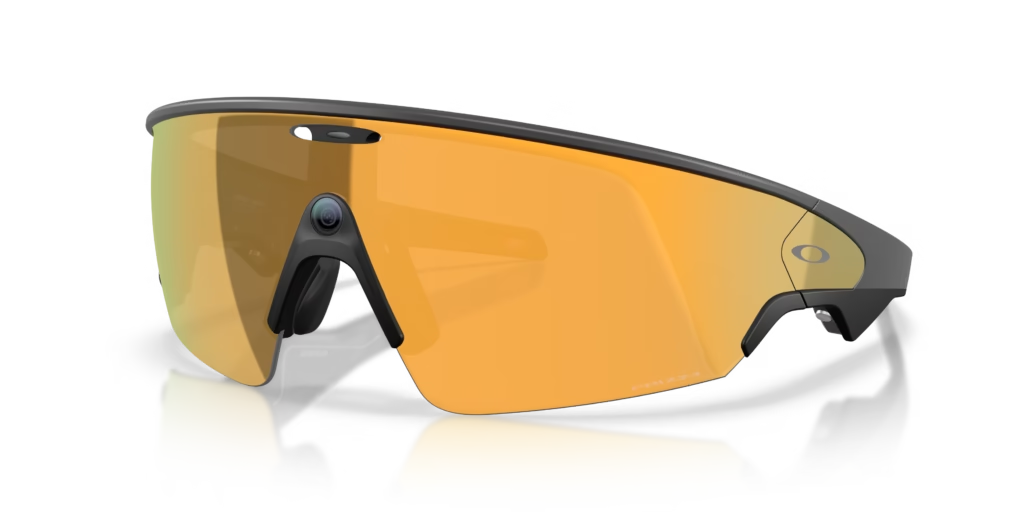
North Focals were built with an entirely different philosophy. Instead of a bright, bold AR display, they use a tiny laser-projected image in one spot in your field of vision. It’s subtle. Almost invisible to bystanders.
North was purchased by Google in 2020, and the technology has been incorporated into Google’s continued development of AR. But the original Focals revealed something important: AR fitness data doesn’t have to be overwhelming.
Why this approach works for fitness:
Not everyone wants a full heads-up display. They want a light push — a little reminder about their pace, a gentle alert when their heart rate spikes, a subtle notification when they’ve reached a goal.
North Focals delivered exactly this. They paired with smartphones via Bluetooth, tapping into fitness data from apps such as Google Fit. The display was small enough to stay in the background but always there when you needed it.
Legacy and influence:
While the original Focals are no longer for sale, they laid the groundwork for what is to come from Google’s AR glasses unit. If this minimalist approach sounds appealing, pay attention to what Google releases next — it’ll likely build heavily on this foundation.
This entry is included because: It shows that AR fitness wearables don’t have to be over-the-top to make an impact. Subtle AR has a place in fitness too.
5. WHOOP 4.0 with AR Integration Potential — A Recovery-First Wearable
Who it’s for: Serious athletes, recovery-minded users, biohackers
For now — WHOOP 4.0 is not a full AR wearable yet. But it deserves a place on this list for two reasons.
First, its sensor technology is some of the best in the wearable space. It tracks HRV (heart rate variability), skin temperature, blood oxygen and sleep quality with remarkable accuracy. Second, WHOOP has publicly indicated development toward AR-integrated coaching interfaces.
Why it matters right now:
The WHOOP 4.0 band connects to a phone app and serves up deep AR-ready data. When combined with AR glasses (like Vuzix or future Google AR devices), it can act as the data engine pulling real-time recovery and performance metrics into your field of view.
Think of WHOOP as the brain and AR glasses as the eyes. If you’re serious about tracking your body’s performance and recovery, pairing a device like WHOOP with the right AR glasses is the kind of setup covered in depth over at AR Body Health — a great resource for anyone exploring AR-powered fitness tools.
Standout stats:
| Metric Tracked | Frequency |
|---|---|
| Heart Rate | Continuous |
| HRV | Every night during sleep |
| Skin Temperature | Continuous |
| Blood Oxygen | Continuous |
| Respiratory Rate | Continuous |
| Activity Strain | Real-time during workouts |
Subscription model: WHOOP operates a membership model — the band itself is free, and you pay a monthly fee for the service. Plans start at around $30/month.
Future outlook: As AR hardware grows lighter and more mainstream, WHOOP-style biosensors will likely be integrated directly into the frames of AR glasses.
6. Meta Ray-Ban Smart Glasses (Gen 2) — AR Fitness Wearable for the Everyday Athlete
Who it’s for: Casual fitness users, walkers, outdoorsy types, social athletes
Meta and Ray-Ban joined forces to build something that didn’t smack of science fiction — and it worked. The Ray-Ban Meta Smart Glasses (second generation) look like ordinary stylish Ray-Ban sunglasses. But they’re packed with tech.
Fitness-relevant features:
The glasses feature open-ear speakers, built-in microphones and a 12MP camera — but most crucially, they run Meta AI. You can ask the built-in AI questions about your workout, get coaching tips or receive audio updates in real time.
Although the display capabilities are more limited than FORM or Everysight Raptor, Meta has confirmed that full AR overlay will be available in future versions. The Gen 2 glasses are an interim play — and they’re already selling like hotcakes.
Why they made this list:
They’re the most accessible entry point into AR-adjacent fitness wearables. They are stylish, affordable and comfortable enough to wear for hours. For a newcomer to the space, they are an excellent introduction.
Battery life: About 4 hours with heavy usage, 6+ hours moderate
Price range: Around $299–$329
The big picture: Meta’s larger roadmap points to a future of full AR overlays with fitness dashboards integrated within. The current version gives you audio AR — the visual AR is on the way.
Side-by-Side Comparison: All 6 AR Fitness Wearables
| Device | Best For | AR Type | Battery | Price |
|---|---|---|---|---|
| FORM Swim Goggles | Swimming | Lens overlay | 16 hrs | $200–$250 |
| Everysight Raptor | Cycling | Waveguide lens | 8 hrs | $649 |
| Vuzix Blade | Multi-sport | Waveguide lens | 2 hrs | $799 |
| North Focals | Casual fitness | Laser projection | 18 hrs | Discontinued |
| WHOOP 4.0 | Recovery tracking | AR-ready sensor | 4–5 days | $30/mo |
| Meta Ray-Ban Gen 2 | Everyday activity | Audio AR (visual coming) | 4–6 hrs | ~$299–$329 |
How AR Fitness Wearables Are Evolving in 2025
The pace of change in this space is fast. Here’s what’s happening right now:
Lighter hardware. Early AR glasses were bulky and uncomfortable. Today’s devices are nearing the weight of regular eyewear. By 2026, most AR fitness glasses are anticipated to weigh under 50 grams.
Better displays. Waveguide technology is improving rapidly. Colors are brighter, fields of view are wider and readability in sunlight has dramatically improved.
AI coaching. AI assistants are already present in devices such as Meta Ray-Ban Gen 2. Future AR fitness wearables will use AI to provide personalized, real-time coaching adapted to your specific biometrics, history and goals.
Integration with gym equipment. Soon AR wearables will sync with treadmills, smart bikes and resistance machines — overlaying form correction tips and performance targets directly in your field of vision.
Social fitness. Imagine the avatar of a friend running alongside you on your morning jog, even if they’re miles away. AR fitness wearables are moving toward shared, social workout experiences. According to Statista’s wearable technology market report, the global wearables market is expected to surpass $150 billion by 2026 — and AR fitness devices are a major driver of that growth.
Who Should Buy an AR Fitness Wearable?
AR fitness wearables aren’t for everyone — yet. Here’s a quick guide:
Buy one if you:
- Take fitness seriously and want real-time data
- Train for specific sports like swimming or cycling
- Get distracted checking your phone during workouts
- Want a more engaging and immersive workout experience
Wait if you:
- Are just starting with fitness and looking for a simple tracker
- Are on a tight budget (none of these devices are cheap)
- Exercise only a few times a month casually
The sweet spot right now is serious hobbyists and athletes. Over the next few years, as prices fall, these devices will go mainstream.
FAQs About AR Fitness Wearables
Q: What exactly is an AR fitness wearable? An AR fitness wearable is a device — usually glasses or goggles — that lays digital fitness data on top of your actual perspective. Instead of glancing at a phone or watch, you see your stats projected in front of you as you move.
Q: Is it safe to wear AR fitness wearables while exercising? Yes, when used correctly. There are sports-specific devices, including FORM Swim Goggles and Everysight Raptor. The displays are arranged so they don’t obstruct your primary field of view — they occupy the peripheral or lower region of your vision.
Q: Do AR fitness wearables work on their own without a phone? The majority of them function as stand-alone training tools during your workout. They store data on the device itself. But you’ll still need a phone (or computer) to sync, review and analyze your workout data afterward.
Q: Can I use AR fitness wearables in every sport? It depends on the device. FORM goggles are designed for the pool. Everysight Raptor is for cycling. The Vuzix Blade is the most versatile and works with several activities. Be sure to confirm sport-specific compatibility prior to purchase.
Q: Are AR fitness wearables worth the price? If you train consistently and want live data to enhance your performance, yes. Devices like the FORM Swim Goggles (~$200) offer excellent value. More premium devices such as the Vuzix Blade are better aimed at pros or serious enthusiasts.
Q: Will AR fitness wearables replace regular fitness trackers? Not immediately. But they’re moving in that direction. As the technology progresses and costs lower, AR wearables will likely provide everything a conventional tracker does — plus the visual overlay benefit.
Q: What is the best way to clean and maintain AR fitness wearables? Most devices have cleaning instructions attached. For swim goggles, rinse with fresh water after pool use. For glasses-type devices, use a microfiber cloth and avoid chemical cleaners. Always follow the manufacturer’s guide.
Wrapping It Up
AR fitness wearables are no longer science fiction. They’re here, they’re real, and the best ones are already yielding measurable benefits for athletes across the performance spectrum.
Whether you’re cutting through laps in the pool with FORM Swim Goggles, shredding cycling intervals with Everysight Raptor or just staying active with Meta Ray-Ban Smart Glasses, there’s an AR fitness wearable that matches your lifestyle.
The key takeaway? Real-time data beats delayed data every single time. And AR fitness wearables provide the most real-time data delivery of anything on the market today.
The technology is only going to improve. Lighter, smarter, cheaper and more powerful. The athletes who start using these devices now are building a habit that will give them a significant advantage as the tech matures.
So — which one caught your eye?