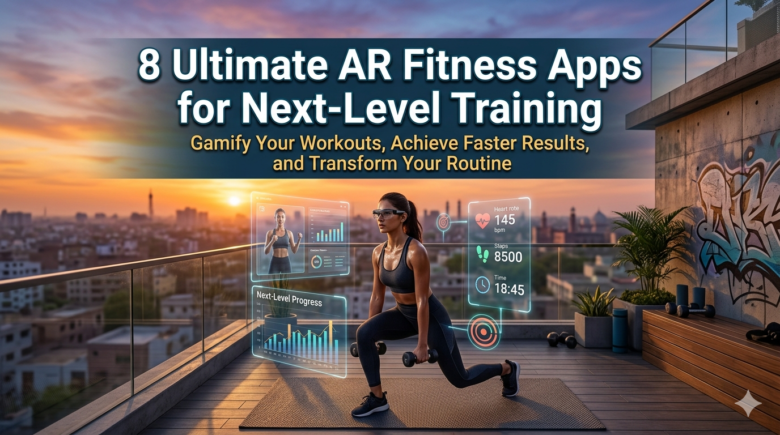
Augmented Reality (AR) has quietly moved from a futuristic idea into something people are actually using for daily workouts. Instead of staring at a flat screen or following static routines, AR fitness apps place movement cues, targets, and coaching elements directly into your real environment. Your room becomes a studio, your hallway becomes a track, and your body becomes the controller.
The biggest shift AR brings isn’t just “cool visuals.” It’s consistency. When workouts feel like interactive experiences instead of repetitive tasks, people are far more likely to stick with them long-term. That’s the real advantage behind the apps below.
This guide breaks down 8 ultimate AR fitness apps designed for next-level training, along with comparisons, structured data tables, and practical insights to help you choose what actually fits your lifestyle.
why AR fitness apps improve consistency
Before looking at individual apps, it’s important to understand the behavior shift they create.
Most people stop exercising not because workouts are too hard, but because they become boring or mentally draining. AR changes that by introducing:
- Real-time visual feedback in your environment
- Game-like progression systems
- Reduced cognitive effort (you just follow cues)
- Immersive distraction from fatigue
- Short-session design that feels “easy to start”
Table 1: Why AR fitness improves adherence
| Factor | Traditional workouts | AR fitness apps |
|---|---|---|
| Engagement | Low to moderate | High due to interactivity |
| Motivation source | Discipline | Game + feedback loops |
| Start difficulty | Mentally heavy | Low friction |
| Boredom resistance | Low | High |
| Habit formation | Slow | Faster |
Now let’s break down the apps.
- FitXR (AR-enhanced studio workouts)
FitXR is one of the most widely recognized immersive fitness platforms, combining boxing, dance, HIIT, and sculpt-style workouts in a virtual studio environment. Some newer modes even blend mixed-reality elements that bring targets and movement cues into your physical space.
It feels like stepping into a fitness class without leaving home.
Key consistency drivers:
- Fast 10–20 minute sessions
- Variety across multiple workout “studios”
- Multiplayer motivation and streak tracking
Table 2: FitXR breakdown
| Feature | Details |
|---|---|
| Workout types | Boxing, dance, HIIT, sculpt |
| Session length | 10–45 minutes |
| Social mode | Yes |
| Equipment | None |
- Supernatural (immersive AR-style scenic training)
Supernatural focuses on full-body cardio workouts in highly immersive scenic environments. You move to music while hitting targets and performing squats, lunges, and stretches.
It is designed to feel like a guided journey rather than repetitive exercise.
Why it builds consistency:
- Daily updated workouts
- Emotional engagement through music
- Beautiful environments reduce fatigue perception
Table 3: Supernatural training structure
| Element | Impact |
|---|---|
| Scenic environments | Reduces mental fatigue |
| Music integration | Increases workout enjoyment |
| Coach guidance | Builds routine structure |
- HOLOFIT (AR fitness exploration training)
HOLOFIT transforms cardio equipment like rowing machines, bikes, or ellipticals into virtual exploration experiences. Instead of staring at a wall, you move through digital landscapes.
Why it works:
- Turns cardio into exploration
- Works with existing gym/home equipment
- Supports endurance building without boredom
Table 4: HOLOFIT experience modes
| Mode | Purpose |
|---|---|
| Explore | Casual scenic movement |
| Train | Structured workouts |
| Race | Competitive challenges |
- Zombies, Run! (story-driven AR running)
Zombies, Run! uses audio-based AR storytelling to turn running into survival missions. You’re not jogging—you’re escaping zombies, collecting supplies, and completing missions.
Why it keeps users consistent:
- Narrative progression (like a game series)
- Missions instead of “runs”
- Emotional urgency increases engagement
Table 5: Motivation mechanics
| Feature | Effect on behavior |
|---|---|
| Story missions | Encourages daily use |
| Audio immersion | Keeps focus outside fatigue |
| Progress unlocks | Reinforces habit loop |
- Active Arcade (movement-based AR gaming fitness)
Active Arcade turns your body into a controller using simple AR motion tracking games. You jump, squat, and move to control gameplay.
Why it works:
- No gym mindset required
- Instant fun feedback loop
- Works in small spaces
Table 6: Active Arcade features
| Feature | Description |
|---|---|
| Game-based workouts | Yes |
| Equipment needed | None |
| Multiplayer | Yes |
| Skill level | Beginner-friendly |
- Kayyo (AR martial arts trainer)
Kayyo focuses on boxing and MMA-style workouts using AR feedback and AI motion tracking. It corrects form while you train.
Why it builds consistency:
- Structured progression system
- Real-time technique correction
- Short, repeatable training sessions
Table 7: Kayyo training breakdown
| Component | Function |
|---|---|
| Punch tracking | Improves form |
| AI coaching | Corrects mistakes |
| Difficulty scaling | Keeps progression steady |
- Gymnotize (AR strength training guide)
Gymnotize provides AR-based exercise demonstrations using animated avatars. It is particularly useful for beginners learning correct form.
Why it helps consistency:
- Removes uncertainty about exercise technique
- Reduces injury risk
- Beginner-friendly structure
Table 8: Gymnotize use case
| Use case | Benefit |
|---|---|
| Strength training | Structured guidance |
| Home workouts | No equipment needed |
| Beginners | Visual learning support |
- Tuby (casual AR workout gaming)
Tuby turns simple movements like squats, jumps, and push-ups into AR mini-games. It’s designed for low-pressure daily activity.
Why it works:
- Extremely low entry barrier
- Short sessions (even 5–10 minutes)
- Fun-first approach reduces resistance
Table 9: Tuby engagement model
| Feature | Effect |
|---|---|
| Mini-games | Reduces boredom |
| Short duration | Encourages daily use |
| No setup | Fast start |
comparison of all 8 AR fitness apps
Table 10: Overall comparison for consistency building
| App | Best for | Session length | Motivation style | Equipment |
|---|---|---|---|---|
| FitXR | Full-body training | Medium | Gamified studio | None |
| Supernatural | Immersive cardio | Medium | Scenic + music | None |
| HOLOFIT | Cardio machines | Long | Exploration | Optional |
| Zombies, Run! | Running | Long | Story-driven | None |
| Active Arcade | Casual movement | Short | Mini-games | None |
| Kayyo | Combat training | Short | AI coaching | None |
| Gymnotize | Beginners | Short | Visual learning | Optional |
| Tuby | Light fitness | Very short | Fun gameplay | None |
how to actually stay consistent using AR fitness apps
Even the best app won’t help if the usage pattern is wrong. The key is not intensity—it’s repetition.
Simple system that works:
- Start with 10–15 minutes daily
- Choose 1 “main app” + 1 backup app
- Use different apps for different moods
- Keep workouts frictionless (no setup excuses)
- Focus on streaks, not perfection
Table 11: Sample weekly AR routine
| Day | App | Focus |
|---|---|---|
| Monday | FitXR | Full-body cardio |
| Tuesday | Kayyo | Strength + combat |
| Wednesday | Zombies, Run! | Outdoor cardio |
| Thursday | Tuby | Light recovery |
| Friday | Supernatural | High-energy cardio |
| Saturday | HOLOFIT | Endurance session |
| Sunday | Active Arcade | Fun movement |
common mistakes people make
- Switching apps too often before forming a habit
- Starting with long sessions instead of short ones
- Treating AR apps like entertainment only (not training tools)
- Ignoring recovery days
- Chasing intensity instead of consistency
consistency vs intensity chart
Table 12: Long-term outcome comparison
| Approach | Early results | Long-term results |
|---|---|---|
| High intensity only | Fast progress | Burnout risk |
| AR-based consistency | Moderate progress | Sustainable fitness |
faqs
- are AR fitness apps actually effective for weight loss?
Yes, they can be effective when used consistently, especially because they increase adherence to daily movement. - do I need VR headsets for AR fitness apps?
Not always. Many AR fitness apps work on smartphones or tablets without headsets. - how long should I use AR fitness apps daily?
Even 10–30 minutes per day is enough if done consistently. - are AR workouts good for beginners?
Yes, most AR fitness apps are designed to reduce complexity and guide beginners visually. - can AR fitness replace the gym completely?
For general fitness, yes. For advanced strength training, it depends on your goals. - why do AR fitness apps help people stay consistent?
Because they reduce boredom, add instant feedback, and make workouts feel like interactive experiences rather than obligations.