Exercising at home seems easy enough. No commute. No gym fees. No waiting for equipment.
But here’s the truth about home workouts that most people experience — they are easy to start, and even easier to quit. The couch is right there. The TV is calling. When nobody’s watching, motivation evaporates quickly.
And that’s precisely where AR fitness home plans step in and turn the tables.
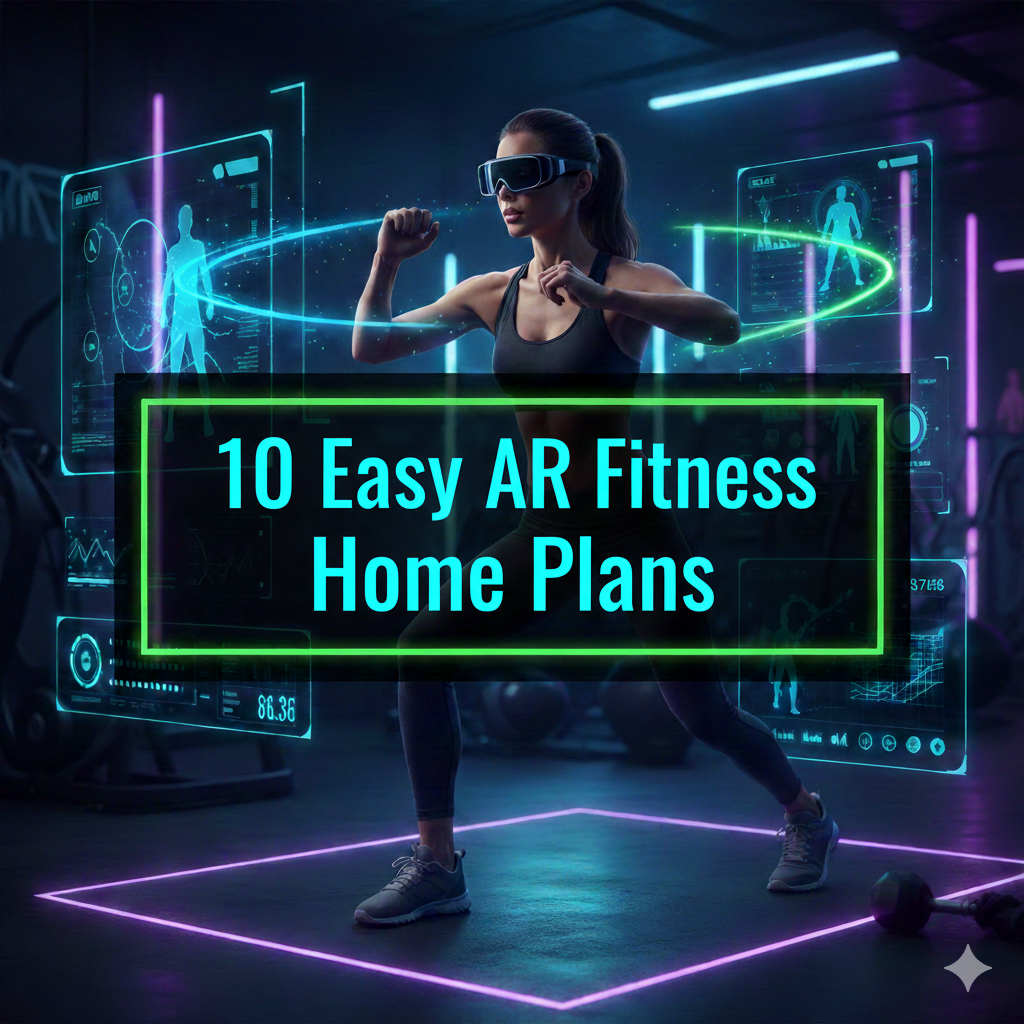
Augmented reality transforms your living room into a personal training studio. It overlays digital coaches, targets, challenges and feedback into your real environment. You don’t have to invest in a fancy home gym. You do not need a personal trainer on speed dial. All you need is a plan — and the right AR tools to support it.
This piece sets out 10 simple AR fitness home plans suited to various goals, fitness levels and schedules. Whether you’ve never broken a sweat at home or you’re an experienced home gym-goer who is ready for something new, there’s a plan here for you.
Time to create your ideal AR home workout plan.
Why AR Fitness at Home Just Hits Different
To jump into the plans, it helps to understand why AR fitness is so effective at home.
When at the gym, there is external motivation all around you. Other people in your midst are working hard. Music is pumping. Trainers are walking the floor. At home, all of that vanishes — and most people find it hard to make up for.
AR fills that motivational gap perfectly. It turns your space into an environment. It provides you with something to respond to, compete against and keep focused on. Research on distraction-based exercise consistently demonstrates that people who concentrate outward — on a game, a target, a visual challenge — tend to work harder and give up less often than those who are focused on how tired they feel.
That’s the secret engine powering every AR fitness home plan on this list.
What You Need to Get Started
You do not have to spend a fortune. Here’s a realistic overview of what different AR fitness setups actually need.
| Setup Level | Equipment Needed | Estimated Cost |
|---|---|---|
| Basic | Smartphone + floor space | $0 extra |
| Mid-level | Tablet or smart TV + AR app | $10–$30/month |
| Advanced | VR/AR headset (Meta Quest) | $300–$500 one-time |
| Premium | Smart home gym with AR overlay | $1,500–$3,000 |
Start where you are. Most of these plans work at the basic or mid-level. You can always upgrade later.
Plan 1 — The 20-Minute Morning Boost
Who It’s For
This plan works well for those who have zero spare minutes in the morning but want to kick-start their day with energy.
How It Works
Fire up an AR fitness app like Supernatural or FitXR and set a 20-minute guided workout the moment you wake up. The AR coach shows up in your space, guiding you through a warm-up, leading a moderate cardio blast and concluding with a quick cool-down.
Here, consistency trumps intensity. Twenty minutes every morning amounts to upwards of 120 hours of exercise per year — without ever entering a gym.
Sample Weekly Schedule
| Day | Session Type | Duration |
|---|---|---|
| Monday | AR cardio flow | 20 min |
| Tuesday | AR bodyweight strength | 20 min |
| Wednesday | Active rest or light stretch | 10 min |
| Thursday | AR cardio flow | 20 min |
| Friday | AR full body circuit | 20 min |
| Saturday | Optional longer session | 30–40 min |
| Sunday | Rest | — |
Pro tip: Ensure your AR device is fully charged and ready to go the night before. Eliminating setup friction makes it way more likely that you’ll actually do it.
Plan 2 — The Beginner Body Reboot
Starting From Zero? That’s Fine.
This plan is intended for total novices. No fitness background needed. Only a smartphone is required.
Three things are the focus: learning basic movement patterns, building the habit of showing up and not getting hurt by doing too much too soon.
AR Tools That Make This Easy
Apps like Kemtai use your phone’s camera to observe your motions and provide instantaneous feedback on form. For the absolute beginner, this is priceless. Instead of guessing whether your squat is correct, the AR overlay tells you this instantly.
Begin with two sessions per week. Each session should be less than 25 minutes. Concentrate on bodyweight movements — squats, modified push-ups, glute bridges and standing marches. Use the AR coach to help set the pace.
After four weeks, add a third session. After eight weeks, sessions can be lengthened to 30 minutes.
Slow and steady is not merely a cliché here. It is the strategy that allows novices to remain injury-free and make gains.
Plan 3 — The Lunch Break Burner
Transform 30 Minutes Into a Complete Workout
Working from home? You have an untapped fitness opportunity that office workers don’t — a lunch break without a commute on either end.
This AR fitness home plan is built around a tight 30-minute window. The aim is to work hard and return to your desk feeling invigorated, not exhausted.
Structure of the Session
Use an AR boxing or dance fitness app for the first 20 minutes. These formats lend themselves well to short bursts, as they keep your heart rate up throughout without needing a lot of equipment or setup.
Spend the last 10 minutes on a guided AR stretch or cool-down to lower your heart rate before heading back to work.
Over five working days, that comes to 150 minutes of exercise per week — more than the minimum recommended by most health guidelines — without encroaching on your evenings or weekends.
Plan 4 — The Family Fitness Hour
Get Everyone Off the Couch Together
Perhaps the most underappreciated AR fitness home plan is not for individuals at all. It’s for families.
From Beat Saber to Supernatural and Thrill of the Fight, AR fitness games are genuinely fun across an array of ages. Kids in particular respond to the gamified format — they don’t even consider it exercise. They think of it as playing.
How to Make It Work With Mixed Fitness Levels
The beauty of AR fitness for families is that everyone works at their own level. One person may be throwing intense boxing combinations while another grooves to a lighter rhythm game. The AR environment accommodates both.
Pick a regular time — Saturday morning or Sunday evening works well for most families. Treat it as a weekly ritual, not an isolated event. After a while, family fitness becomes ingrained in your household culture.
Bonus benefit: Children who grow up tying movement to fun are much more likely to remain physically active as adults. It’s a long-term victory disguised as just another fun Saturday activity.
Plan 5 — The Stress Buster Evening Routine
Wind Down by Moving It Out
Stress and physical tension accumulate during the day. By the end of the day, many people feel wound up, restless or mentally exhausted. This plan uses AR fitness specifically to decompress.
Choosing the right type of AR workout is crucial for evening use. High-intensity cardio right before bed can disrupt sleep. Instead, this plan focuses on moderate movement, breathwork and guided AR yoga or mobility flows.
Best AR Apps for the Evening Wind-Down
Apps like Tripp (which combines mindfulness with immersive AR environments) and guided VR yoga platforms can give a truly calming experience while still putting your body in motion.
A 30–40 minute evening session organized like this works really well:
- 10 minutes of light AR movement (walking in place, gentle arm circles, side steps)
- 15 minutes of AR-guided yoga or mobility flow
- 10 minutes of AR breathwork or guided relaxation
This approach doesn’t just improve your fitness. It reduces cortisol, enhances sleep quality and leaves you feeling truly recharged by bedtime.
Plan 6 — The 30-Day AR Strength Builder
Build Real Muscle Without Picking Up a Weight
This is a structured, progressive 30-day plan focused on developing functional strength through bodyweight AR workouts.
The plan runs in four stages across the month.
| Week | Focus | Sessions Per Week | Duration |
|---|---|---|---|
| Week 1 | Movement foundations | 3 | 20–25 min |
| Week 2 | Endurance base | 4 | 25–30 min |
| Week 3 | Strength progressions | 4 | 30–35 min |
| Week 4 | Peak challenge | 5 | 35–40 min |
AR form correction tools are crucial here. As exercises get harder — from standard push-ups to decline push-ups, from bodyweight squats to single-leg squats — the risk of form breaking down increases. Allowing the AR system to track your technique allows you to progress safely.
Movements Covered in This Plan
The 30-day plan is built around six foundational movements: push, pull, squat, hinge, carry and core. Every session in the plan hits at least three of these patterns. By the end of week four, your body should feel significantly stronger — and you’ll have created a sustainable habit in the process.
Plan 7 — The Step Counter Challenger
Outsmart the Sedentary Lifestyle
Sitting has been dubbed “the new smoking” — and with good reason. Long stretches of inactivity are associated with numerous health problems, even in people who exercise regularly.
This AR fitness home plan fills in the hours not spent on structured workouts. The objective is to reduce total sitting time by making movement breaks feel engaging rather than like interruptions.
How AR Gamifies Your Daily Steps
Apps like Zombies, Run! build AR-style narrative layers onto your walking. You aren’t just walking around your house or neighborhood — you’re on a mission. You’re collecting supplies. You’re outrunning something. The narrative provides meaning to every step.
Pair this with a modest step goal — 8,000 to 10,000 steps per day — tracked via your phone or a basic fitness band. Use the AR narrative as your primary motivation layer.
Over a week, someone hitting 10,000 steps per day covers roughly 35 to 40 miles. That’s a significant amount of active movement added to your life with minimal effort and maximum engagement.
Plan 8 — The Injury Recovery Plan
Move Again Without Fear
This plan is designed for individuals returning from an injury — a sprained ankle, a pulled muscle, post-surgery recovery or general deconditioning after taking time off.
Returning to exercise after injury is mentally challenging. There’s fear of re-injury. There’s uncertainty about what’s safe. There’s frustration at being less active than you used to be.
AR fitness tackles all three of these issues head-on.
Why AR Is Such a Good Fit for Rehabilitation
Real-time joint tracking through AR apps such as Kaia Health shows you exactly how far you’re moving a joint and whether you’re within the safe range defined by your physiotherapist. You receive immediate feedback rather than just guessing.
The gamification layer helps you get through otherwise deeply boring recovery exercises. And the adaptive difficulty of good AR platforms means the system grows with your improving capacity — you’re never stuck doing the same thing when you’re ready to go further.
Important note: Always receive medical clearance prior to engaging in any exercise following injury. Do not use AR as a replacement for professional physiotherapy guidance — use it as a supplement to the technology. If you want to understand how technology meets the body with recovery techniques, AR Body Health is a great resource for exploring body-focused recovery approaches.
Plan 9 — The High-Performance Sports Add-On
Already Fit? AR Can Still Push You Further
This plan isn’t for beginners. It’s for those who already have a strong fitness baseline and want to use AR to hone particular athletic qualities — reaction time, coordination, explosive power and sport-specific movement patterns.
AR fitness can train these qualities in ways that traditional gym work often can’t. When you’re responding to holographic targets appearing in random places around your space, your nervous system is working in a way that no barbell ever requires.
What This Plan Looks Like
Two to three AR sessions per week are added on top of an existing training program — not replacing it. Sessions are short (20–30 minutes) and extremely focused.
For a soccer player, an AR session could center around quick directional changes, reaction time and coordination. For a tennis player, it might stress shoulder mobility, lateral quickness and hand-eye accuracy. For a general athlete, a mixed AR combat sports session integrates agility, power and cardiovascular conditioning at the same time.
| Athletic Quality | Best AR Format | Sample App |
|---|---|---|
| Reaction time | AR boxing | FitXR |
| Coordination | Rhythm fitness | Beat Saber |
| Explosive power | AR combat | Thrill of the Fight |
| Endurance | AR cycling/running | Zwift |
| Flexibility | AR yoga flow | Tripp / VR yoga apps |
Plan 10 — The Habit Builder Plan
The Most Important Plan on This List
Every other plan on this list needs to be followed consistently in order to work. This plan is all about creating that consistency.
It’s not the hardest plan. It’s not the most intense. But for most people, it’s the one that leads to everything else — because it treats the habit of exercising as the goal in itself, rather than the workout.
The Science Behind the Plan
Behavioral research consistently tells us that the easiest way to form a new habit is to make it easy, immediate and rewarding. AR fitness works perfectly for all three.
Easy: Even five minutes of AR time counts. Seriously. The aim for the first two weeks is simply to open the app and do something every single day. At this stage, quantity trumps quality.
Immediate: AR platforms provide instant gratification — points, visual effects, stats comparisons and progress tracking. Every session has a payoff you can see right away.
Rewarding: The AR environment itself becomes the reward over time. You start to look forward to it. That’s when the habit is truly established.
The 8-Week Habit Ramp
| Weeks | Daily Goal | Session Length |
|---|---|---|
| 1–2 | Just show up | 5–10 min |
| 3–4 | Build momentum | 15–20 min |
| 5–6 | Establish rhythm | 25–30 min |
| 7–8 | Commit to the plan | 30–40 min |
Eight weeks from now, you won’t need motivation to work out. You’ll have a habit. And a habit is infinitely more valuable than a burst of motivation that comes and goes in two weeks.
Which Plan Is Right for You?
With 10 choices on the table, it’s useful to have a straightforward framework for selecting the right starting point.
| Your Situation | Best Starting Plan |
|---|---|
| Complete beginner | Plan 2 — Beginner Body Reboot |
| Short on time | Plan 1 — Morning Kickstart or Plan 3 — Lunch Break Burner |
| Family setting | Plan 4 — Family Fitness Hour |
| High stress levels | Plan 5 — Stress Buster Evening Routine |
| Recovering from injury | Plan 8 — Injury Recovery Plan |
| Already athletic | Plan 9 — High-Performance Add-On |
| Struggling with consistency | Plan 10 — Habit Builder Plan |
There’s no wrong choice. The best AR fitness home plan is the one you’ll actually follow.
The Worst Mistakes People Make With AR Home Workouts
Despite having a great plan, people still trip up. Here are the most common mistakes and how to avoid them.
Skipping the warm-up. AR fitness can be so engaging that you dive straight in. Don’t. Even five minutes of gentle movement before a vigorous session is enough to substantially lower the risk of injury.
Choosing the wrong intensity. Picking a plan that’s too hard leads to burnout. Choosing one that’s too easy results in boredom. Be honest about your current level and start one step below where you think you should be.
Relying on motivation alone. Motivation comes and goes. Treat your AR sessions like appointments. Consistency built on schedule beats consistency built on feeling like it.
Ignoring the data. The vast majority of AR platforms deliver detailed post-session data — calories burned, heart rate zones, form scores, personal bests. Use this data. It tells a story about your progress that raw feelings never can.
FAQs About AR Fitness Home Plans
Q: How much space do I need at home for AR fitness? Most AR fitness apps perform well in a small cleared area of about 6 feet by 6 feet. Some full-body AR workouts benefit from a little more space, but most of the plans on this list are designed for average living room conditions.
Q: Can I do AR fitness every day? Yes — but vary the intensity. Alternating between more intense AR sessions and lighter movement or recovery-oriented sessions safeguards against overtraining while keeping the habit long-term sustainable.
Q: Do AR fitness home plans work for older adults? Absolutely. Most AR fitness platforms provide low-impact options at different difficulty levels. Real-time form feedback is especially useful for older adults who want to exercise safely without a trainer present.
Q: Do AR fitness apps work without the internet? Some have offline modes, but the majority of AR fitness platforms need an internet connection to work fully — especially those with live social features or adaptive coaching.
Q: How do I know if an AR fitness app is really tracking my form correctly? Well-known apps such as Kemtai and Kaia Health apply validated pose estimation technology that has been clinically or scientifically tested. Look for applications that give detailed information on their tracking accuracy and come with genuine user reviews backing up their form correction claims.
Q: Which AR fitness app is best for complete beginners? Kemtai and Kaia Health are both well worth trying — they’re camera-based, headset-free and provide clear real-time feedback that beginners genuinely benefit from. If walking or cycling is your entry point, Zwift is a great option.
Q: Can AR fitness home plans replace gym memberships entirely? For most people with general fitness goals — improving health, losing weight, building functional strength, reducing stress — yes, a well-structured AR fitness home plan can fully substitute for a gym membership. Elite athletes or those with very specific strength goals may still benefit from supplementary gym access.
Your Next Step Starts Today
AR fitness home plans aren’t a hope for the future. They’re a practical, accessible and genuinely effective way to work out right now, in the home you already live in.
The 10 plans in this article cover every starting point, every schedule and every fitness goal. There’s no reason to keep postponing a consistent fitness routine because the gym feels too far, too expensive or too intimidating.
Your living room is already a gym. You just need to activate it.
Pick one plan. Download one app. Clear a small space. And press start.
Because the best workout is always the one you actually do — and with AR fitness in your corner, you may be amazed how often that actually turns out to be.