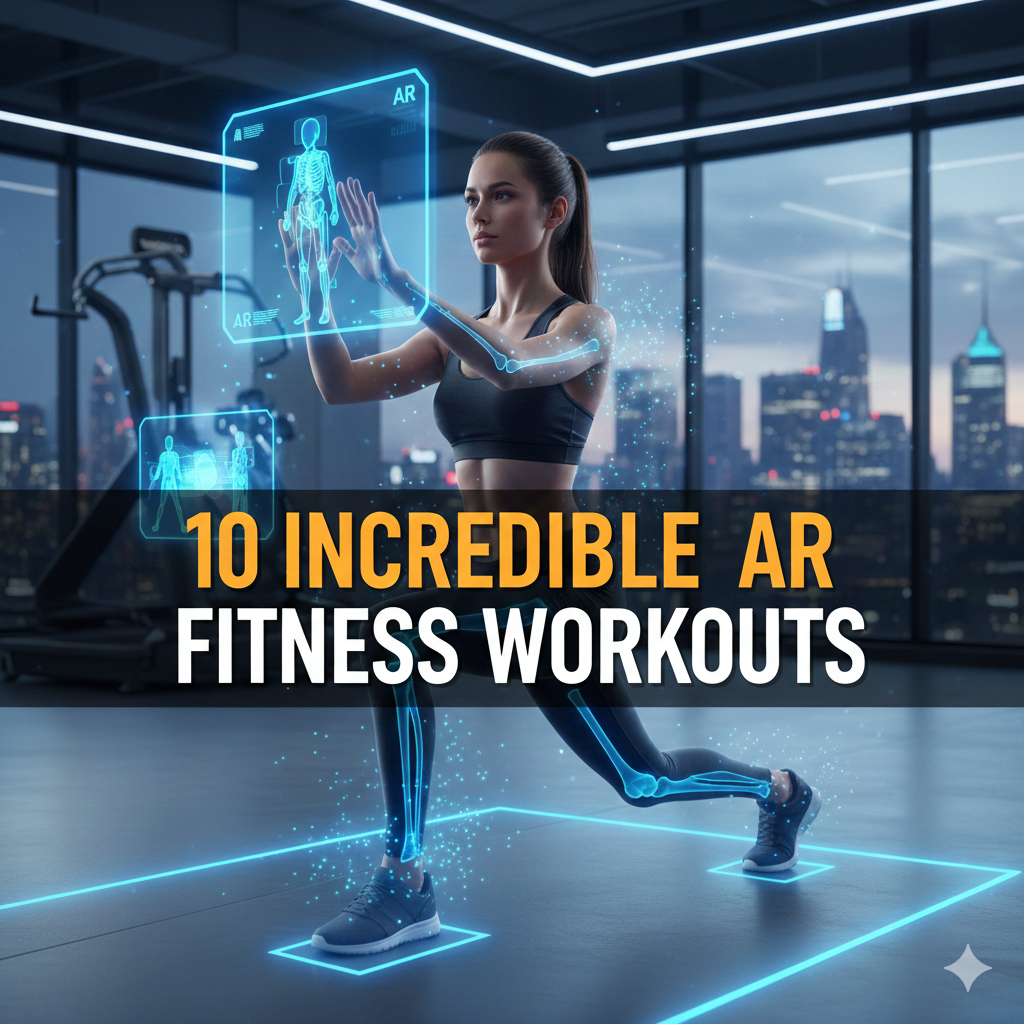
What if, at the same time, your workout could feel like a video game and an adventure and a personal training session?
That’s precisely what AR fitness workouts provide. Augmented reality is more than just for gaming or trying on virtual sunglasses. It has officially hit the gym — or rather, it has brought the gym to you.
All over, people are saying goodbye to long, lonely treadmill runs and boring weights. They’re swapping them out with interactive, immersive AR fitness workouts that tax the body while giving a thrill to the mind at once. The results are real. The sweat is real. And the fun? That’s real too.
From total beginners to advanced athletes wanting something new, AR fitness is packed with powerful activity. Read on for ten of the best AR fitness workouts you can try right now — what they are, how they work, and why they could be the workout evolution you’ve been hoping for.
Why Augmented Reality Fitness Workouts Are Effective
Before we delve into the list, it’s worth knowing why AR fitness workouts are effective.
Boredom is one thing that traditional workouts tend to fail due to. When exercise is a chore, motivation can fade away quickly. AR fitness workouts address this problem by making movement an experience.
According to a study conducted by the University of Westminster, participants who exercised using immersive technology experienced significantly greater levels of enjoyment and were also more likely to maintain their routines over time. Higher enjoyment equals higher consistency. Higher consistency equals better results.
AR fitness workouts also include instant feedback, social connectivity, and goal-based progression — three powerful psychological drivers that keep individuals returning again and again.
Workout #1 — AR Boxing: Smash Your Way to a Fitter Body

The continued popularity of this type of AR workout has led to the emergence of one in particular as a serious heavyweight: AR boxing. And for good reason.
On a Meta Quest headset, apps such as FitXR or Supernatural send virtual targets flying toward you at varying speeds and angles. You punch and duck and dodge — all while getting an intense full-body workout.
What AR Boxing Works Out
| Muscle Group | How It’s Activated |
|---|---|
| Shoulders | Constant punching motion |
| Core | Rotating with each punch |
| Legs | Squatting and dodging |
| Arms | Jab, cross, hook |
| Cardio System | Continuous high-intensity movement |
A half-hour AR boxing session can burn 300 to 500 calories depending on intensity. That competes with a traditional cardio-kickboxing class — but you don’t even have to leave your living room.
Who It’s Best For: Anyone looking for a high-energy cardio workout with some strength training thrown in.
Workout #2 — AR Dance Fitness: Shake Your Groove Thing and Burn Calories Quickly
Dance fitness has always been one of the most effective cardio workouts. Add augmented reality into the mix, and it becomes a beast of its own.
Apps such as Dance Reality and Just Dance directly integrate AR to insert dance moves and rhythm prompts into your environment. You see arrows, footprints, and glowing guides on your floor through your camera. You follow them and dance your way to a complete workout.
What Sets AR Dance Fitness Apart
You don’t have to be a dancer. The AR guides tell you where to step and when. The music maintains your energy. And an hour later, you’ve sweat through your clothes without feeling one second of it was “exercise.”
Dance-based AR fitness workouts are great for cardiovascular fitness. Consistent participation can enhance heart rate recovery, expand lung capacity, and raise overall stamina in as little as a few weeks.
Who It’s Best For: People who despise traditional cardio but very much enjoy music and movement.
Workout #3 — AR Yoga: Stretch, Breathe, and Build Flexibility on the Fly

Yoga is one of the most potent exercises for flexibility, strength, and mental wellness. AR yoga takes it to a whole new level.
Yoga-Go AR and Nadi X are apps that use augmented reality to project a virtual instructor into your real space. The instructor shows you each pose life-size — so you can copy them with precise alignment.
What Sets AR Yoga Apart From Standard Yoga Videos
With a regular video, you’re always staring at a screen on the wall or floor. Your form suffers. AR yoga comes with the instructor standing in your room, moving along with you. Some apps will even access your camera to analyze your pose and offer real-time adjustments.
If you want to dig deeper into how AR complements body health and wellness practices like yoga, check out AR Body Health — a great resource worth exploring for anyone serious about integrating augmented reality into their wellness routine.
Gains in flexibility, less stress, and better posture — all through a more immersive AR experience.
Who It’s Best For: Newcomers to yoga, people who are stressed out or tight, and anyone focused on flexibility and mobility.
Workout #4 — AR HIIT: Short, Intense, and Wicked Effective
High-Intensity Interval Training — or HIIT as it is more commonly known — is one of the most efficient workout styles ever created. Add AR to the mix and you end up with something truly next level.
AR HIIT workouts use platforms such as Les Mills Body Combat and FitXR to help you power through explosive intervals. Virtual coaches push you through burpees, squat jumps, mountain climbers, and sprints — while the AR environment responds to your movement.
A Sample AR HIIT Session (20 Minutes)
| Interval | Exercise | Duration | Rest |
|---|---|---|---|
| 1 | AR Target Punches | 40 seconds | 20 seconds |
| 2 | Squat Jumps | 40 seconds | 20 seconds |
| 3 | Mountain Climbers | 40 seconds | 20 seconds |
| 4 | Burpees | 40 seconds | 20 seconds |
| 5 | Lateral Shuffles | 40 seconds | 20 seconds |
Complete this circuit three to four times. The AR environment maintains the energy by tracking your reps, showing you your heart rate, and awarding points for completing each round.
HIIT workouts have been shown to incinerate calories for as long as 24 hours after the session ends — something known as the afterburn effect, or EPOC (Excess Post-Exercise Oxygen Consumption).
Who It’s Best For: Individuals short on time but looking for maximum calorie burn and cardiovascular benefit.
Workout #5 — AR Strength Training: Build Muscle With a Virtual Spotter

AR strength training is one of the top growing AR fitness workouts in the space. Apps such as Kaia Health and HomeCourt use your phone camera to monitor your movements and take you through resistance-based workouts while providing real-time feedback.
How AR Strength Training Works
Your phone is propped up in front of you. The app places digital markers on your body, tracking joint angles, rep counts, and range of motion. The app tells you if your squat isn’t deep enough. If your back rounds during a deadlift, it tells you right away.
This is about as close to having a real personal trainer — without the price tag.
Best Exercises to Try in AR Strength Workouts
- Bodyweight squats with depth tracking
- Push-up form analysis
- Glute bridge with hip angle monitoring
- Lunges with knee alignment feedback
- Plank holds with a timer and core activation cues
These AR fitness workouts help you build real muscle — the feedback makes sure you’re doing every movement correctly. Good form means the right muscles are engaging to do the work.
Who It’s Best For: Beginners working on good movement patterns, and intermediate lifters without a coach.
Workout #6 — AR Running Adventures: Make Every Jog a Mission
Running outdoors is terrific for the body but terrible for the mind — at least for a lot of people. AR running workouts solve that problem by making every jog a story-driven mission.
Zombies, Run! is the gold standard here. You pop your earbuds in and the app tells a post-apocalyptic story in which you are the hero. Zombies chase you. You collect supplies. You build a survivor camp. All while doing your actual route in your actual neighborhood.
According to research from the American College of Sports Medicine, narrative-driven exercise experiences can add around 28% more time on average to whatever unguided run people would usually engage in.
Other AR Running Apps Worth Trying
| App | Key Feature | Platform |
|---|---|---|
| Zombies, Run! | Story-driven zombie missions | iOS & Android |
| RunAR | AR checkpoints on real routes | iOS |
| Strava with AR Overlays | Social route challenges | iOS & Android |
| Nike Run Club | AR coaching cues | iOS & Android |
Who It’s Best For: Runners who have a tough time finding motivation, people preparing for a 5K or 10K, and anyone who wants outdoor exercise to feel like an adventure.
Workout #7 — AR Cycling: Pedal Through Virtual Worlds From Your House
Indoor cycling gets boring. You ride, you gaze at a wall, you question your existence. That all changes with AR cycling.
Platforms like Zwift and BitGym use augmented reality to transport you into virtual cycling environments. You pedal through lush mountain passes, along coastal roads, and through futuristic cities — all while on your stationary bike at home.
Why AR Cycling Is So Effective
The immersive environment lowers the perception of effort. This is a real, studied phenomenon. When your brain is busy with a colorful, exciting virtual world, it won’t pay as much attention to the pain you feel from your muscles and lungs working hard. Studies have shown that cyclists using immersive visual environments ride 20% longer on average than those staring at a blank wall.
AR cycling workouts are great for building leg strength, improving cardiovascular endurance, and burning calories while putting minimal stress on your joints — making them well-suited to people with joint problems who need to steer clear of high-impact exercise.
Who It’s Best For: Indoor cycling enthusiasts, those recovering from lower-body injuries, and anyone looking for a low-impact but high-output cardio option.
Workout #8 — AR Martial Arts: Train Like a Fighter Without a Sparring Partner
Traditionally, learning martial arts means a dojo, an instructor, and a sparring partner. AR martial arts workouts put an end to all three of these requirements.
Apps such as Liteboxer and The Thrill of the Fight use augmented reality to create a virtual opponent in front of you. You practice strikes, combos, blocks, and footwork — all against a virtual opponent who responds to your movements.
Benefits of AR Martial Arts Workouts
Full-body conditioning. Martial arts movements use the whole body — legs, core, arms, and cardio system all at once.
Stress relief. One of the best physical stress and tension releases is striking movements. AR martial arts workouts provide this in a safe, controlled atmosphere.
Skill development. AR opponents give you targets to hit and respond to your timing, unlike just shadow boxing. It develops actual coordination and reflexes over time.
A 45-minute AR martial arts session can burn around 400 to 600 calories depending on style and intensity level.
Who It’s Best For: Those seeking a combat sports experience, high-calorie-burning workouts, and powerful stress reduction.
Workout #9 — AR Climbing: Conquer Virtual Walls for Real Strength
Rock climbing is one of the best full-body workouts in existence. It develops grip strength, back muscles, core stability, and problem-solving skills simultaneously. But not everyone has a climbing wall at their disposal.
AR climbing workouts solve this. Apps like ClimbAR project virtual climbing routes onto your real wall at home. You trace the holds, make the moves, and send the route — all through your phone or AR glasses.
What Muscles Do AR Climbing Workouts Use
| Muscle Group | Activation Level |
|---|---|
| Forearms & Grip | Very High |
| Upper Back (Lats) | Very High |
| Biceps | High |
| Core | High |
| Shoulders | Moderate to High |
| Legs | Moderate |
Even simulated climbing motions — reaching, pulling, balancing — strongly engage these muscle groups. With real bodyweight resistance, AR climbing makes for a surprisingly tough workout.
Who It’s Best For: Anyone seeking upper body and core strength, climbers trying to train at home, and anyone looking for a workout that also builds mental focus.
Workout #10 — AR Mindful Movement: Recover, Reset, and Come Back Stronger
Not all workouts have to be high intensity. Recovery workouts are equally as valuable as the high-intensity ones. AR mindful movement merges gentle physical activity with immersive augmented reality settings to create an experience that feels genuinely restorative.
Apps such as TRIPP, Headspace Move, and Guided Meditation VR put you in soothing AR spaces — forests, beaches, mountains — as they direct your breathwork, mobility flows, and gentle stretching.
The Case for Recovery Workouts in Your Weekly Schedule
Recovery days often get the short end of the stick because they don’t feel productive. But skipping recovery leads to overtraining, injury, and burnout. AR mindful movement transforms recovery from a chore into a reward.
Here’s what a basic AR recovery session could look like:
| Phase | Activity | Duration |
|---|---|---|
| Opening | Guided breathwork in AR forest environment | 5 minutes |
| Movement | Gentle mobility flow with virtual instructor | 15 minutes |
| Stretching | Full-body stretch with AR pose guides | 10 minutes |
| Closing | Mindfulness meditation with calming AR visuals | 5 minutes |
This kind of session lowers muscle soreness and cortisol levels and sets your body up for when you tackle your next tough workout.
Who It’s Best For: Everyone — especially athletes who train five or more days a week, people with significant stress levels, and beginners needing active rest days.
At a Glance — How These 10 AR Fitness Workouts Stack Up
| Workout | Intensity | Calories Burned (30 min) | Best For |
|---|---|---|---|
| AR Boxing | High | 300–500 | Cardio + Strength |
| AR Dance Fitness | Moderate–High | 200–400 | Cardio + Fun |
| AR Yoga | Low–Moderate | 100–200 | Flexibility + Mindfulness |
| AR HIIT | Very High | 350–500 | Fat Burn + Cardio |
| AR Strength Training | Moderate–High | 150–300 | Muscle Building |
| AR Running | Moderate–High | 250–400 | Endurance |
| AR Cycling | Moderate–High | 250–450 | Low-Impact Cardio |
| AR Martial Arts | High | 300–500 | Full-Body + Stress Relief |
| AR Climbing | High | 250–400 | Strength + Focus |
| AR Mindful Movement | Low | 80–150 | Recovery + Wellness |
Building a Weekly Routine With AR Fitness Workouts
The best approach is variety. By interspersing different AR fitness workouts throughout your week, you can challenge your body and keep your mind active.
Here’s a sample weekly plan:
Monday — AR HIIT (20–30 minutes) Tuesday — AR Strength Training (30–40 minutes) Wednesday — AR Yoga or Mindful Movement (30 minutes) Thursday — AR Boxing or Martial Arts (30–45 minutes) Friday — AR Running or Cycling (30–45 minutes) Saturday — AR Dance Fitness (30–40 minutes) Sunday — AR Mindful Movement or complete rest
This plan covers all of the major fitness bases — cardio, strength, flexibility, and recovery — while sparing you from boredom with new routines every single day.
FAQs About AR Fitness Workouts
What equipment do I need for AR fitness workouts? Most AR fitness workouts require only a smartphone. If you want a more immersive experience, a Meta Quest 3 headset gives you access to the full range of AR and VR fitness apps. A yoga mat, a little space, and comfortable workout clothes complete everything you need.
Do AR workouts help with weight loss? Yes, absolutely. High-intensity options like AR boxing, HIIT, and martial arts can burn between 300 to 500 calories a session. AR fitness workouts are an amazing tool for weight loss when combined with a balanced diet. The main benefit is adherence — since the workouts are enjoyable, people continue doing them more often.
Is it possible to build real muscle from AR fitness workouts? Yes. AR strength training and climbing workouts use bodyweight plus resistance moves to activate real muscle groups. The AR technology enhances form, so the right muscles are doing the work consistently. To make big muscle gains, you might want to supplement AR workouts with free weights or resistance bands.
Are AR fitness workouts safe for older adults? Many AR fitness workouts — especially yoga, mindful movement, and cycling — are low-impact and well-suited to older adults. Always check in with a doctor before beginning any new exercise routine. Choose the least-intense option first and build up from there.
How much do AR fitness apps cost? Prices vary widely. Most apps have free tiers with limited features. Premium subscriptions are generally priced at $10 to $40 per month. A Meta Quest device for truly immersive AR workouts costs $300 to $500 — and can pay off in the long run compared to gym fees.
Can you get a proper AR workout without a headset? Yes. Many powerful AR fitness workouts require nothing other than a smartphone. Apps like Zombies, Run!, Kaia Health, and Dance Reality offer great workouts using just your phone camera and screen.
How long should an AR fitness workout session be? As a novice, stick with 20 to 30 minutes per session. As your fitness level builds, target 30 to 45 minutes. Recovery sessions can be short — 20 minutes is enough to work wonders.
The Next Workout Is More Interesting Than You Might Think
AR fitness workouts are here to stay. They are the future of how people move, exercise, and maintain their bodies.
The 10 workouts in this article cover nearly every fitness goal — fat loss, muscle building, flexibility, endurance, stress relief, and recovery. There’s really something here for every level of fitness, every schedule, and every personality.
The science backs it up. The technology is ready. All that remains is for you to give it a shot.
Pick one workout from this list. Clear some space. Open an app. And find out what it’s like when exercise stops being something you hate and becomes something you genuinely look forward to.
Your strongest, healthiest self is out there — and AR fitness workouts are one of the most exciting ways to get you there.