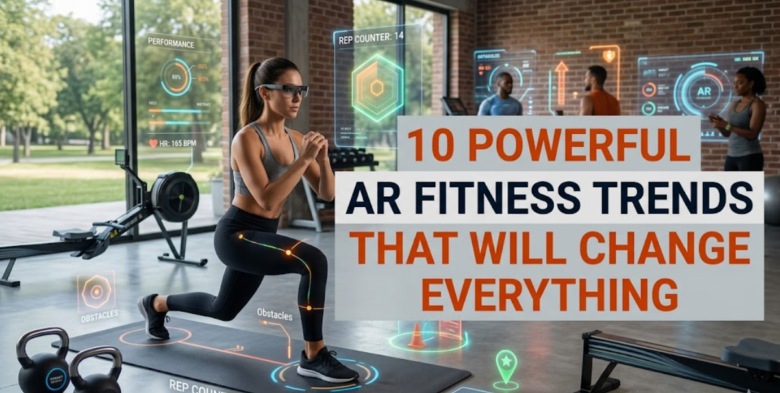
Augmented reality fitness is no longer a niche experiment or a futuristic gimmick. In 2026, it has quietly become one of the fastest-growing intersections of health tech and interactive entertainment. What started as simple smartphone overlays has evolved into full-body training systems, immersive outdoor games, and AI-powered coaching environments.
But what matters more than the technology itself is the direction it’s heading.
AR fitness is not just improving workouts—it is redefining what a workout even means.
Below are ten powerful AR fitness trends that are already emerging or accelerating rapidly, and are likely to shape how people move, train, and stay healthy in the near future.
quick overview of AR fitness evolution
| Era | Phase | Description |
|---|---|---|
| 2016–2019 | Early AR Fitness | Basic step tracking + gamified apps |
| 2020–2023 | Hybrid Growth | Camera-based AR workouts, pandemic boost |
| 2024–2026 | Immersive AR Fitness | AI coaching + real-time body tracking |
| 2027+ (projected) | Full Spatial Fitness | AR glasses + environment-wide workouts |
The shift is clear: from screen-based interaction → to environment-based interaction.
trend 1: full-body AR tracking without wearables
One of the biggest breakthroughs is the move toward markerless full-body tracking.
Instead of requiring sensors or wearable devices, modern AR fitness systems now use:
- AI pose estimation
- depth-sensing cameras
- multi-angle motion analysis
This allows apps to understand:
- joint angles
- movement accuracy
- balance shifts
- muscle engagement patterns
comparison table:
| Tracking Method | Accuracy | Accessibility | Cost |
|---|---|---|---|
| Wearables | Very high | Low | High |
| Phone camera AI | High | Very high | Low |
| Depth sensors | Very high | Medium | High |
| AR glasses (new) | Extremely high | Growing | Very high |
Why it matters: it removes friction. The fewer devices needed, the more likely people are to actually use it.
trend 2: fitness games replacing traditional workout apps
The line between gaming and fitness is disappearing.
Instead of “sets and reps,” users now:
- dodge virtual obstacles
- chase digital targets
- complete story missions
- compete in AR leaderboards
Example comparison:
| Traditional App | AR Game Equivalent |
|---|---|
| 30-minute cardio | Escape zombie chase mission |
| Squat routine | Hit moving targets game |
| Running intervals | AR race against ghost runner |
This shift is important because engagement—not intensity—is what drives consistency.
trend 3: AI personal trainers inside AR environments
AI coaching is becoming deeply integrated into AR fitness platforms.
Instead of watching a video, users now receive:
- real-time posture correction
- voice feedback during movement
- adaptive difficulty scaling
- personalized training adjustments
AI coaching layers:
| Layer | Function |
|---|---|
| Visual AR overlay | Shows correct form |
| Audio feedback | Gives corrections in real time |
| Adaptive engine | Adjusts difficulty |
| Performance memory | Tracks long-term progress |
This effectively replaces the need for a human trainer in many cases.
trend 4: outdoor AR fitness ecosystems
AR fitness is moving beyond indoor workouts.
Outdoor AR systems now turn cities, parks, and streets into interactive training maps.
Examples:
- virtual checkpoints across running routes
- location-based fitness quests
- AR treasure hunts requiring physical movement
- group-based competitive fitness events
environment comparison:
| Environment | Engagement Level | Difficulty |
|---|---|---|
| Gym | Medium | Controlled |
| Home | Medium–high | Flexible |
| Outdoor AR zones | Very high | Dynamic |
This trend is especially strong in urban fitness communities.
trend 5: multiplayer AR fitness competitions
Fitness is becoming social again—but in a digital-physical hybrid way.
Users can now:
- compete in real-time AR races
- join global fitness leagues
- challenge friends in virtual arenas
- participate in ranked workout battles
multiplayer engagement breakdown:
| Mode | Interaction Type | Motivation Level |
|---|---|---|
| Solo AR workout | Self-driven | Medium |
| Friend challenges | Competitive | High |
| Global leaderboards | Competitive + social | Very high |
| Team events | Cooperative | Very high |
This social layer dramatically improves retention rates.
trend 6: adaptive difficulty based on biometrics
AR fitness systems are starting to adjust workouts based on:
- heart rate
- fatigue level
- movement quality
- breathing patterns
Instead of fixed routines, workouts evolve in real time.
adaptive system flow:
User state → AI detection → intensity adjustment → feedback loop → updated challenge
This creates a dynamic workout that feels personalized at every second.
trend 7: mixed reality wearables replacing smartphones
While smartphones dominate now, AR glasses are quickly entering fitness spaces.
Benefits include:
- hands-free workouts
- wider field of view
- more immersive overlays
- continuous tracking without holding a device
device shift forecast:
| Device | 2026 Usage | 2030 Projection |
|---|---|---|
| Smartphones | High | Medium |
| Smartwatches | Medium | Medium |
| AR glasses | Growing | Very high |
| Full XR suits | Experimental | Emerging |
This trend may eventually redefine home fitness entirely.
trend 8: gamified recovery and injury prevention
AR fitness is not just about training—it is also improving recovery.
New systems now include:
- guided stretching routines in AR
- posture correction for rehabilitation
- mobility training games
- injury prevention feedback loops
recovery comparison:
| Method | Feedback | Engagement |
|---|---|---|
| Static stretching | Low | Low |
| Video guidance | Medium | Medium |
| AR recovery training | High | High |
This is especially important for long-term fitness sustainability.
trend 9: personalized fitness worlds
Instead of generic workouts, users are now entering customized AR environments.
Examples include:
- futuristic training arenas
- nature simulation zones
- competitive sports fields
- fantasy-style workout missions
These environments adapt based on:
- user progress
- fitness goals
- performance history
personalization depth:
| Level | Description |
|---|---|
| Basic | Custom workouts |
| Medium | Theme-based AR environments |
| Advanced | Fully adaptive fitness worlds |
| Future | Persistent virtual fitness universe |
This makes exercise feel like entering a game world.
trend 10: emotion-driven fitness feedback systems
One of the most fascinating trends is emotional adaptation.
AR systems are beginning to detect:
- frustration levels
- motivation drops
- fatigue signals
- engagement patterns
Then they respond by:
- reducing difficulty
- changing environment
- switching game modes
- offering motivational cues
emotion-response loop:
Emotion detection → AI interpretation → workout adjustment → improved engagement
This creates a highly human-like training experience.
impact summary of all trends
| Trend Category | Main Benefit |
|---|---|
| AI coaching | Personalization |
| AR gaming | Engagement |
| Wearable-free tracking | Accessibility |
| Multiplayer systems | Motivation |
| Adaptive training | Efficiency |
Together, these trends point toward a future where fitness is no longer separate from daily life—it is embedded into it.
challenges still facing AR fitness
Despite rapid growth, challenges remain:
- battery consumption on mobile devices
- accuracy limitations in complex movements
- space constraints indoors
- accessibility gaps in developing regions
- over-gamification reducing seriousness for some users
However, each year reduces these limitations significantly.
future outlook of AR fitness
The next phase of AR fitness will likely include:
- full-room spatial mapping
- persistent fitness avatars across apps
- real-world gyms layered with AR overlays
- AI fitness ecosystems that learn lifelong habits
In simple terms: fitness will stop being an activity you schedule—and become something you exist inside of.
FAQs
- What is AR fitness exactly?
AR fitness combines physical exercise with augmented reality elements like digital overlays, interactive challenges, and real-time feedback. - Do AR fitness trends require special devices?
Most current trends work on smartphones, but future systems will increasingly use AR glasses and wearable sensors. - Is AR fitness better than traditional workouts?
Not necessarily better, but often more engaging, which leads to higher consistency for many users. - Can AR fitness help beginners stay motivated?
Yes. Gamification and real-time feedback make workouts feel less intimidating and more enjoyable. - Are AR fitness apps safe to use daily?
Generally yes, as long as users follow proper form guidance and avoid overtraining. - What is the biggest future trend in AR fitness?
AI-driven adaptive workouts combined with AR glasses are expected to be the most transformative shift.