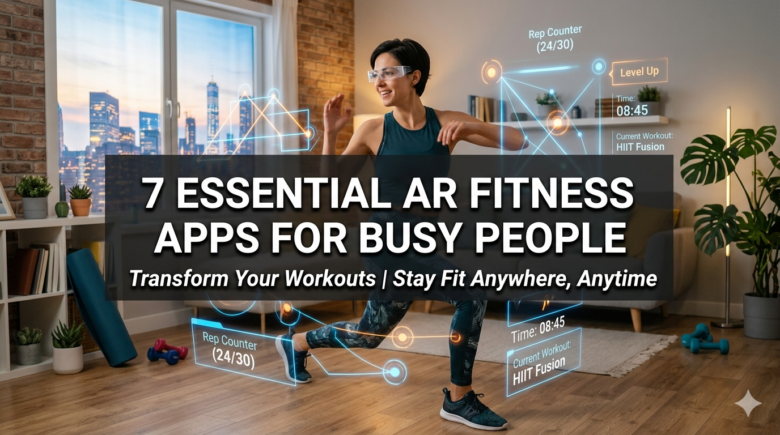
There’s a quiet shift happening in fitness—and if you’re someone constantly juggling deadlines, errands, and personal commitments, you’ve probably felt it. Traditional gym routines don’t always fit into modern schedules anymore. That’s where augmented reality (AR) fitness apps come in, blending movement with immersive digital layers that make workouts faster, more engaging, and surprisingly efficient.
Unlike standard fitness apps, AR platforms place interactive elements into your real environment. You’re not just following instructions—you’re reacting, competing, and moving with purpose. The result? Shorter workouts that feel less like chores and more like experiences.
This article explores seven essential AR fitness apps designed specifically for busy people. Along the way, you’ll find data tables, comparisons, and practical insights to help you choose what actually works.
why AR fitness works for busy lifestyles
Before diving into apps, it’s worth understanding why AR is gaining traction.
AR fitness apps merge digital visuals with your real surroundings, turning exercise into a gamified and interactive experience.
Instead of scheduling long gym sessions, users can squeeze in short, effective bursts of activity—often anywhere, anytime. This flexibility is one of the biggest reasons AR fitness is growing rapidly.
Key benefits:
- Time-efficient workouts (10–20 minutes)
- No need for gym equipment
- Higher engagement = better consistency
- Real-time feedback on movement and form
quick comparison of AR fitness app categories
| Category | Best For | Time Required | Equipment Needed | Engagement Level |
|---|---|---|---|---|
| Gamified fitness | Motivation & fun | 10–20 min | None | Very high |
| AR trainers | Form & technique | 15–30 min | Optional | High |
| Running AR apps | Outdoor activity | 20–40 min | None | Medium |
| Visualization apps | Progress tracking | 5–10 min | None | Low–medium |
- Active Arcade – turn your body into the controller
This app feels less like exercise and more like play.
Instead of tapping buttons, your body becomes the controller. You jump, dodge, and react to on-screen prompts projected into your space. Games like reaction challenges and movement-based drills make it ideal for short bursts of activity.
Why it works for busy people:
- No setup time
- Quick sessions (under 15 minutes)
- Engaging enough to replace “scroll time”
According to reviews, it requires minimal or no equipment and offers multiplayer options, adding a social element to quick workouts.
- Fyter – structured workouts with AR feedback
If you prefer something closer to a traditional workout—but smarter—this is where Fyter shines.
It combines AR overlays with skeletal tracking to guide your form and count reps in real time.
Features:
- HIIT, boxing, and strength routines
- Real-time motion tracking
- Progress analytics and leaderboards
Best use case:
Busy professionals who want structured workouts without a trainer.
- AR Fitness Trainer – your personal trainer at home
This app literally places a virtual trainer in your room.
You can walk around the trainer, observe movements from different angles, and then replicate exercises.
Why it stands out:
- Great for beginners
- Helps with form correction
- Works in small spaces
Perfect for:
People who don’t have time to attend guided classes.
- Kayyo – high-intensity combat workouts
For those who want intensity without complexity, Kayyo offers AR-assisted MMA training.
The app analyzes your punches, alignment, and movement, delivering real-time feedback.
What makes it effective:
- Short, high-impact sessions
- Skill-based progression
- Real-time performance tracking
This is ideal for people who want maximum calorie burn in minimal time.
- AR Trend – Funny Challenge – fitness disguised as fun
Sometimes, the biggest challenge isn’t time—it’s motivation.
This app solves that by turning workouts into playful challenges where your body acts as the controller. It uses motion tracking to gamify movement and keep users engaged.
Best for:
- Beginners
- People who get bored easily
- Quick daily activity boosts
- Fitness AR – visualize your progress
This app is different. It focuses less on doing workouts and more on visualizing them.
By integrating with platforms like Strava, it creates 3D AR maps of your runs and rides.
Why it matters:
- Helps track progress visually
- Encourages consistency
- Great for runners and cyclists
Perfect for busy people who need motivation more than instruction.
- Tuby – simple, beginner-friendly workouts
Tuby keeps things simple and effective.
You perform exercises like squats, jumps, and push-ups within AR-based mini-games.
Why it’s useful:
- Easy learning curve
- Short sessions
- Works anywhere
Best suited for:
People starting their fitness journey with limited time.
performance comparison of the 7 apps
| App | Workout Type | Avg Session Time | Skill Level | Unique Feature |
|---|---|---|---|---|
| Active Arcade | Gamified | 10–15 min | Beginner | Body as controller |
| Fyter | Structured training | 20–30 min | Intermediate | Skeletal tracking |
| AR Fitness Trainer | Guided workouts | 15–25 min | Beginner | Virtual trainer |
| Kayyo | MMA training | 10–20 min | Intermediate | AI feedback |
| AR Trend | Gamified | 10–15 min | Beginner | Motion challenges |
| Fitness AR | Visualization | 5–10 min | All levels | 3D workout maps |
| Tuby | Gamified workouts | 10–20 min | Beginner | Simple exercises |
how to choose the right AR fitness app
Choosing the wrong app wastes more time than it saves. So focus on this:
If you want quick motivation → go for gamified apps
If you want structure → choose trainer-based apps
If you run or cycle → pick visualization tools
If you want intensity → try AR combat training
Simple rule:
Pick the app that removes friction, not adds complexity.
sample weekly routine using AR fitness apps
| Day | App | Workout Type | Duration |
|---|---|---|---|
| Monday | Active Arcade | Cardio game | 15 min |
| Tuesday | Fyter | Strength training | 25 min |
| Wednesday | Tuby | Light workout | 15 min |
| Thursday | Kayyo | HIIT/MMA | 20 min |
| Friday | AR Fitness Trainer | Technique | 20 min |
| Saturday | Fitness AR | Review progress | 10 min |
| Sunday | AR Trend | Fun recovery workout | 15 min |
the psychology behind AR fitness success
One underrated reason AR fitness works is psychological engagement.
People are more likely to stick with activities that feel like play rather than obligation. AR turns repetition into interaction, making workouts feel shorter and more rewarding.
As one Reddit user put it:
“AR can make workouts feel more like gaming”
That simple shift—from effort to enjoyment—can make all the difference for consistency.
future of AR fitness for busy people
AR fitness isn’t just a trend—it’s part of a broader shift toward flexible, home-based exercise.
Experts note that AR encourages exploration, autonomy, and engagement in fitness routines, especially for people who avoid gyms.
Expect to see:
- Smarter motion tracking
- Wearable AR integration
- AI-driven coaching
- More immersive fitness games
final thoughts
If you’re busy, the biggest challenge isn’t knowing what to do—it’s actually doing it.
AR fitness apps remove many of the barriers:
- No travel time
- No complicated setup
- No boredom
But not all apps are equal. The best one is the one you’ll actually open daily.
Start small. Try one. Build consistency.
That’s where real results begin.
FAQs
- Are AR fitness apps effective for weight loss?
Yes, especially gamified and HIIT-based apps. They encourage consistent movement, which is more important than intensity alone. - Do I need special equipment for AR workouts?
Most apps only require a smartphone. Some may optionally use wearables or accessories. - How much time should I spend on AR fitness daily?
Even 10–20 minutes per day can be effective if done consistently. - Are AR fitness apps suitable for beginners?
Absolutely. Many apps like Tuby and AR Fitness Trainer are designed specifically for beginners. - Can AR apps replace the gym?
For general fitness, yes. For heavy strength training, you may still need equipment. - Do AR fitness apps work offline?
Some features may work offline, but most require internet for full functionality, updates, and tracking.