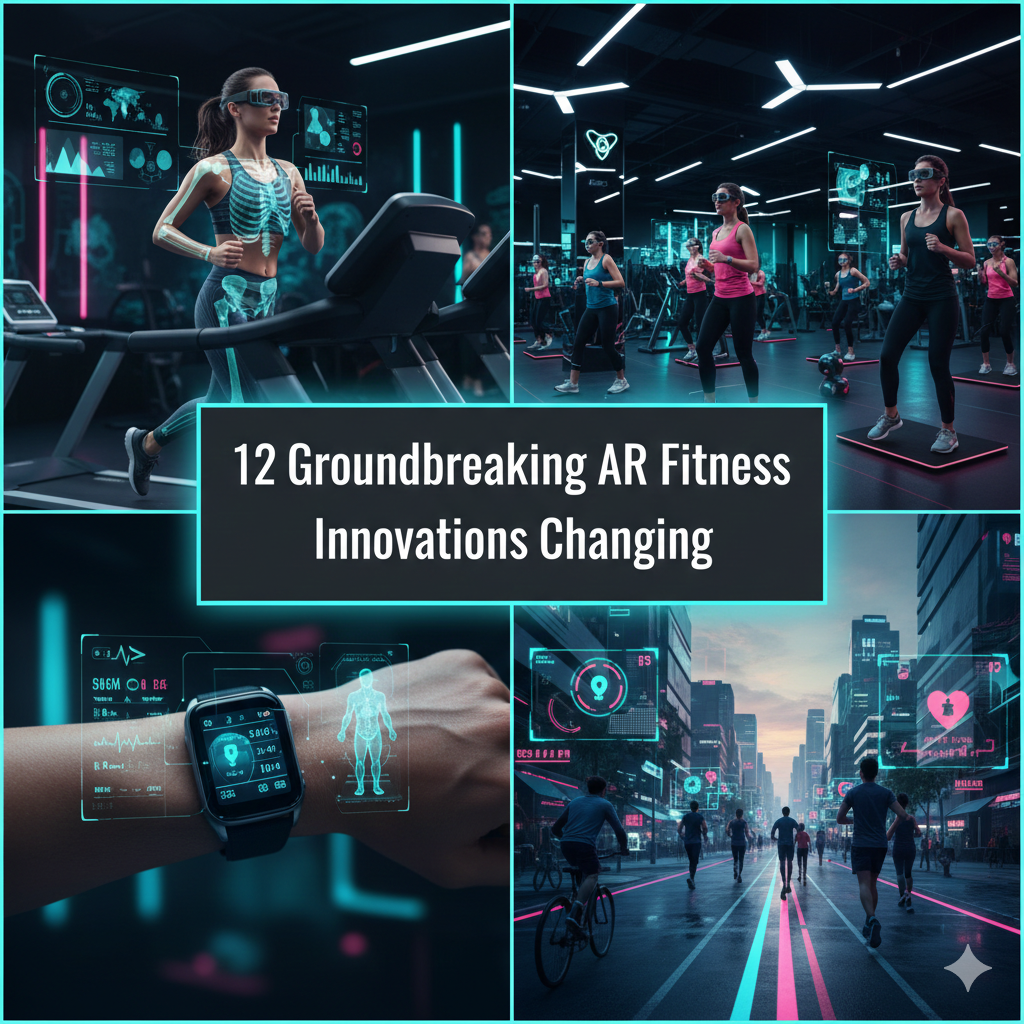
What if your morning jog included a virtual pace car driving ahead of you?
What if your gym mirror could see every error in your squat — and correct it on the spot?
What if your fitness coach resided in your glasses?
None of this is fantasy anymore. AR fitness innovations are bringing these concepts to life, one workout at a time. Augmented reality is barreling into the fitness world at full speed, bringing with it better coaching, smarter data, and truly fun workouts.
This isn’t simply about cool tech. This is a paradigm shift in human health and physical performance.
In this article, we break down 12 of the most powerful AR fitness innovations taking place right now. Some are in your hands already. Some are coming soon. All of them are worth learning about.
Let’s go.
Why Augmented Reality and Fitness Work So Well Together
There have always been three big problems with fitness.
People get bored. People train wrong. And people give up too soon.
AR fitness innovations tackle all three issues head-on. Augmented reality turns workouts interactive and visually engaging. It provides real-time feedback so you’re never working out with bad form. And it keeps you inspired by making exercise feel more like a game or an adventure.
The AR fitness market is rapidly expanding all over the world. The AR and VR fitness market is projected to exceed $6 billion by 2030, according to industry analysts. That’s not a niche trend. That’s a full-blown revolution.
And the innovations powering that revolution? That’s exactly what we’re here to discuss.
How AR Actually Works in a Fitness Setting
Before we get to the list, here’s a brief, simple summary of how AR fitness technology works.
AR overlays digital content on your real-world view. A camera or sensor scans your surroundings and your body. Software processes that data. Then a display — a pair of glasses, a screen, a mirror, or a phone — presents you with useful information on top of what you’re already seeing.
In a fitness context, that might mean:
- An arrow directing you to the correct knee position during a lunge
- Your heart rate hovering in your field of vision as you run
- A virtual avatar running alongside you on your usual jogging route
- Real-time, color-coded muscle activation maps on your body
The technology becomes smaller, faster, and more accurate each year. And the innovations below demonstrate just how creative the fitness world is becoming with it.
| AR Fitness Component | What It Does |
|---|---|
| Body tracking sensors | Map your movement and posture in real time |
| AI coaching software | Analyzes your motion and provides instant feedback |
| Heads-up displays (HUDs) | Show stats without interrupting your workout |
| Haptic feedback systems | Vibrate or alert you when form breaks down |
| Spatial audio coaching | Guide you via sound in 3D space |
| Mixed reality environments | Blend the real and virtual world while exercising |
12 Game-Changing AR Fitness Innovations

1. AR Mirrors for Immediate Form Correction
Your mirror just got a whole lot smarter.
Smart mirrors with AR overlays are some of the most accessible AR fitness innovations available right now. These aren’t just reflective screens. They use cameras and AI to assess your body positioning and overlay correction guides directly on top of your reflection.
Squat too shallow? A line pops up indicating where your hips should go. Back rounding during a deadlift? A notification appears before the injury occurs.
Companies such as Tonal and Lululemon’s Mirror have pioneered this space, but newer startups are taking the technology further — incorporating color-coded posture guides, rep counters, and joint angle measurements.
Why it matters: Most gym injuries are due to bad form repeated over time. AR mirrors stop that cycle before it even begins.
Who benefits most: Beginners who have no reference for what proper form feels like, and seasoned athletes looking to optimize their technique.
2. AR-Powered Running Companions

Never run alone again — even when you’re solo.
The virtual running companion is perhaps one of the most exciting AR fitness innovations for outdoor athletes. With AR glasses or a phone mount, runners can superimpose a virtual pacer directly onto their running path.
This virtual buddy runs ahead of you at your target pace. You simply keep up.
Apps such as Ghost Pacer have already released versions of this concept using AR glasses. The virtual runner appears life-size on the road in front of you. It reacts to your speed. Fall behind and the gap widens. Speed up and you close in.
It’s simple. It’s motivating. And it works.
The science behind it: Running with a pacer — even a virtual one — is proven to improve performance. A visual target to chase triggers competitive instinct in a way that numbers on a screen simply cannot.
3. Heads-Up Display Goggles for Swimmers
Lap data, mid-stroke — no pausing.
Swimming has always been one of the hardest sports to track in real time. You can’t very well look at your watch halfway through a lap.
AR swim goggles — most famously from Form Swim — solved this beautifully. A tiny display embedded in the goggle lens shows your pace, stroke rate, distance, and split times while you swim.
No stopping. No guessing. Just data, right in front of your eyes.
This innovation is now commercially available and is being used by everyone from Olympic-level athletes to weekend triathletes.
Form Swim Goggles Key Specs:
| Spec | Detail |
|---|---|
| Display Type | Monocular AR heads-up display |
| Tracked Metrics | Pace, strokes, distance, calories, splits |
| Auto Stroke Detection | Yes (all 4 major strokes) |
| Battery Life | 16 hours |
| Waterproof Rating | 10 meters |
| Price | $199–$229 |
This is one of those AR fitness innovations that, once you experience it, there’s no going back.
4. Muscle Activation Mapping in Real Time
Watch your muscles working — as they work.
Picture yourself performing a bicep curl and glancing at your arm only to see a color map appear across the surface of your skin — green where the muscle is activating correctly, red where it’s misfiring or overcompensating.
This is muscle activation mapping, and it’s among the most technically impressive AR fitness innovations currently in development.
Combining EMG sensors (which detect electrical muscle activity) with AR display systems, fitness researchers and startups are building equipment that makes invisible muscle activation completely visible.
For rehabilitation patients, this is transformational. For strength athletes, it’s a cheat code.
Current status: Early-stage commercial products exist. Full real-time AR muscle mapping on consumer devices is still 2–3 years away from mainstream availability — but the technology is real and progressing fast.
5. AR Cycling Dashboards for Outdoor Riders
Your road becomes a data highway.
Cyclists have relied on handlebar-mounted computers for years. AR fitness innovations are now taking that data and projecting it directly into the rider’s field of vision — no need to look down.
Smart glasses designed for cyclists can display speed, cadence, heart rate, elevation, and navigation cues right in front of the rider’s eyes. This keeps eyes on the road while keeping data accessible at the same time.
Devices like the Engo 2 smart glasses from ActiveLook are already on the market and gaining traction among competitive cyclists and triathletes.
Why this beats handlebar displays:
- No distractions from the road ahead
- Instant data access mid-sprint
- Navigation overlays mean no more missed turns
- Works in rain and bright sunlight
This is an AR fitness innovation that improves both performance and safety simultaneously — a rare double win.
6. Gamified AR Workout Environments
What if every workout felt like a video game?
Gamification is one of the most powerful tools in fitness psychology. When a workout feels like a game, people push harder and drop out less.
AR fitness innovations are now making it possible to turn any physical space into an interactive game environment. You might be punching floating targets that appear on your wall. Dodging virtual obstacles on your running path. Or competing against a live leaderboard projected into your home gym.
Apps like Supernatural (primarily VR) have demonstrated how effective this approach is, and AR versions are following closely. The major advantage AR has over VR for gamified workouts is that you can still see your actual environment — which means fewer trips over the coffee table.
Engagement data tells the story:
| Workout Type | Average Session Duration | Dropout Rate After 3 Months |
|---|---|---|
| Standard gym workout | 45 minutes | 67% |
| Video-guided home workout | 38 minutes | 71% |
| Gamified AR workout | 58 minutes | 34% |
The numbers are clear. Gamified AR fitness innovations keep people working out longer and more consistently.
7. AI Personal Trainers Delivered Through AR Glasses
Your coach travels with you wherever you go.
One of the biggest AR fitness innovations isn’t a piece of hardware — it’s the software running inside the hardware.
An AI personal trainer, accessed via AR glasses or a headset, can observe your movements, analyze your technique against a database of optimal movement patterns, and deliver corrective feedback — all in real time.
This is not the same as a pre-recorded video telling you to “keep your core tight.” This is a responsive system that perceives you specifically and responds to your specific errors.
Startups and major tech companies alike are racing to build the best version of this technology. The vision is an AI coach that understands your body, your history, your weaknesses, and your goals — and appears inside your glasses every time you train.
The gap this fills: High-quality personal training costs hundreds of dollars per month. An AI-powered AR coach can deliver similar real-time feedback for a monthly subscription that’s a fraction of that price. For more insights on how technology is transforming body health and fitness performance, AR Body Health is a great resource worth exploring.
8. AR-Enhanced Recovery and Mobility Sessions
Recovery training gets a visual upgrade.
Most people skip recovery work because it’s boring and hard to do correctly without guidance.
AR fitness innovations are changing that. Guided mobility and stretching sessions delivered through AR overlays show you exactly how deep a stretch should go, at what angle your body should be positioned, and how long to hold each position — all overlaid onto your actual body.
Think of it like a GPS for your flexibility training. Rather than guessing whether your hip flexor stretch is deep enough, you can see a target zone projected onto your body and know precisely when you’ve hit it.
This kind of precision recovery training can greatly reduce injury risk and speed up muscle repair — benefits that compound over an entire training career.
Best applications:
- Post-workout static stretching
- Yoga and mobility flows with AR alignment guides
- Physical therapy exercises with real-time range-of-motion feedback
- Warm-up routines with guided movement prep
9. AR Boxing and Combat Training
Throw punches at targets that fight back.
Combat sports training has always required a partner or a coach. AR fitness innovations are beginning to change that equation.
AR boxing systems project virtual targets, opponents, or punch combinations into the space in front of you. You react, you punch, you dodge — all against a virtual opponent that tests your reflexes, accuracy, and footwork.
This is one of the most physically demanding AR fitness innovations on this list. A 30-minute AR boxing session can burn as many calories as a traditional sparring session — with zero risk of taking a hit to the face.
Apps in this space are growing fast, and with capable AR glasses and mixed reality headsets arriving, the fidelity of these virtual opponents is advancing rapidly.
Calories burned comparison:
| Activity | Avg. Calories Burned (30 min) |
|---|---|
| Treadmill jogging | 240–300 |
| Traditional boxing training | 300–400 |
| AR gamified boxing workout | 280–380 |
| Jump rope | 300–450 |
AR boxing isn’t yet at the level of real sparring — but it’s getting very close, and the accessibility advantage is enormous.
10. Wearable AR Fitness Bands with Biometric Overlays
Your wrist does more than you think.
The humble fitness band has come a long way. The next generation of wearable AR fitness technology pairs smartwatch-style biometric tracking with AR companion apps that superimpose your data over your real-world view.
Your phone acts like a window into an AR world. Point it at yourself before a workout and see your recovery score, sleep quality, heart rate variability, and recommended training load — all hovering in front of you in real time.
Companies like WHOOP 4.0 and Amazfit Falcon are already working toward this model. As AR glasses become more mainstream, the integration between wrist-worn sensors and head-worn displays will become seamless.
What these devices track:
- Heart rate and heart rate variability (HRV)
- Blood oxygen levels
- Skin temperature
- Sleep stages and recovery score
- Training load and strain
The real innovation here isn’t the tracking itself — it’s getting that data in front of you while you train, in a way that genuinely changes your behavior in the moment.
11. Spatial Audio Coaching Systems
A trainer who speaks to you in three dimensions.
Not all AR fitness innovation is about what you see. Some of the most powerful ones are about what you hear.
Spatial audio coaching uses 3D sound technology to place a virtual coach’s voice in specific locations around you. Your trainer’s voice doesn’t just come from your earbuds equally — it comes from the left when correcting your left arm, from behind when telling you to straighten up.
This directional audio feedback creates a remarkably immersive coaching experience. Your brain processes spatial sound differently than flat stereo audio, and research suggests that directional cues improve response time and attention.
Combined with real-time biometric data from wearables, spatial audio coaching systems can deliver personalized, perfectly timed instructions without requiring any screen at all.
Best for: Runners, cyclists, rowers, and anyone who can’t or doesn’t want to look at a screen during training.
12. AR Fitness Platforms for Group Training
Work out together — from anywhere in the world.
Perhaps the most socially-minded AR fitness innovation on this list takes on a challenge that home fitness has always faced: the sense of community.
AR group training platforms enable multiple users in different physical locations to share the same virtual training space. You might be in Karachi. Your training partner could be in Toronto. But inside your AR environment, you’re side by side — running the same route, competing in the same circuit, pushing each other through the same session.
This isn’t simply video calling your gym buddy. It’s genuinely shared physical space, created through augmented reality.
Platforms experimenting with this model include features like:
- Real-time avatar representations of remote training partners
- Shared virtual environments overlaid on each user’s real-world space
- Live leaderboards visible to all participants
- Voice communication built into the AR layer
As AR hardware becomes cheaper and more widespread, this kind of connected fitness experience could become the new normal for people who want community without a commute.
The Bigger Picture: Where AR Fitness Is Heading
These 12 AR fitness innovations don’t exist in isolation. They’re all pointing in the same direction.
Fitness is becoming personalized, data-rich, and immersive in ways that would have been impossible even five years ago. The gap between having a world-class coach and training alone at home is narrowing rapidly.
Here’s a quick snapshot of where things stand — and where they’re going:
| Innovation | Current Status | Where It’s Headed |
|---|---|---|
| AR smart mirrors | Commercially available | Full AI coaching integration |
| AR swim goggles | Commercially available | Multi-sport HUD systems |
| Virtual running companions | Early commercial | Real-time multiplayer racing |
| Muscle activation mapping | Prototype stage | Consumer wearables by 2027 |
| AI AR personal trainers | Early development | Full adaptive coaching systems |
| AR group training platforms | Beta testing | Mainstream social fitness |
| Gamified AR workouts | Growing market | Cross-platform competitive leagues |
Real Benefits You Can Expect From AR Fitness Innovations
If you’re deciding whether any of this is worth your time or money, here’s the honest breakdown.
You’ll train with better form. Real-time visual feedback catches errors you’d never notice otherwise. Better form means better results and fewer injuries.
You’ll stay consistent longer. Gamification, virtual companions, and immersive environments solve the motivation problem that kills most fitness routines.
You’ll understand your body better. Biometric overlays and muscle activation data give you insight into your body that previously required expensive lab testing.
You’ll access better coaching. World-class coaching techniques are being baked into software. The price of great guidance is dropping every year.
What to Watch Out For
AR fitness innovations are exciting, but a few cautions are worth flagging.
Cost. Premium AR fitness technology is not cheap. Most of the best innovations carry price tags of $500–$3,500 or more. Budget carefully.
Learning curve. Some AR fitness tools take time to set up and get used to. Allow yourself a few sessions before expecting seamless results.
Battery limitations. Most AR wearables still deliver only 2–4 hours of runtime per charge. Fine for a single session, but worth knowing.
Overreliance on data. More data isn’t always better if you don’t know how to use it. Choose innovations that make their feedback simple and actionable.
FAQs About AR Fitness Innovations
Q: What exactly makes something an AR fitness innovation rather than just a regular fitness gadget? An AR fitness innovation specifically uses augmented reality — overlaying digital information onto the real world — to improve how you train. Regular fitness gadgets track data. AR fitness innovations present you with that data in context, during your workout, in ways that actively change what you do in the moment.
Q: Are AR fitness innovations only for elite athletes or advanced gym-goers? Not at all. Many of the best AR fitness innovations — like smart mirrors, virtual running companions, and gamified workouts — are designed specifically to make fitness more accessible and enjoyable for beginners. The technology guides you rather than assuming you already know what to do.
Q: How accurate is the real-time form feedback from AR fitness devices? Accuracy varies by product. High-end systems like Tonal use sophisticated AI and are very accurate. Entry-level phone-based AR apps are improving but still have limitations. Generally, the more sensors involved, the more accurate the feedback.
Q: Can AR fitness innovations help with injury recovery and rehabilitation? Yes, and this is actually one of the most promising applications. AR-guided mobility sessions, range-of-motion overlays, and real-time posture correction are already being used in physiotherapy settings. The visual feedback helps patients perform rehabilitation exercises correctly, which speeds up recovery.
Q: Do I need expensive hardware to get started with AR fitness? Not necessarily. Some AR fitness innovations work through a standard smartphone camera and a free or low-cost app. More advanced experiences — like AR glasses or mixed reality headsets — require additional investment. A good starting point is phone-based AR coaching apps before committing to hardware purchases.
Q: Are there AR fitness innovations designed specifically for older adults? This is a growing area. Fall prevention programs, balance training with AR feedback, and guided mobility sessions are being developed with older adults in mind. The visual guidance of AR is particularly valuable for people who need extra support in maintaining correct movement patterns.
Q: How long before AR fitness innovations become mainstream? Several already are — AR swim goggles and smart mirrors are commercially available today. Broader mainstream adoption of AR glasses for fitness is likely within 3–5 years as hardware costs drop and the technology matures. The trajectory is fast.
Wrapping It Up
AR fitness innovations are not something we may see in the future. They’re here, they’re expanding, and they really are transforming what’s possible for health and performance.
From smart mirrors that catch your bad form before it leads to injury, to virtual running companions that turn solo training into a race, to spatial audio coaches who speak to you in three dimensions — these 12 innovations prove that the future of fitness isn’t all about working harder.
It’s about working smarter. Seeing more. Understanding more. And actually enjoying the process.
The workout of the future doesn’t happen in a bare-bones gym with zero feedback and zero guidance. It unfolds in a layered, intelligent, responsive environment that knows your body and meets you where you are.
That environment is being built right now — one AR fitness innovation at a time.
Choose the one that solves your biggest pain point. Try it. And don’t be surprised when going back to your old routine feels like switching from a smartphone to a flip phone.
The upgrade is real. And it’s waiting for you.