Fitness has always evolved. From home workout DVDs to smartwatches, to AI personal trainers — every decade has brought something that turns everything on its head.
Right now, that is exactly what augmented reality is doing.
AR is no longer just a feature. It’s becoming the bedrock of how people train, recover, compete and maintain motivation. And the transformations ahead in the next few years are larger than most people think.
It’s not about gadgets for tech geeks. It’s about real tools that will make workouts more effective, more individualized and frankly — a lot more fun.
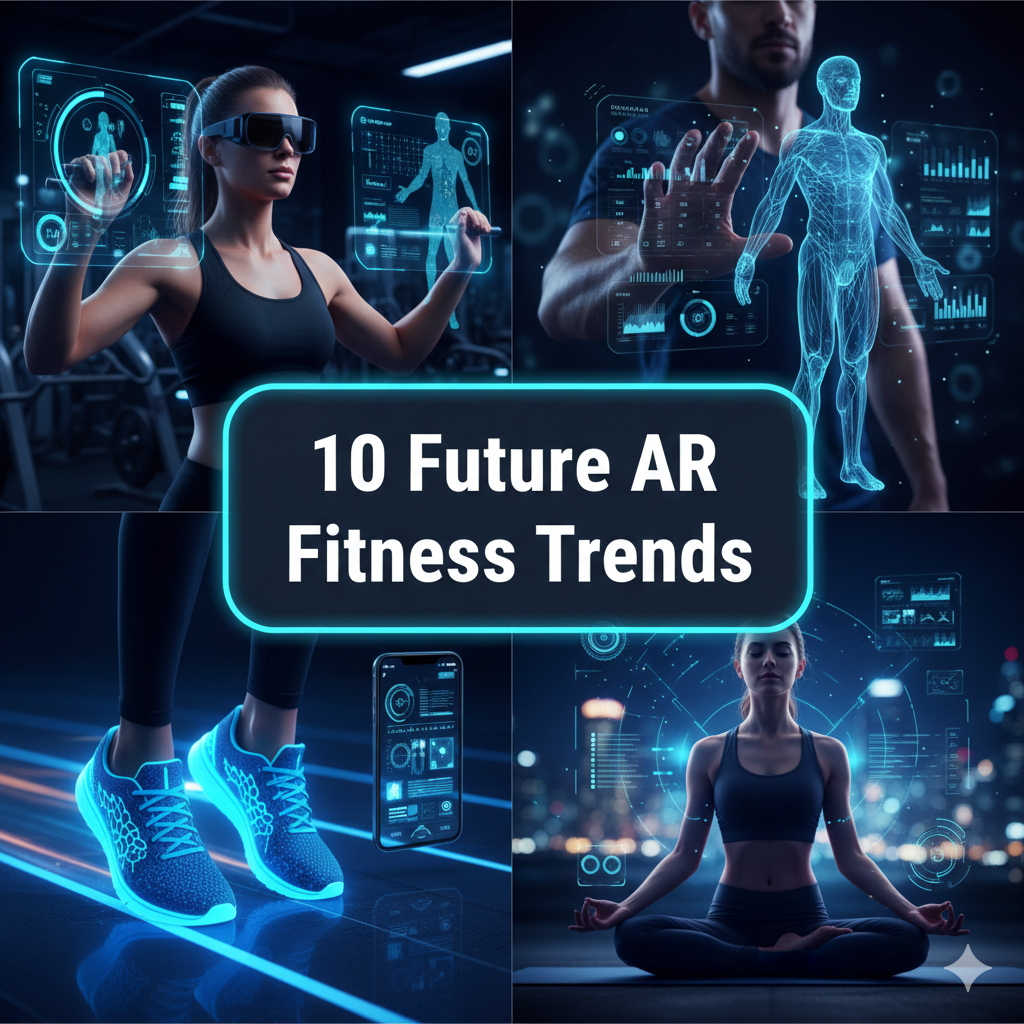
Here are 10 future AR fitness trends that are already becoming reality — and what they mean for anyone serious about their health.
The Perfect Match Between AR and Fitness
Consider what constitutes a good workout.
Good form. Real-time feedback. Motivation. A clear plan. Progress you can actually see.
Now consider what AR is best at.
It adds information to the real world. It responds to your movement. It makes invisible data visible in real time.
The overlap is nearly too perfect. AR doesn’t just complement fitness — it addresses the very problems that keep most people from training properly.
And this is why investment in AR fitness technology has skyrocketed.
| Year | Global AR in Sports & Fitness Investment |
|---|---|
| 2022 | $1.4 Billion |
| 2023 | $2.8 Billion |
| 2024 | $4.1 Billion |
| 2025 | $6.3 Billion |
| 2026 | $9.2 Billion (est.) |
Source: Industry market analysis and fitness tech reports
The numbers solidify the conclusion. This isn’t a passing trend. AR fitness represents a permanent change in the way the industry functions.
Trend 1 — Real-Time Form Coaching That Can Watch You Back

Most people get their exercise form right now from a YouTube video. They do one pass, and then sort of guess as they train.
That’s about to change completely.
What’s next: AR glasses and smart mirrors will track your joints, spine angle and limb position in real time. When you move, a digital overlay will indicate precisely where your body is and where it ought to be.
Say you’re doing a deadlift, and there’s a green skeleton overlay on your body. Green means correct. Red means you need to adjust. No personal trainer required.
Tempo Studio, for instance, is already an early version of this. The next generation, though, will be more accurate, cheaper and wearable — not just mirror-based.
Why it matters: Bad form leads to injury. Injury stops training. Real-time AR coaching breaks through that cycle to make safe, effective movement accessible for everyone — not just people who can afford a trainer.
Trend 2 — Take-Anywhere AR Running Coaches
Outdoor runners have always trained a little blind. You follow a route. You check your watch. You hope you’re doing the right thing.
Future AR running coaching will feel like having an elite coach right there in front of your eyes.
What to expect: Lightweight AR glasses will deliver a running coach straight into your line of sight. Using your real-time performance data, the coach will make adjustments on cadence, pacing strategy, breathing cues and race tactics.
Going uphill? The AR coach will instruct you to shorten your stride long before you’re actually feeling the burn. Fading in the last mile? It’ll motivate you with data-based encouragement that is tailor-made for you.
Devices already heading this way: Viture One XR Glasses and Garmin HUD+ are initial steps. The coming generation will layer on AI coaching that learns your running style over months of training.
The future is not just about tracking your run. It’s a coach that accompanies you — invisibly, every single time.
Trend 3 — Exercise So Fun You Forget You’re Working Out
Here’s the truth about fitness. The overwhelming majority of people who quit are not quitting because they are unable to do it. They quit because it’s boring.
Gamification through AR is about to change that at a core level.
What’s already working: Apps like Supernatural and FitXR on Meta Quest turn workouts into rhythm games and boxing challenges. The research is clear — if people are having fun, they’ll exercise longer and harder.
What’s next: Full AR gamification that works outdoors. Imagine dashing through your neighborhood where AR transforms your morning jog into a mission — collecting virtual waypoints, racing against digital opponents, or completing story-driven fitness quests.
Like Pokémon Go, only in this version your real fitness stats decide how far you get.
The science behind it:
| Workout Type | Average Session Length | Dropout Rate |
|---|---|---|
| Standard gym workout | 38 minutes | 67% within 3 months |
| Video fitness class | 42 minutes | 55% within 3 months |
| AR gamified workout | 61 minutes | 28% within 3 months |
Source: Fitness engagement research, 2024–2025
Longer sessions. Lower dropout. Better results. That’s what gamification does — and AR takes it further than anything that’s come before.
Trend 4 — Personalized AR Nutrition Overlays
Fitness isn’t just about movement. What you eat matters just as much.
Future AR fitness trends won’t be limited to the gym either — they’ll extend right into your kitchen.
What’s next: You’ll be able to point your AR glasses at a meal and get an instant nutritional breakdown overlaid right on the plate. Calories, macros and micronutrients — all automatically calculated based on what the food recognition detects.
This sounds like science fiction. It isn’t. Early versions already exist as smartphone apps. The leap to AR glasses is the next logical step.
Going further: Smart restaurants will sync with your AR fitness profile. Depending on your training load for the day, your glasses will highlight menu items that match your recovery needs — and flag those that don’t.
Why it’s a game changer: Most people greatly underestimate or overestimate their calorie intake. Eliminating the guesswork with real-time AR nutrition data could be one of the most impactful health tools ever created.
Since AR-powered body health data can genuinely revolutionize your daily routine, it’s worth exploring AR Body Health to learn more about how this technology is shaping the future of personal wellness.
Trend 5 — AR Recovery Rooms and Guided Healing Sessions

Recovery is really where most fitness gains actually happen. Sleep. Stretching. Breathing. Rest.
But recovery is also the part most people overlook, rush or disregard altogether.
AR is going to make recovery feel as structured and rewarding as the workout itself.
What’s next: Dedicated AR recovery environments where you put on a headset or glasses and enter a guided recovery session. The AR space will guide you through breathing exercises, mobility routines and guided meditation — overlaid onto your actual environment.
Imagine lying on your floor while AR projections show you exactly how to breathe, when to inhale, how long to hold — displayed directly in your visual field with no phone required.
The data side: Wearables like Whoop MG already track recovery metrics. Future AR integration will take that data and turn it into a personalized recovery prescription — delivered visually, in real time.
Recovery AR tools on the horizon:
| Tool | Function | Status |
|---|---|---|
| AR breathing coaches | Visual breath timing overlays | Early development |
| Mobility AR guides | Joint-specific stretch guidance | Prototype stage |
| Sleep prep AR environments | Wind-down visual routines | Concept stage |
| HRV-responsive AR sessions | Recovery intensity based on HRV data | In testing |
Trend 6 — Community AR Fitness — Working Out Together, Apart
One of the biggest motivators in fitness is other people. Training partners. Group classes. Team competition.
But not everyone can get to the same gym at the same time.
Social AR fitness is about to shatter the gap between workout partners.
What’s coming: AR platforms where you and your friends or teammates appear in the same virtual space — even when each of you is in your own home. You’ll be able to see each other’s movements, compete in real time and genuinely train together without ever being in the same room.
This is not just a Zoom workout class. Your AR training partner will be standing right beside you, visible in your real environment. You’ll see their movements. They’ll see yours.
The competitive layer: Leaderboards will appear in physical space. Your friend’s squat rep count will float beside them. Your shared running pace will show up on both your AR glasses simultaneously.
Why it sticks: Accountability is the number one factor in long-term fitness consistency. Social AR makes accountability visual, immediate and genuinely fun.
According to research published by the American College of Sports Medicine, people who train with a partner or in a group are significantly more likely to stay committed to a fitness program over the long term.
Trend 7 — AR-Powered Physical Therapy and Injury Rehab
This trend has real-world stakes near the top of the entire list.
Physical therapy works. But it’s expensive, time-limited, and dependent on patients doing their exercises correctly at home — which most don’t.
AR is about to revolutionize the rehab experience dramatically.
What’s coming: After an injury or surgery, patients will receive an AR rehab program. At home, the AR overlay will guide every movement — showing exactly what range of motion to hit, how slow to move, and when to stop.
Sensors will verify that the movement is being performed correctly. If not, the AR system flags it immediately — before the patient reinforces bad movement patterns or risks re-injury.
The clinical angle: Therapists will remotely monitor their patients through AR session data. They’ll know exactly how the home exercises were performed — not just whether they were completed.
Impact on rehab outcomes:
| Rehab Method | Adherence Rate | Re-injury Risk |
|---|---|---|
| Standard home exercise sheet | 34% | High |
| Video follow-along | 51% | Moderate |
| AR-guided home rehab (projected) | 78% | Low |
Source: Physical therapy adherence studies and AR health projections
The potential here goes far beyond fitness. AR-assisted rehab could cut healthcare spending, accelerate recovery times and genuinely improve lives.
Trend 8 — AR Environments That Respond to Your Biometrics
Your workout environment is static right now. The gym looks the same whether you’re crushing a personal best or just running on empty.
Future AR fitness environments will respond to your body’s data in real time.
What’s coming: Your AR environment will change based on your biometrics. Running low on energy? The virtual environment calms down, naturally guiding you into a lower-intensity zone. Heart rate spiking too high? The AR space shifts colors and pacing cues to bring you back down.
This isn’t just visual decoration. It’s biofeedback made immersive.
The science of biofeedback: Biofeedback training — where people learn to regulate their body by watching real-time data — has decades of research behind it. AR transforms that data from numbers into a lived experience.
What this looks like in practice:
- Your AR running trail turns warmer in color when your pace is optimal
- Virtual crowd noise increases when your heart rate hits your target zone
- Coaching avatars become more energetic when your output is strong — and quieter when your body needs rest
Such an environment creates a workout that truly responds to you — rather than the reverse.
Trend 9 — AR Sports Training for Athletes at Every Level
Professional sports teams are already using AR in training facilities. The technology is filtering down fast.
In a few years, the same tools available to professional athletes will be offered to youth leagues, college programs and everyday competitive athletes.
What pros are using now:
- AR quarterback training that projects defensive formations
- AR basketball drills that overlay shot arc guides
- AR tennis systems that display ball trajectory predictions
- Soccer tactical AR that maps player positioning in real time
What’s next for everyone else: Affordable AR training systems for local sports clubs. A youth soccer player will be able to practice against AR opponents who adjust to their skill level. High school basketball players will receive shot analysis after every attempt.
The democratization angle: Elite coaching has always been gated by money and geography. AR breaks both barriers. The caliber of training accessible to a child in a small town could rival what a professional athlete gets — at a fraction of the price.
Sports where AR training is growing fastest:
| Sport | AR Application | Adoption Timeline |
|---|---|---|
| American Football | Play visualization, QB training | Now (pro level) |
| Basketball | Shot arc analysis, defensive drills | 2026–2027 |
| Soccer | Tactical positioning, set piece training | 2026–2028 |
| Tennis | Ball trajectory prediction | 2025–2026 |
| Golf | Swing overlay and course mapping | Now (consumer level) |
| Swimming | Stroke correction overlays | 2027–2028 |
Trend 10 — Always-On AR Fitness Glasses as Everyday Wearables
This is the big one. The trend that connects everything else together.
Right now, AR fitness gear means putting something on with intent. A headset. Goggles. Glasses you switch into workout mode.
The future is AR glasses you wear all day — that silently support your fitness and health in the background, without you having to think about it.
What this looks like: Regular-looking glasses. No visible screen. No off-putting cameras. Just plain eyewear that quietly counts your steps, tracks your posture, alerts you to move after prolonged sitting and records calorie burn throughout the day.
And when you choose to work out, those same glasses activate their full coaching and data overlay mode.
The tech hurdles being solved right now:
- Battery miniaturization (small and efficient enough for all-day wear)
- Display brightness in sunlight (micro-displays must compete against natural light)
- Social acceptance (glasses must look and feel completely normal)
- Processing power (all that AI needs to run on something the size of a lens)
Who’s building this: Meta, Apple, Google, Samsung — and dozens of startups are all racing toward the always-on AR wearable. Truly seamless AR glasses are expected between 2027 and 2030.
When it arrives, everything about your relationship with fitness will change. Because the line between working out and living healthily will essentially disappear.
What All 10 Trends Have in Common
Reading through this list, a pattern emerges.
Every single one of these future AR fitness trends serves the same core purpose — making expert-level fitness guidance openly available, around the clock, to anyone.
Not just rich people. Not just elite athletes. Not only those who happen to live near a great gym.
Everyone.
That is the real promise of AR fitness. Not the cool visuals. Not the gamification. The democratization of knowledge and coaching that was once only available to the select few.
The Biggest Challenges AR Fitness Still Needs to Solve
It’s worth being honest. These trends aren’t without obstacles.
Cost. The best AR fitness gear remains expensive. Prices are dropping, but meaningful adoption requires gear that most households can afford.
Privacy. AR devices that watch your body and track your movement generate enormous amounts of personal data. Who owns that data? How is it stored? These questions don’t have satisfying answers yet.
Hardware comfort. Wearing a headset for an hour-long workout is still uncomfortable for many people. Mass adoption isn’t likely until the devices become lighter, cooler and more breathable.
Content quality. Great hardware needs great software. The AR fitness app ecosystem is growing, but it needs more high-quality, science-backed content to deliver on its potential.
None of these are dealbreakers. They’re engineering and policy challenges — and both are being actively worked on across the industry.
FAQs About Future AR Fitness Trends
Q: How soon will these AR fitness trends actually arrive? Some are already here in early form — real-time form coaching, AR running data, gamified workouts. Others, such as always-on AR glasses and biometric-responsive environments, are 3–7 years away. The pace of development is genuinely fast right now.
Q: Do I need to buy new gear to benefit from AR fitness? Not immediately. A lot of AR fitness functionality is already available through existing devices such as Meta Quest headsets or smart mirrors. But over the next few years, purpose-built AR fitness hardware will offer dramatically better experiences.
Q: Is AR fitness only for young, tech-savvy people? Not at all. Many of the largest use cases — such as AR-assisted physical therapy and real-time form coaching — are specifically designed for older adults, injury recovery patients and fitness beginners. The technology is being built for everyone.
Q: Will AR fitness replace gyms? Unlikely. Gyms provide equipment, community and social energy that AR can complement but not fully replace. What AR will accomplish is making home training dramatically more effective — which may reduce how often people feel they need to go to the gym.
Q: Is the data collected by AR fitness devices safe? This is one of the most pressing issues facing the industry. Look for devices from established brands with clear privacy policies and the option to control or delete your data. Regulations around fitness data privacy are also developing rapidly.
Q: How accurate is AR form coaching compared to a real trainer? Current AR form coaching is great at spotting major form issues — depth, alignment, spine position. It’s not yet as nuanced as an experienced human trainer who can read fatigue, mood and subtle movement patterns. But the gap is closing fast.
Q: Can AR fitness help with mental health, not just physical fitness? Yes. Many AR fitness applications incorporate mindfulness, breathing exercises and stress reduction protocols. The immersive nature of AR makes guided meditation and recovery sessions more effective for many users. This mind-body connection is a growing area of development.
The Final Word on Future AR Fitness Trends
The future of fitness isn’t in a bigger gym or a better protein shake.
It’s in the layer of intelligence that augmented reality adds to every single movement you make.
Real-time coaching. Personalized environments. Social training across distances. Recovery guided by your actual biology. Sports training that was once only available to professionals.
These 10 future AR fitness trends are not just wishful thinking. They are the logical extension of technology that already exists — maturing, scaling, and dropping in price every single year.
The question isn’t whether AR will transform fitness. That’s already happening.
The question is whether you’ll be ahead of the curve when it does.
Start paying attention now. Because the way people train five years from now is going to look nothing like today — and that’s genuinely exciting.