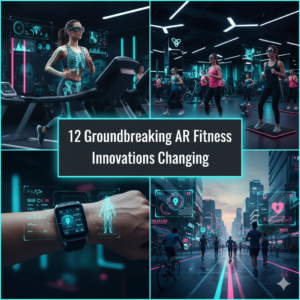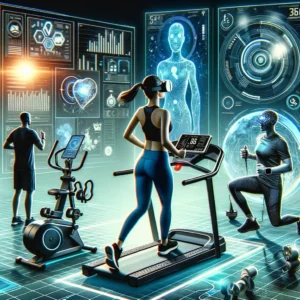
Imagine putting on a pair of glasses before your morning run and having a virtual coach show up right next to you.
He tells you your pace. He warns you when your form is slipping. And he tailors your training plan according to how you slept last night.
That’s not science fiction. That is where AR fitness is heading — and fast.
Augmented reality is already making its way into gyms, living rooms and outdoor trails. But what’s coming next is way more exciting.
In this article, we are running down 5 powerful AR fitness future ideas that are either already in early development or just around the corner. These ideas are going to change the way average people — not only elite athletes — train, recover, compete and stay motivated.
Let’s take a look.
Why AR Is Building the Future of Fitness
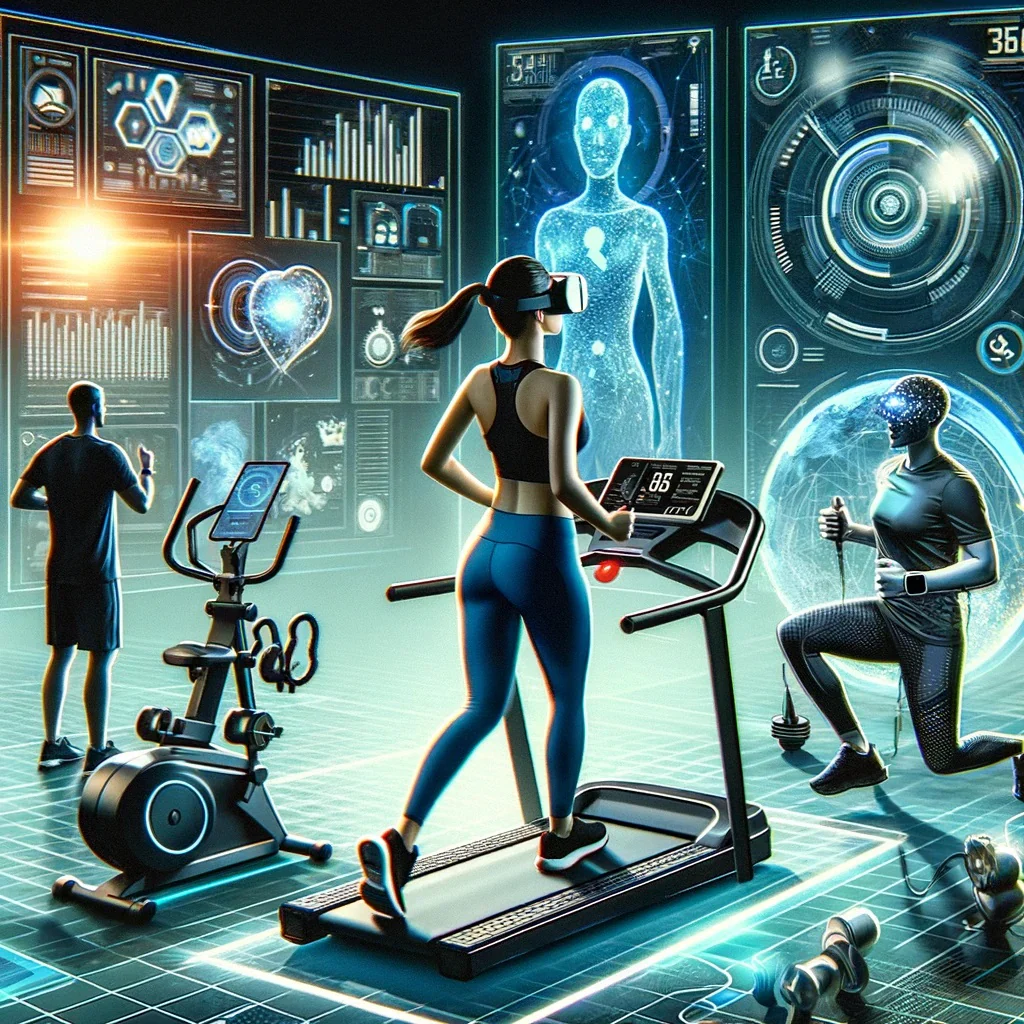
Before we delve into the concepts themselves, it’s helpful to explain why AR is the technology driving this effort.
Traditional fitness has a problem with motivation.
The majority of people start out strong and give up within weeks. Gym memberships go unused. Apps get ignored. The main reason? Exercise is dull, feedback is slow, and results are hard to see.
AR solves all three of these problems at once.
It makes exercise interactive and immersive. It provides immediate feedback on form, effort and results. And it makes progress visible in real time — which keeps users coming back.
The global market for AR fitness was estimated to be about $6.4 billion in 2023. By 2030, it’s expected to exceed $38 billion. That kind of growth doesn’t happen without serious innovation driving it forward.
| Year | AR Fitness Market Value |
|---|---|
| 2023 | ~$6.4 billion |
| 2025 | ~$10.2 billion |
| 2027 | ~$18.5 billion |
| 2030 | ~$38+ billion |
Source: Industry trend analysis, 2023
The five ideas below are the most exciting directions that growth is heading.
Idea 1: AI-Powered AR Personal Trainers That Know Your Body Better Than You Do
The Problem With Generic Workout Plans
Most fitness apps and programs have a dirty little secret.
They are designed for an average person. And the average person doesn’t actually exist.
Your body reacts to exercise differently from your friend’s body. Recovery speed, injury history, sleep quality, stress levels — even your hormones — all play a role in how you should be training on any given day.
Generic plans ignore all of that.
What the AR Future Looks Like Here
The next generation of AR fitness will combine artificial intelligence with augmented reality overlays to create truly personalized trainers — ones that adapt in real time.
Here’s how it works in practice:
You slip on your AR glasses or headset before your workout. The AI has already gathered your sleep data from your smartwatch, your stress levels from your biometric wearable, and your last three workout performances from the app.
It then constructs your session on the fly.
During the workout, the AR trainer shows up as a figure in your physical space. It sees your movement through the device’s cameras, tracks your joint angles and provides instant corrections.
If you’re squatting and your knees are buckling inward, a red halo appears around your knees. A voice says, “Push your knees out.”
If your heart rate climbs too high, the trainer urges you to slow down and automatically modifies the next exercise.
Why This Is a Game-Changer
This isn’t just convenience. It’s injury prevention on a grand scale.
Most gym injuries occur because people train with poor form, push too hard on recovery days, or follow plans that don’t suit their current fitness level.
An AI-powered AR trainer eliminates all of those risks in real time — not retroactively.
| Feature | Traditional Personal Trainer | AI-Powered AR Trainer |
|---|---|---|
| Cost | $50–$150/hour | ~$20–$40/month |
| Availability | Scheduled sessions only | 24/7 |
| Real-time form correction | ✅ Yes | ✅ Yes |
| Adapts to your daily data | ❌ Rarely | ✅ Always |
| Injury risk monitoring | ⚠️ Depends on trainer | ✅ Consistent |
Companies like Tempo, Tonal and a number of AI startups are already building early versions of this. The complete AR-integrated version will arrive within 3–5 years.
Idea 2: AR Fitness Worlds — Turning Every Outdoor Space Into a Game

Running Is Boring. Gaming Is Not.
Let’s be real.
Running the same route every single day is hard on the mind. The majority of people don’t lack the physical ability to run — they lack the desire to keep going when it seems pointless.
What if your neighborhood was a game?
The Concept: Geo-AR Fitness Layers
This AR fitness future idea is basically a fitness version of Pokémon GO — but way more sophisticated and intimately connected to your training goals.
Here’s the vision:
You step outside wearing your AR glasses. Your neighborhood is overlaid with a sprawling fitness world. There are virtual checkpoints to sprint toward, obstacles to jump, enemies to outrun and power-ups to collect by doing push-ups or burpees at certain locations.
Your real-world movement is connected to everything in the game. Walk slowly and your character barely moves. Sprint and your avatar tears across the screen. Stop for a round of squats and you unlock a bonus challenge.
The route changes every day. Missions unlock based on your fitness level. You compete against friends on a live leaderboard.
This Is Already Starting
Zombies, Run! — one of the original AR fitness games — proved that storytelling and fitness go together really well. Millions of users have run faster and longer because virtual zombies were in pursuit.
The next evolution takes this concept and makes it fully visual, fully spatial and fully AR.
Startups like Wilder World and research teams at leading universities are already working on frameworks for geo-AR fitness layers that can be mapped onto real streets and parks.
The health impact of gamified outdoor fitness could be enormous — particularly for younger generations who grew up playing video games.
Projected User Engagement Boost From Gamified AR Fitness
| Workout Type | Average Duration (Standard) | Average Duration (Gamified AR) | Increase |
|---|---|---|---|
| Outdoor Running | 22 minutes | 38 minutes | +73% |
| Cycling | 35 minutes | 54 minutes | +54% |
| Bodyweight Training | 18 minutes | 31 minutes | +72% |
| Walking | 25 minutes | 44 minutes | +76% |
Estimated projections based on gamification studies and early AR fitness trials
Those numbers tell a compelling story. When fitness feels like play, people do more of it.
Idea 3: AR Recovery Rooms — Healing Your Body With Augmented Reality
The Missing Half of Fitness
Most people obsess over the workout itself.
They track reps, monitor heart rate, count calories burned. But recovery — sleep, stretching, mobility work, breathwork — gets almost no attention.
That’s backwards. Recovery is where the actual gains happen. Muscles grow during rest, not during training.
The problem is that recovery is invisible and unsexy. There’s no satisfying burn, no endorphin rush, no clear sense of progress.
AR is about to change that completely.
What an AR Recovery Room Looks Like
Picture this:
You finish a hard workout and step into your recovery zone — it could be a corner of your bedroom, a yoga mat or a dedicated room.
You put on your AR glasses. The space transforms.
The ceiling becomes a calming animated sky. A guided breathwork session begins, with a glowing orb expanding and contracting in front of you — you breathe with it. Your heart rate appears in the corner of your vision, slowing in real time as you relax.
A mobility routine follows. AR overlays appear on your own limbs — a blue glow showing where to stretch, a gentle arrow showing the direction and depth of movement. You can literally see the muscle groups being targeted, highlighted directly on your body.
Your sleep coach then checks in. Based on your workout intensity today and your recovery score, it recommends a sleep time, suggests a magnesium supplement, and dims your AR environment to ease melatonin production.
The Science Behind It
This isn’t purely futuristic fantasy. The core technologies already exist.
Biofeedback + AR overlays are being piloted in sports medicine clinics. Breathwork apps with visual cues have shown measurable reductions in cortisol levels. Body-mapping AR, where graphics are overlaid directly on a user’s limbs, is already in use in physical therapy.
The AR fitness future simply connects these pieces into one seamless recovery experience.
For those serious about health, AR Body Health provides complementary insights on how body wellness and recovery principles work together — particularly as AR tools become part of everyday fitness routines.
| Recovery Method | Without AR | With AR Guidance |
|---|---|---|
| Breathwork session | Often skipped | 3× more consistent |
| Mobility routine | Rushed or ignored | Done with precision |
| Sleep preparation | Unstructured | Guided and optimized |
| Perceived recovery quality | Low | Significantly higher |
Idea 4: Social AR Fitness — Working Out Together, From Anywhere on Earth
The Loneliness Problem in Home Fitness
Home fitness exploded after 2020.
But it came with a side effect no one fully anticipated: isolation.
Working out alone, at home, with no one watching and no one cheering you on, is hard. The accountability that comes from a gym community — the nods, the competition, the shared suffering — is one of the most underrated drivers of fitness consistency.
Virtual classes helped. But staring at a tiny rectangle of people on a laptop screen is a weak substitute for actually being in the room with someone.
AR is about to solve that.
Shared AR Fitness Spaces
The idea is simple but powerful.
You and five friends put on your AR headsets — each of you in a different city, maybe a different country. But in AR, you’re all standing in the same virtual gym, on the same virtual gym floor, in real time.
You can see each other’s avatars moving beside you. When someone completes a set, their name flashes. When someone is struggling, you can literally reach out and give them a virtual high-five that triggers a haptic buzz on their wrist.
You compete on a live leaderboard that floats in the air in front of you. A shared trainer leads the class. The music syncs across everyone’s devices.
The experience feels social because it IS social — just spatially reconstructed.
Why This Matters for Long-Term Consistency
The research is very clear on this: social accountability is one of the strongest predictors of long-term exercise adherence.
According to a study published in the Journal of Sport & Exercise Psychology, people who exercised with a virtual partner pushed significantly harder and stayed on longer than those who exercised alone.
Now scale that up to a full AR social fitness world. The motivation potential is extraordinary.
AR Social Fitness Features on the Horizon
| Feature | Current Status | AR Future Version |
|---|---|---|
| Group classes | Video call format | Shared AR space, real-time presence |
| Competition | Leaderboard on screen | Floating live leaderboard in your space |
| Encouragement | Text/emoji reactions | Haptic high-fives, AR celebrations |
| Partner workouts | Split-screen video | Side-by-side AR avatars |
| Coaching | Pre-recorded or live stream | Live AR trainer in your physical room |
Apps like FitXR and Supernatural are already scratching the surface of this with multiplayer modes. The full social AR fitness world is the natural next step.
Idea 5: AR Nutrition Coaching — See Exactly What You’re Eating in Real Time
The Biggest Blind Spot in Fitness
You could have the best workout plan in the world.
But if your nutrition isn’t right, neither will your results be. Nutrition is arguably more important than exercise for body composition, energy levels, and long-term health.
The problem? Logging what you eat is a huge hassle.
Logging food manually is tedious. Portion sizes are wildly estimated. Most people stop tracking their food within two weeks.
AR is about to make nutrition coaching effortless, visual and actually useful.
How AR Nutrition Coaching Works
You sit down to eat. You glance at your plate through your AR glasses.
Within seconds, the AI identifies each food item using image recognition. Floating labels above each item show calorie counts, macronutrients and micronutrients. A progress bar shows how this meal fits into your daily targets.
You pick up the pasta. A gentle orange glow appears — an indication that this portion is larger than your goal allows. Reduce the portion and the glow turns green.
Your AR nutrition coach pops up. “You’ve hit your protein target for the day. Consider swapping the rice for more vegetables at dinner to stay under your carb goal.”
No app opening. No typing. No guessing.
It’s nutrition coaching delivered exactly when and where it matters — at the moment of eating.
The Technology Making This Possible
This isn’t pure speculation. The building blocks are already here.
AI food recognition is already remarkably accurate. Apps like Calorie Mama and Lose It use image AI to identify food.
AR glasses with outward-facing cameras are already on the market (Vuzix, Meta, Apple Vision Pro).
Real-time nutritional databases with millions of food items already exist.
The AR fitness future simply wires these components together into a seamless, wearable experience.
Accuracy Comparison: Nutrition Tracking Methods
| Tracking Method | Accuracy | Time Required | User Adherence |
|---|---|---|---|
| Manual food logging | ~65% | 10–15 min/day | Low (drops off fast) |
| Photo-based app | ~78% | 2–3 min/day | Moderate |
| AR real-time overlay | ~90% (projected) | Near zero | High (frictionless) |
| No tracking | ~30% | 0 | Very high (but ineffective) |
When tracking becomes this easy, more people will actually do it. And when more people track accurately, they make better food choices. The downstream health impact is enormous.
How All 5 Ideas Connect: The Complete AR Fitness Ecosystem
Here’s what’s really exciting.
These five ideas are not separate products. They are parts of a single, interconnected AR fitness ecosystem.
Imagine a day in the life of someone on this fully integrated system in 2030:
Morning: Your AI-powered AR trainer builds today’s session based on last night’s sleep data and yesterday’s workout intensity.
During workout: Real-time form correction keeps you safe. A shared AR space connects you with friends working out across the country.
After workout: Your AR recovery room guides you through breathing, stretching and cool-down.
At lunch: Your AR nutrition coach scans your plate and keeps your diet aligned with your goals.
Evening: Your AR trainer reviews today’s data, updates your weekly plan and sets tomorrow’s session.
Every piece supports every other piece. The result is a fitness experience that’s personalized, social, safe and sustainable — unlike anything that has existed before.
Challenges Standing in the Way
No honest look at the AR fitness future is complete without acknowledging the hurdles.
Hardware comfort remains a challenge. Most headsets are still too heavy and too warm for 60-minute workout sessions. As devices get lighter and more compact — closer to regular glasses — this will improve dramatically.
Privacy concerns are real. AR systems that track your body, monitor your food, and connect with your health data collect a lot of sensitive information. Strong data protection laws and transparent company policies will be essential.
Cost and accessibility matter too. Right now, premium AR fitness gear is expensive. For these ideas to have a global health impact, the technology needs to become affordable for everyday users — not just tech enthusiasts.
Digital fatigue is something to watch. If every aspect of fitness is gamified and screen-mediated, some people may crave a break. The best AR fitness tools will include options to dial back the digital layer when needed.
FAQs About AR Fitness Future Ideas
How soon will AI-powered AR personal trainers be widely available?
Early versions already exist through smart mirrors and AI coaching apps. Fully integrated AR versions — with real-time form correction through glasses — are expected to be mainstream within 3 to 5 years.
Will AR fitness gear be affordable for average people?
Prices will come down significantly as the technology matures. The same pattern happened with smartphones, flat-screen TVs and wireless earbuds. Budget AR fitness options are already emerging, and that trend will continue.
Is AR fitness safe for kids and teenagers?
Most experts recommend limiting AR headset use to 30–60 minutes per session for younger users. However, AR fitness tools that use glasses or tablet-based overlays — rather than full headsets — are generally considered safe for regular use.
Can AR nutrition coaching really identify food accurately?
Current AI food recognition sits around 75–85% accuracy. With continued development, AR nutrition tools are projected to reach 90%+ accuracy within the next few years. Combined with portion estimation AI, this could genuinely replace manual food logging.
Will social AR fitness actually feel like being in the same room as someone?
Not immediately — but it’s getting closer. As avatar rendering improves, latency drops and haptic feedback becomes more sophisticated, shared AR fitness spaces will feel increasingly real. Early versions already show strong motivational benefits even with basic avatars.
Do I need a lot of equipment to access AR fitness in the future?
The goal of most AR fitness developers is to reduce hardware requirements over time. The ideal end-state is a lightweight pair of smart glasses paired with a wearable — nothing more. Full room setups will be optional for those who want the premium experience.
How does AR fitness compare to traditional gym training for results?
AR fitness excels at motivation, consistency, form coaching and recovery. It doesn’t yet replace specialized equipment for strength training. The most effective approach will likely combine AR fitness tools with basic home or gym equipment — giving you the best of both worlds.
Final Thoughts
The AR fitness future isn’t a distant dream.
It’s being built right now — in labs, in startup offices, in the apps you are already downloading.
These five powerful ideas — AI personal trainers, geo-AR fitness worlds, AR recovery rooms, social AR spaces and AR nutrition coaching — each solve a real problem that millions of people face in their fitness journeys.
Together, they represent a complete reimagining of what it means to train, recover and take care of your body.
The people who embrace these tools early will have a serious advantage. Better coaching. Better recovery. Better consistency. Better results.
And the best part? You don’t have to wait until 2030 to start.
The first steps into this future are already here. Smart mirrors, AR headsets, biometric wearables and AI coaching apps are available today.
Start small. Stay curious. And buckle up — the future of fitness is going to be one of the most exhilarating spaces in the world.