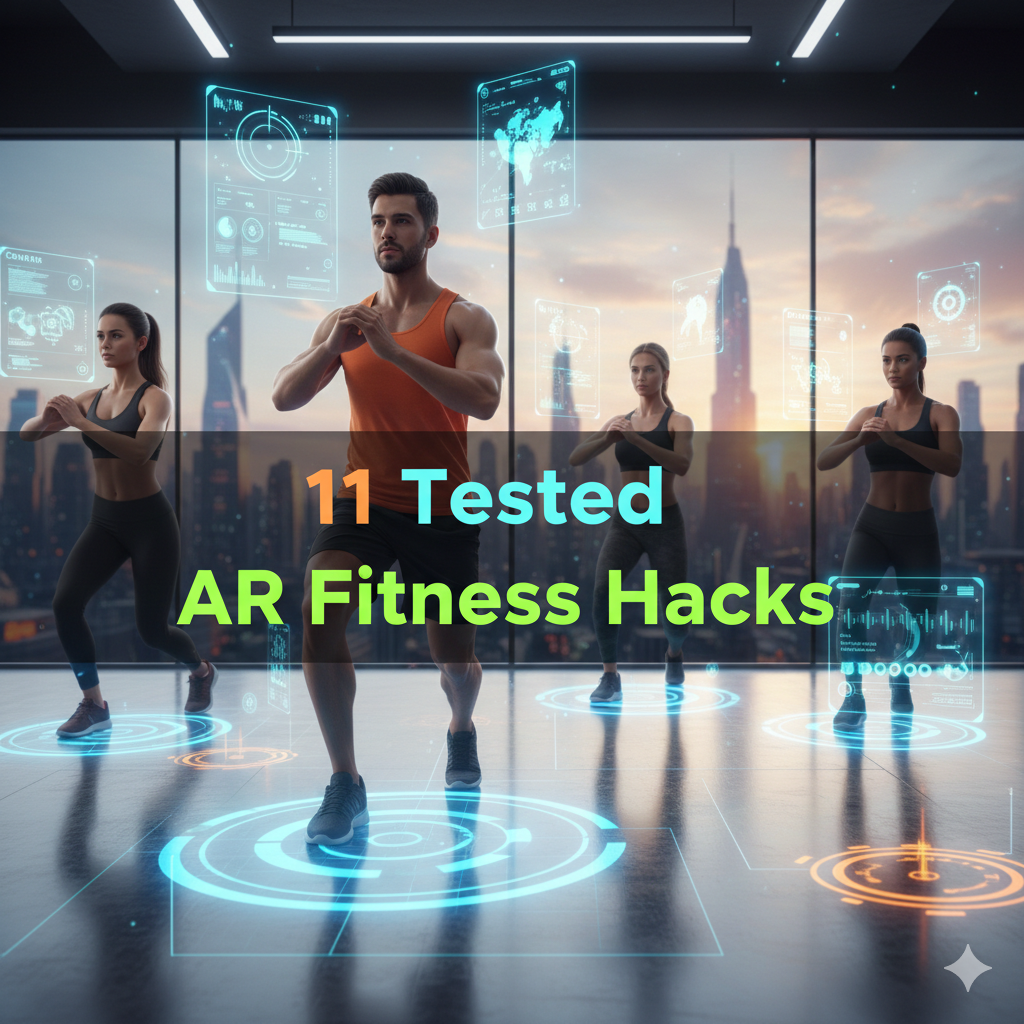
Now picture putting on a pair of smart glasses and your workout coach suddenly materializing in the middle of your living room. Or running through your neighborhood as a virtual dragon chases you for motivation. Doesn’t that sound like a video game?
Welcome to AR fitness — and it already exists.
Augmented reality (AR) fitness is merging the digital world with physical movement. It adds digital graphics, sounds and data on top of your physical environment. And it’s making workouts far more fun, effective and customized than before.
In 2026, more people are trading out drab treadmill workouts for AR fitness hacks to get fit. Whether you’re a complete novice or a gym rat, these hacks can apply to you.
This article outlines 11 proven AR fitness hacks in a format that’s easy to follow and based on actual results — which you can hit the ground running with today.
The Reason AR Fitness Is Taking Off Right Now
Before diving into the hacks, let’s take a look at why AR fitness is on the fast track to growing so widely.
The international AR fitness marketplace was valued at greater than $2.7 billion in 2024 and is projected to surpass $9 billion by 2029. That’s a massive jump. Fitness brands, game developers and tech companies alike are throwing money at improving AR workouts.
Here’s a brief overview of what is behind that growth:
| Reason | Effect on Users |
|---|---|
| Gamification of exercise | Turns every workout into a game-like experience |
| Real-time feedback | Improves form immediately |
| Personalized coaching | Plans tailored to needs without going to the gym |
| Social AR features | Work out with friends in different locations |
| Wearable tech integration | Collects health statistics during workouts |
Now let’s dive into the good stuff.
Hack #1 — Make a Game of Your Morning Run

Running is great for you. But let’s be honest — it becomes dull quickly.
Apps like Zombies, Run! and Run an Empire employ AR and GPS to make your jog an adventure. You gather supplies, build virtual cities or outrun zombie hordes — all depending on your movement in the real world.
The result? You find yourself running farther without even realizing it.
Why it works: When your brain is engaged by a story or vision, it isn’t worrying about just how much your legs are throbbing. This is known as attentional distraction, and research shows that it can diminish perceived effort while exercising by up to 32%.
How to start: Download a location-based AR running app. Set a 20-minute goal. Just let the story draw you forward.
Hack #2 — Real-Time Correction With Augmented Reality Mirrors
One of the biggest reasons people get hurt at the gym is bad form. Squatting incorrectly, lifting with your back rather than your legs — small mistakes compound over the years.
AR smart mirrors such as Tempo and Forme Life use cameras and AI to track your movements, projecting digital overlays over your reflection. They tell you precisely where your posture deviates and how to align it, in real time.
What These Mirrors Can Track:
- Angle of the joints during squats and lunges
- Shoulder alignment in overhead presses
- Hip position during deadlifts
- Balance and symmetry between left and right sides
Pro tip: If you can’t afford a smart mirror yet, some smartphone apps are made to do a similar job with the camera in your phone — typically for free or low cost.
Hack #3 — Experiment With AR-Powered Home Workouts With Virtual Coaches
For the vast majority of people, hitting the gym on a daily basis is not practical. With work, school and life, it’s difficult to carve out the time.

AR home workout apps will virtually beam a trainer right into your living room via your phone or AR headset. You watch them performing the exercise in front of you. You copy their movements. The app scores your accuracy.
Top Apps to Try:
- FitXR (for Meta Quest headsets)
- Les Mills Body Combat (mixed reality)
- Nike Training Club with AR overlays on select devices
Why Are Virtual Coaches Better Than YouTube Videos?
| YouTube Workouts | AR Virtual Coaches |
|---|---|
| No feedback | Real-time feedback on form |
| One-size-fits-all | Adjusts to your fitness level |
| Easy to quit | Gamified, hard to stop |
| Passive watching | Active participation required |
This is especially useful for beginners who feel intimidated at the gym.
Hack #4 — Superimpose AR Data on Your Outdoor Cycling
Cycling outdoors is already fun. AR makes it smarter.

Smart cycling glasses such as Engo 2 or Cosmo Connected project your speed, heart rate, cadence and navigation directly on the lens. You see the data without ever looking down at your phone.
This means you keep your eyes on the road while remaining fully aware of how well you perform.
The result: Riders who use real-time AR data while riding generally perform better in terms of pacing, and can push harder during uphill efforts because they know exactly when to increase their effort.
Top AR Cycling Metrics to Keep an Eye On:
- Heart rate zones — whether you’re burning fat or building endurance
- Cadence (RPM) — the key to knee-saving, efficient pedaling
- Power output (watts) — for serious performance tracking
- Navigation arrows — so you won’t miss a turn on an unfamiliar route
Hack #5 — Taking AR Group Fitness Classes Without Leaving Home
Working out alone is one of the biggest motivation killers. It’s too easy to quit when no one is watching.
AR group fitness solves this. Apps such as Supernatural (for Meta Quest) and Holofit place you in a virtual space — say, an ancient ruin, a futuristic space station or a tropical beach — where you can exercise with actual people from around the world.
You see their avatars. They see yours. There’s a live leaderboard. There are group challenges.
The social accountability element is real. Research at the University of Aberdeen has shown that training with a partner — even a virtual one — makes people work out 78% more often.
How to get involved: You will need a VR/AR headset such as the Meta Quest 3. That’s now more accessible than ever, as prices dropped significantly in 2025–2026.
Hack #6 — Track Your Strength Sessions Smarter With AR
Lost in your own head counting reps while simultaneously trying not to drop a dumbbell? There’s a better way.
AR wearables and apps can now automatically count your reps, track your rest times and even tell you when to add weight — all in real time.
Devices That Do This Well:
- Apple Vision Pro with compatible fitness apps
- Meta Ray-Ban smart glasses with fitness integrations
- WHOOP strap paired with AR dashboards
Sample AR Strength Session Breakdown:
| Exercise | Reps Tracked | Rest Timer | Next Weight Suggestion |
|---|---|---|---|
| Barbell Squat | 10/10 ✅ | 90 sec | +5 lbs next week |
| Bench Press | 8/10 ⚠️ | 120 sec | Hold current weight |
| Romanian Deadlift | 10/10 ✅ | 90 sec | +5 lbs next week |
| Pull-Ups | 6/10 ⚠️ | 120 sec | Add resistance band support |
The red/green system makes it easier to make smarter decisions without a personal trainer on-site.
Hack #7 — Make Stretching and Recovery Less Boring With AR Guides
Most people skip stretching. It’s not exciting. It does not seem like a “real” workout. But it’s one of the key components of any fitness routine.
AR flips this on its head by transforming recovery sessions into guided, visual experiences. You are guided by a holographic instructor who moves along with you, holds poses at the appropriate moments and gently reminds you to breathe.
Apps like Stretch It and DownDog Yoga already have AR features that project the pose straight over your body through the phone’s camera — so you can see if there’s a misalignment without needing a mirror.
Hack within a hack: Combine AR stretching with soothing music or nature soundscapes for a complete mind-body recovery session. This lowers cortisol (the stress hormone) faster and accelerates muscle recovery.
If you’re serious about whole-body wellness — not just workouts — check out AR Body Health for resources that connect movement, recovery, and long-term health.
Hack #8 — Level Up Your Steps With AR Treasure Hunts
Not everybody wants to lift weights or do cardio classes. And that’s totally fine. One of the best AR fitness hacks is also one of the simplest: walk more, but make it enjoyable.
The best-known example is Pokémon GO. Since it launched, studies have found players cover 1,473 extra steps on average every day. That equates to about 3–4 additional miles a week — just from playing a game.
Other apps like Geocaching and Ingress do similar things. They conceal virtual rewards throughout physical spaces. You walk to collect them.
Extra Steps Per Day With AR Walking Apps (Average):
- Pokémon GO: +1,473 steps/day
- Geocaching AR: +980 steps/day
- Ingress: +1,100 steps/day
- Zombies, Run! (walking mode): +1,250 steps/day
Walking 1,000 extra steps per day burns about 40–50 extra calories. That means about 4–5 pounds of fat over the course of a year, just from walking more.
Hack #9 — Personalize Nutrition With AR Food Scanning
Fitness isn’t just about exercise. The food you consume is just as important — if not more.
AR nutrition apps allow you to point your phone camera at a meal and instantly see calorie counts, macronutrient breakdowns and ingredient details overlaid on the screen.
Apps Worth Trying:
- Calorie Mama — AI + AR detects food and estimates servings
- Noom — integrates with camera-based food logging
- PlateJoy — creates meal plans and allows you to scan ingredients
How AR Food Scanning Works:
- Launch the app and aim your camera at your plate
- The app recognizes every food item with image recognition
- A digital overlay displays calories, protein, carbs and fat
- The app logs it automatically to your daily tracker
This takes the guesswork out of healthy eating. You don’t have to weigh food or remember calorie counts. The AR does it for you.
Hack #10 — Monitor Mental Fitness With AR Breathing and Mindfulness Tools
There is a direct relationship between physical fitness and mental fitness. Stress, anxiety and bad sleep can ruin even the best workout routine.
AR mindfulness tools are helping people deal with stress and build up mental resilience.
How it works: Apps like Tripp (VR/AR) and Healium use AR to render real-time biofeedback — such as your heart rate or brainwave activity — into immersive visual environments around you. When you manage to stay calm, a virtual forest grows. When you’re anxious, storm clouds appear.
That visual feedback trains your mind to regulate stress more quickly than existing meditation apps.
The science supports this: A 2023 study published in Frontiers in Psychology found that biofeedback-assisted AR mindfulness sessions lowered anxiety levels by 41% compared to standard breathing exercises.
Quick AR Mindfulness Routine (5 Minutes):
- Minute 1–2: Open your AR breathing app and follow along with the expand/contract visual prompt
- Minute 3–4: Breathe in time with the visual rhythm shown on screen
- Minute 5: Let the biofeedback bring your heart rate down into a calm zone
Do this before bed or after a hard workout for maximum results.
Hack #11 — Set Visual AR Fitness Goals You Can Actually See
Here’s a really underrated hack: visualization.
For decades, elite athletes have practiced mental visualization. AR brings those visuals a step further, turning them into something real and interactive.
Some AR fitness platforms allow you to set a goal — running a 5K, losing 10 pounds, or doing 20 pull-ups — and then provide a visual progress map in augmented space. You literally witness how far you’ve come and how close you are to your goal.
Why this matters: Seeing progress triggers a spike of dopamine in your brain. Dopamine is the “reward” chemical. It makes you want to keep going. It builds habit loops that endure.
Apps like Strava are already experimenting with AR route replays, which allow you to see a ghost version of your past self running beside you — motivating you to out-run yourself.
Actionable tip: Set aside five minutes every Sunday to check your AR progress dashboard. Celebrate small wins. Adjust goals if needed. Then go crush the next week.
Putting It All Together — Your AR Fitness Action Plan
You don’t have to do all 11 hacks in one go. Choose a few that suit your current fitness level and goals.
Here’s a simple starting guide:
| Your Goal | Best AR Hacks to Start With |
|---|---|
| Weight loss | Hacks #1, #8 & #9 |
| Muscle gain | Hacks #2, #6 & #3 |
| Flexibility | Hack #7 |
| Mental health | Hack #10 |
| Stay consistent | Hacks #4, #5 & #11 |
Pick your goal. Pick your hacks. Start this week.
FAQs About AR Fitness Hacks
Q1: Do I have to buy expensive equipment to try AR fitness? No. Most AR fitness apps require only your smartphone. You can get going without a VR headset or smart glasses. Apps like Pokémon GO, Zombies, Run! and Calorie Mama are free or low cost.
Q2: Do AR workouts have the same effectiveness as conventional gym workouts? Yes — and at times more effective. People stay committed to their workouts because AR offers a more fun experience. The number one factor in fitness results is consistency.
Q3: Is AR fitness safe for children and teenagers? The majority of AR fitness apps are age-friendly. But parents should monitor age ratings and screen time. Walking-based apps such as Pokémon GO have proven to be a safe and healthy choice for younger users.
Q4: Can an AR fitness app replace a personal trainer? They can take you most of the way there. AR apps offer real-time feedback, customized plans and motivation. But for serious athletes or people recovering from injury, a real trainer still provides value that technology can’t fully replace.
Q5: How much data do AR fitness apps use? It varies. GPS-based apps like Zombies, Run! use moderate data. VR/AR streaming apps consume significantly more. If data usage is an issue, download content offline where you can or use Wi-Fi when working out.
Q6: What is the best AR fitness app for beginners? Pokémon GO is the simplest entry point — no fitness knowledge required; just walk and play. For structured workouts, FitXR on Meta Quest is beginner-friendly with guided sessions.
Takeaways on AR Fitness Hacks
AR fitness isn’t a passing fad. It represents a real evolution in the way people move, train and care for their bodies.
The 11 hacks included in this article run the gamut — from making your daily jog feel like a trek through an adventure world, to eating right with food-scanning technology, to handling stress with biofeedback mindfulness tools.
The best part? It doesn’t require you to change everything about your life. One small AR upgrade to your routine can unleash an avalanche of healthy habits.
Technology is finally bringing fitness to life in a fun, personal and relevant way for everyone — not just elite athletes or gym fanatics.
So pick one hack. Try it today. And allow augmented reality to do its job: making the real world just a bit more thrilling.