The reality is that the majority of people give up on their fitness regimen in just a matter of weeks.
Not because they’re lazy. Not because they don’t care. But because working out is repetitive and confusing — and honestly, pretty boring.
Here’s the thing though. Augmented reality (AR) is slowly turning the whole fitness world upside down. It’s transforming boring workouts into immersive experiences. It’s replacing guesswork with real-time feedback. And it’s making people really want to come in every single day.
AR fitness training is a wave, not a fad. It’s a more intelligent, interactive approach to getting in shape — and you don’t have to be a tech whiz to do it.
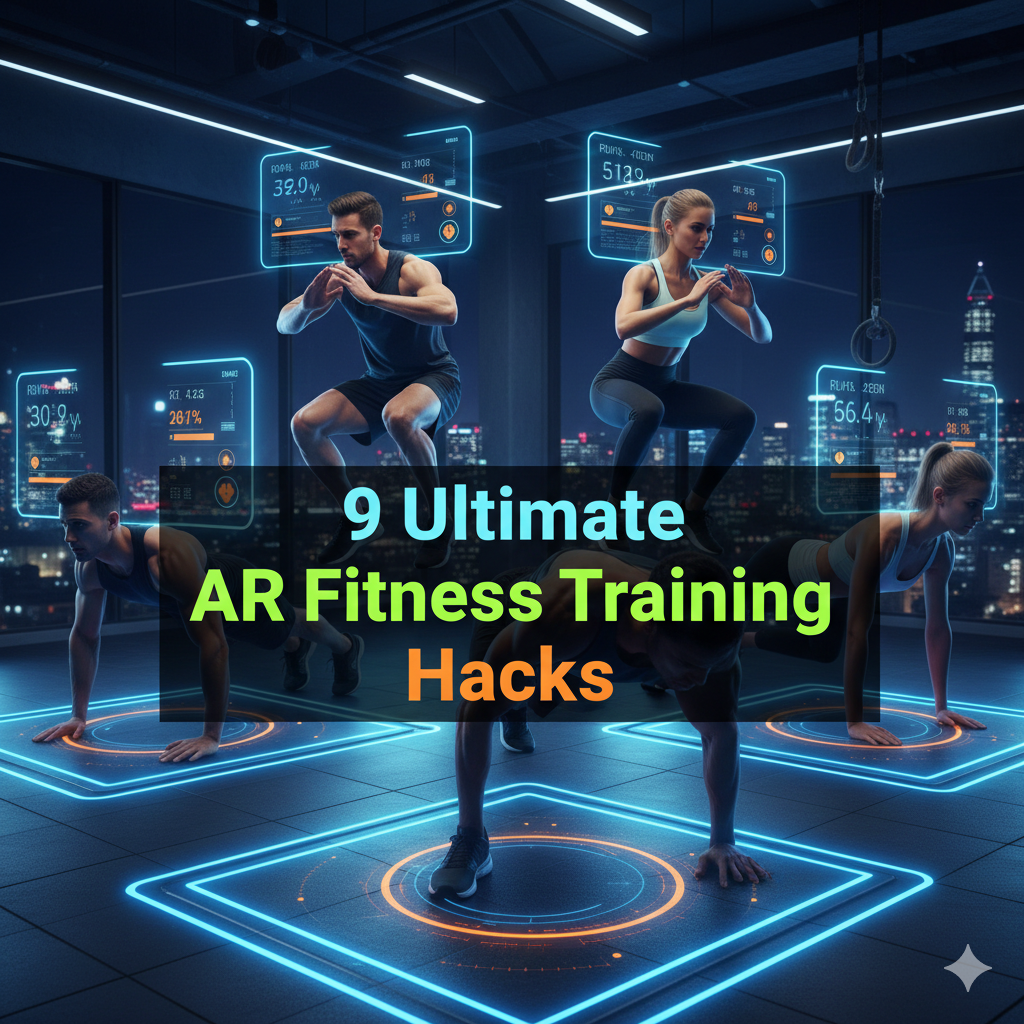
In this piece, we’re exploring 9 ultimate AR fitness training hacks that will revolutionize your mobility, training and recovery experience. Whether you’re a complete novice or you’ve been hitting the gym for years, these hacks will help you get ahead of the game.
Let’s go.
Hack #1 — Correct Your Form With AR Before It Becomes a Bad Habit
The Invisible Issue With Most Workouts
Here’s a dirty little secret no one tells you when you take up exercise — bad form abounds.
People squat with their knees caving in. They deadlift with rounded backs. Their push-ups are done with sagging hips. And they keep getting it wrong, week after week, because nobody is watching and telling them otherwise.
Poor form doesn’t just slow your results. It leads to real injuries. Strained muscles, joint pain, even chronic damage.
How AR Registers What Your Eyes Cannot
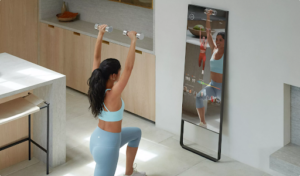
AR fitness apps track your body in real time using the camera on your phone or tablet. They track the positions of your joints — shoulders, hips, knees, ankles — and superimpose digital guides over your movements.
It’s like a GPS system for your body. If you stray from the right path, the app notifies you on the spot.
Apps like ARENA, Kaia Health and FitXR are already doing this at a really substantial level. They don’t merely observe you — they guide you mid-rep.
Why This Hack Changes Everything
Fixing form early builds better muscle memory. Over time, your body learns the correct movement pattern and executes it automatically.
That translates to faster results, fewer injuries and workouts that actually work.
Tip: Prop your phone up on a stand so it faces you while working out. Use your AR fitness app and allow it to track your posture for at least the first 4–6 weeks of any new exercise.
Hack #2 — Use AR Environments to Transform Your Living Room Into a Full Gym

You Don’t Need a Fancy Gym to Train Like a Pro
Not having a good gym nearby is one of the biggest excuses people give for skipping workouts. Too expensive. Too far away. Too crowded.
AR completely destroys that excuse.
How AR Builds Immersive Workout Environments
AR workout apps can turn your living room, bedroom, or even your backyard into a complete interactive training space. Put on AR glasses or open an app, and your entire space is populated with virtual equipment, coaching overlays and even sparring partners.
Some platforms superimpose virtual obstacles, targets or resistance cues onto your environment. You’re not merely doing jumping jacks in your living room — you’re evading virtual opponents or striking targets that pop up on your walls.
Platforms worth trying:
- FitXR — boxing, dance, and HIIT in immersive AR/VR environments
- Supernatural — full-body workouts in gorgeous 3D environments
- Holofit — rowing, cycling and elliptical training with AR overlays
The Motivation Payoff
Your brain functions differently when your environment changes. Studies have shown that people work out longer and harder in immersive exercise environments when they are visually engaged. They also report enjoying the session more — which means they come back.
That’s the real hack here. AR doesn’t just make your gym better. It makes you want to use it.
Hack #3 — Let AR Walk You Through Warm-Ups So You Stop Skipping Them
The Warm-Up Skip Is More Costly Than You Realize

Ask any personal trainer what their biggest frustration is. Most will give you the same answer — people skip warm-ups.
It seems harmless. Five minutes of stretching? Who has time for that?
But here’s the reality. Skipping your warm-up raises your injury risk steeply. Cold muscles tear more easily. Unprimed joints don’t absorb impact well. And you perform worse in the actual workout.
AR-Guided Warm-Ups Are Different
Static warm-ups are often rushed or skipped entirely. AR warm-ups are different — they’re interactive.
The app projects movement cues, timers and feedback right into your space. You follow along with the AR guide through each stretch and mobility drill. If you move too quickly or skip a position, it notices.
Some apps personalize your warm-up depending on which workout you’re about to do. Leg day? Your AR coach guides you through hip openers, ankle circles and glute activation. Upper body day? The focus shifts to shoulder mobility and thoracic rotation.
Apps that nail this:
- Kaia Health (customized warm-up flows)
- ROMWOD (mobility-first training with guided overlays)
- Nike Training Club (continuously adding AR features)
Make Warm-Ups Non-Negotiable
Once your AR coach is taking you through it step by step, skipping the warm-up feels odd. The habit builds naturally. And in a few weeks, you won’t even consider skipping it.
Hack #4 — Monitor Muscle Activation in Real Time While You Train
Most People Aren’t Sure Which Muscles They’re Even Using
That sounds crazy, but it’s true. Most people doing a chest press have no real idea whether they’re primarily recruiting their chest muscles, triceps or front shoulders. They just push and hope for the best.
This is why so many people plateau. They’re not targeting the correct muscles. And they don’t know it.
The AR Muscle Activation Overlay
Some next-gen AR fitness tools can now overlay a real-time muscle activation map onto your body as you work out. The muscles you’re engaging light up in color. The ones you’re leaving behind stay dark.
It’s almost like heat vision for your own body during a workout.
This technology exists in more sophisticated platforms and physical therapy tools, but it’s filtering into mainstream fitness apps at a rapid pace.
| What You’re Doing | What You Think Is Working | What AR Reveals |
|---|---|---|
| Chest press with bad form | Chest muscles | Mostly front deltoids |
| Squats with forward lean | Quads and glutes | Lower back overloaded |
| Bent-over row with hips up | Upper back | Biceps doing most of the work |
| Lateral raises too fast | Side deltoids | Traps taking over |
Why This Matters for Your Results
With visibility into exactly which muscles are firing, you can make real-time adjustments to your form. You slow down. You focus. You make the mind-muscle connection that coaches have been preaching about for decades — only now you can actually see it.
The result? You get more out of every single rep.
Hack #5 — Turn Fitness Into a Game You Can’t Stop Playing With AR Gamification
Why Your Brain Prefers Games Over Workouts
Your brain is wired to seek rewards. Points, level-ups, badges, progress bars — these are dopamine triggers. That’s why video games can hold someone’s attention for hours while 20 minutes on a treadmill feels like a punishment.
AR fitness training hacks this reward system and plays to your strengths.
How Gamified AR Workouts Work
AR fitness platforms overlay game mechanics directly onto physical exercise. You earn points for finishing reps. You level up by hitting cardio targets. You compete with friends on leaderboards — all while actually moving your body.
Some platforms build story-driven AR workout experiences. You’re not simply running — you’re fleeing a virtual zombie horde (yes, this is an actual app). You’re not just doing burpees — you’re defending a virtual fortress.
Top gamified AR fitness tools:
- Zombies, Run! — narrative-driven AR running app
- Ring Fit Adventure (Nintendo Switch) — full-body RPG workout
- Holofit — AR cardio based on competition and achievements
- Beat Saber — rhythm-controlled full-body movement in AR/VR
The Consistency Hack Buried Inside the Fun
The number one predictor of fitness success is consistency. Not intensity. Not the perfect program. Just showing up, day after day.
Gamification turns the act of showing up into its own reward. You stop working out to look better in the mirror and start working out because you genuinely want to find out what happens next.
That mindset shift is worth more than any supplement or training program.
Hack #6 — Use AR Breathing Guides to Supercharge Your Performance and Recovery
The Breathing Mistake That’s Ruining Your Workouts
The majority of people breathe incorrectly while working out.
They hold their breath during heavy lifts. They hyperventilate during cardio. They never think about breath timing at all.
This matters more than most people realize. Improper breathing reduces oxygen delivery to your muscles, unnecessarily raises your heart rate and increases your perceived effort. In plain English — it makes exercising feel harder than it has to be.
AR Overlays for Breath Timing
AR fitness tools are now infusing breathing guides directly into workout sessions. A visual cue — a glowing ring that expands and contracts, a wave of color, or a simple animated prompt — appears in your AR view, guiding you precisely when to inhale and exhale during each movement.
For strength training: exhale during exertion (the hard part), inhale on the return.
For cardio: rhythmic nasal breathing keeps your heart rate regulated and builds aerobic capacity.
For recovery: a longer exhale than inhale activates your parasympathetic nervous system and helps you recover more quickly between sets.
Tools that incorporate this:
- DEEP (breath-controlled AR experiences)
- Prana (AR + wearable breathing tracker)
- Whoop (recovery-focused breathing analytics)
A Simple Breathing Chart for Your Workouts
| Training Phase | Inhale Timing | Exhale Timing | Purpose |
|---|---|---|---|
| Strength — lifting phase | Before the rep | During exertion | Stabilize core |
| Strength — rest phase | Slow and deep | Longer than inhale | Lower heart rate |
| Cardio — steady state | Every 2–3 steps | Every 2–3 steps | Maintain rhythm |
| Cool-down / recovery | 4 seconds in | 6–8 seconds out | Activate recovery |
Everything gets easier when you start breathing right. Your endurance improves. Your lifts feel lighter. Your recovery between sets speeds up.
Hack #7 — Design Your Own AR Workout Challenges to Overcome Plateaus
Why Plateaus Happen (And Why Most People Quit When They Do)
You’ve been training for a couple of months. At first the results were amazing — you felt stronger, leaner, fitter. Then suddenly, nothing changes. The scale stops moving. Your lifts stop improving. You feel stuck.
It’s a plateau, and it happens to all of us. The cause? Your body has adjusted to your current routine. It needs a new challenge.
The typical response to plateaus is either quitting or just doing more of the same — neither of which works.
AR-Powered Progressive Overload
AR fitness platforms can now set progressive challenges that automatically ramp up in difficulty as you improve. The app measures your performance over time and introduces new goals, new movement variations and new levels of intensity before your body settles into comfort.
This is known as progressive overload — the process of gradually increasing the demands on your body — and it’s the most important driver of long-term fitness success.
With AR, progressive overload becomes automatic. You don’t have to calculate percentages or thumb through a training journal. The system handles it for you, presenting each new challenge as a fresh goal to reach.
How this plays out in practice:
- Week 1: 3 sets of 10 push-ups, AR tracks speed and range
- Week 3: App introduces tempo push-ups and increases target reps
- Week 6: AR overlays resistance targets and introduces one-arm variations
- Week 10: Full challenge mode with real-time competition overlays
Beating the Plateau With Variety
AR also introduces exercise variety in ways that keep training fresh. New movements, new environments, new challenges — all keeping your body guessing and your mind engaged.
Plateaus don’t stand a chance.
Hack #8 — Use AR Recovery Tools to Train Harder Without Breaking Down
Recovery Is Where the Real Gains Happen
Here’s something many beginners don’t realize — your muscles don’t grow during the workout. They grow during recovery. The workout creates the stimulus. Sleep, nutrition and rest do the actual building.
If you’re not recovering properly, you’re leaving results on the table — and risking burnout or injury.
AR-Assisted Recovery Sessions
AR is already being used to guide active recovery sessions — gentle movement, stretching and mobility work that helps your body bounce back faster without simply sitting still.
AR recovery apps superimpose foam rolling guides onto your body, showing you exactly which areas to target and how much pressure to apply. They guide you through mobility flows, timing each position and cueing your breathing.
Some platforms even take your biometric data (from a smartwatch or fitness tracker) and use it to build a customized AR recovery session based on how hard you trained that day.
Recovery tools using AR and smart data:
| Tool | What It Does | Best For |
|---|---|---|
| Whoop + Recovery Mode | Tracks strain and recommends AR recovery | Serious athletes |
| ROMWOD | AR-guided mobility and flexibility flows | Daily recovery |
| Therabody App | Guides percussive therapy with visual overlays | Muscle soreness |
| Eight Sleep | Optimizes sleep data, AR dashboards | Sleep-based recovery |
The Hack Most People Ignore
The athletes who recover fastest aren’t the ones who rest the most. They’re the ones who recover smarter. AR converts passive rest into active, guided recovery — and that difference makes a world of difference in how quickly you can train hard again.
Hack #9 — AR Social Fitness Features Keep You Accountable Without the Awkwardness
The Accountability Problem With Solo Training
Training alone is hard. There’s no one to push you. Nobody to notice if you miss a day. No one to cheer you on when you hit a new personal record.
This is why group fitness and personal training generally produce better results than working out alone for most people. Not because the exercises are different — but because of accountability.
AR Multiplayer Fitness — Train Together From Anywhere
AR fitness platforms are building social features that let you work out alongside friends, family or even strangers — in a shared virtual space, even if they’re miles apart.
You can see each other’s AR avatars exercising in real time. You compete on shared leaderboards. You can cheer each other on with in-app reactions. Some platforms even enable you to pair with a live AR coach who watches your form remotely and gives feedback in real time.
For more on how AR is reshaping the way we approach fitness and body health, AR Body Health is a fantastic resource worth bookmarking.
Social AR fitness platforms to explore:
- FitXR (multiplayer workout rooms)
- Peloton (live class leaderboards with AR-style overlays)
- Supernatural (community challenges and shared goals)
- Zwift (AR-style social cycling and running)
Why This Is the Single Most Underrated AR Fitness Hack
Accountability is the magic ingredient that separates people who get results from those who don’t. When someone is counting on you to show up — even virtually — you show up.
AR social fitness removes the intimidation of in-person group classes while keeping the motivational power of training with others. It’s the best of both worlds.
Your 30-Day AR Fitness Starter Plan
You’ve got 9 powerful AR fitness training hacks. Now here’s how to actually put them to use.
| Week | Focus | Action Step |
|---|---|---|
| Week 1 | Form & Foundation | Set up an AR fitness app and train every session with real-time form tracking |
| Week 2 | Environment & Warm-Up | Experience an immersive AR workout space + add AR-guided warm-ups |
| Week 3 | Gamification & Breathing | Switch to a gamified platform + activate breathing overlays for better oxygen use |
| Week 4 | Recovery & Social | Add an AR recovery session + invite a friend to train together |
Don’t rush. Don’t overwhelm yourself. Choose one hack per week and let it become a habit before adding the next.
FAQs About AR Fitness Training
Q: Will I need AR glasses or special hardware to get started? No. Most AR fitness apps require only your smartphone and camera. AR glasses and wearables unlock additional functionality but are not needed to begin.
Q: Are AR fitness apps suitable for total beginners? Absolutely. Many AR fitness platforms are purposefully built with novices in mind — through guided tutorials, form correction mechanics and difficulty levels that adjust to the user.
Q: Will AR fitness training replace a personal trainer? It can replace many functions of a personal trainer — form coaching, programming and motivation. But a human trainer still provides personalized insight, particularly for complex injuries or highly specific goals. Think of AR as a supercharged assistant.
Q: What do AR fitness apps cost? Prices vary. Many offer free basic versions. Premium subscriptions usually cost $10–$30 per month. Platforms with advanced AR features may cost more.
Q: Can I use AR fitness apps outdoors? Yes. There are AR fitness apps designed specifically for outdoor use — running apps, cycling apps and even dedicated hiking platforms use AR overlays in outdoor environments.
Q: Does AR fitness training help with weight loss? Yes, especially because of the consistency it encourages. People who enjoy their workouts do them more often. More frequent exercise, paired with improved form and smarter recovery, lays the groundwork for sustainable fat loss.
Q: What’s the best AR fitness app for beginners right now? FitXR, Kaia Health and Nike Training Club (with AR features) are great starting points. Zombies, Run! is a brilliant option for anyone who wants to make cardio fun from day one.
The Final Word
AR fitness training isn’t about replacing hard work. It’s about making hard work smarter, more interactive and more sustainable.
The 9 ultimate AR fitness training hacks in this article cover every aspect of your training journey — from correcting your form on day one, to building immersive workout environments, to training with friends across the globe, to recovering like a professional athlete.
You don’t need a fancy gym. You don’t need an expensive trainer. You need the right tools, the right habits and the willingness to try something new.
AR is that something new. And it’s not the future anymore — it’s right now.
Pick one hack. Start today. Your body will thank you for it.