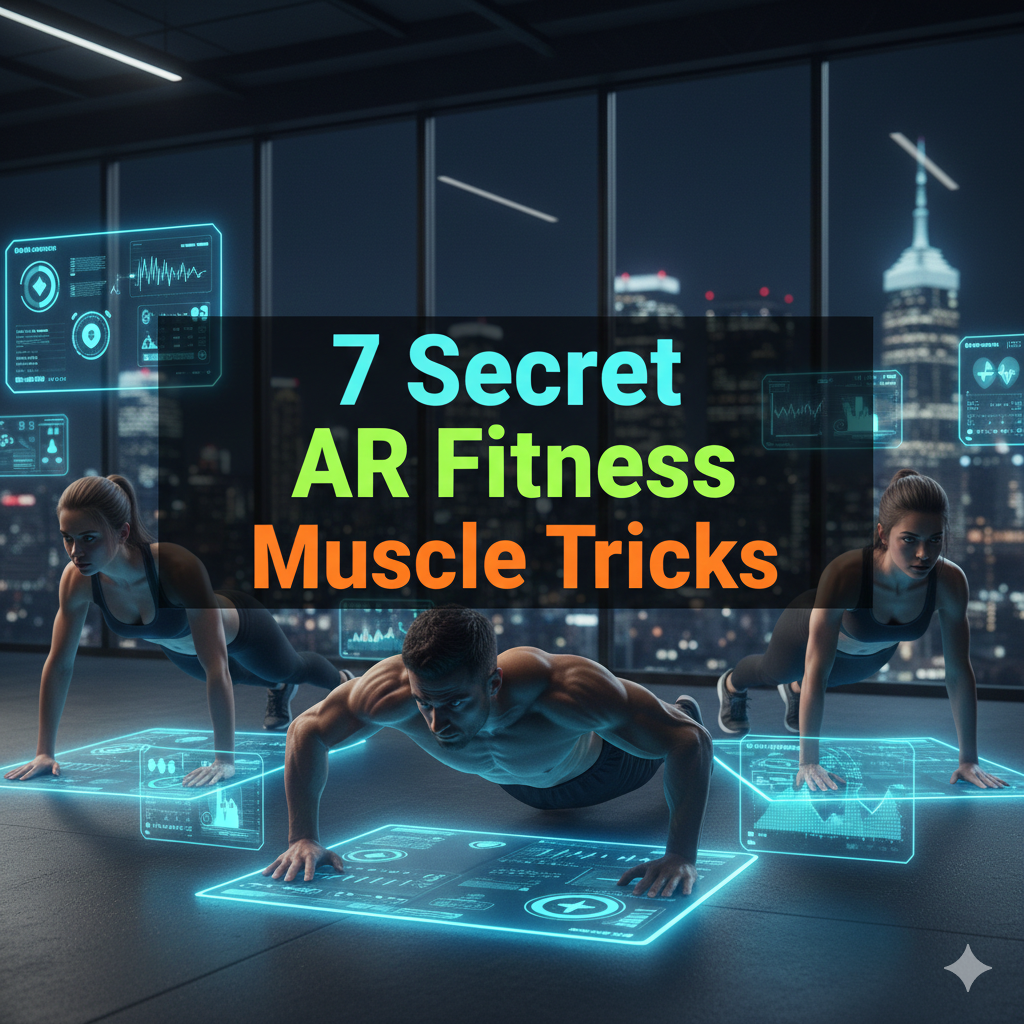
What if your phone could watch you lift and tell you exactly what you’re doing wrong? What if you had a digital coach floating directly in front of you for every rep, counting your sets, correcting your form and pushing you harder than you ever would yourself?
That’s not the future. That’s AR fitness muscle training — and it’s here now.
Augmented reality is revolutionizing the way people build muscle. No longer just for gamers and tech geeks. Normal people — novices, athletes, home gym heroes — are using AR devices to become stronger, leaner and more consistent than ever in their lives.
The problem? Most people are unaware these tricks exist.
This article unlocks 7 secret AR fitness muscle tricks that are actually working in 2026. All seven are practical, tried-and-true and something you can start practicing today — no pricey gym membership needed.
Let’s get into it.
Why Muscle Building Is the Ideal Activity for AR
But before we get to the hacks, here’s the part that most fitness influencers overlook.
Gaining muscle isn’t solely about picking up heavy things. It’s about precision. It’s about the proper movement, at the proper angle, with the right amount of tension — every single rep.
That’s what AR does best.
AR adds digital information on top of your real world. It sees your body, analyzes your movement and provides you with immediate feedback. No guessing. No bad reps. No wasted sessions.
It’s like having a sports scientist in your pocket — one who observes every workout and instructs you on how to maximize each rep.
Here’s a short guide to how AR compares with traditional muscle-building methods:
| Training Method | Form Feedback | Rep Tracking | Personalization | Motivation Tools |
|---|---|---|---|---|
| Solo gym workouts | ❌ None | Manual counting | ❌ None | ❌ Limited |
| Personal trainer | ✅ Yes | ✅ Yes | ✅ Yes | ✅ Yes |
| YouTube workouts | ❌ None | Manual counting | ❌ None | ⚠️ Partial |
| AR fitness muscle training | ✅ Real-time | ✅ Automatic | ✅ Adaptive | ✅ Gamified |
The numbers don’t lie. AR muscle training ticks every box that counts.
Now let’s get into the real tricks.
Trick #1 — Have AR Monitor Your Form So You Stop Wasting Reps

Here’s a harsh reality: the majority of gym-goers are working out incorrectly.
Not slightly wrong. Actually wrong. Wrong enough to diminish muscle growth, create imbalances and, ultimately, result in injury.
Bad form is the silent killer of gains.
AR solves this by turning your phone or smart mirror into a form-checking tool that watches every single rep. It uses your camera and body-tracking software to map your joints, spine and limbs in real time. Then it tells you precisely what’s wrong.
What AR Form Correction Really Catches:
- Knees caving inward during squats
- Lower back rounding during deadlifts
- Uneven shoulder height during bench press
- Incomplete range of motion on pull-ups
- Excessive swinging during bicep curls
Apps like Kaia Health, ARENA and FormCheck AI are already doing this. You place your phone on a stand, press record and the AR overlay tracks your body in real time as you move.
The result is more quality reps per set. And more quality reps equals more muscle — plain and simple.
Quick tip: Just one session per week using AR form correction can reveal chronic mistakes you didn’t realize you’ve been making for months.
Trick #2 — Activate the Right Fibers With AR Muscle Activation Maps
This has to be one of the most underrated AR fitness muscle tricks out there.
Very few people know what part of a muscle they’re truly activating during an exercise. They perform a chest press and believe that their whole chest is engaged. But perhaps only the lower pec is actually working. Perhaps the shoulder is coming into play. Maybe the tricep is compensating.
AR muscle activation maps completely change this.
These tools use color-coded overlays — projected onto your body or displayed on your screen — to indicate which muscle fibers are firing during each movement. Green means the target muscle is activated. Yellow indicates a secondary muscle is assisting. Red means something is taking over that shouldn’t be.
How Muscle Activation Mapping Works in Practice:
| Color | What It Means | What to Do |
|---|---|---|
| 🟢 Green | Target muscle is fully engaged | Keep going — great form |
| 🟡 Yellow | Secondary muscle assisting | Normal, but be wary of the angle |
| 🔴 Red | Wrong muscle in control | Stop, reset, change grip or stance |
This is major for anyone who has felt stuck at a plateau. If your chest isn’t growing, it could be because your shoulders are doing all the pressing work. AR lets you see this instantly.
Apps and tools testing this tech: Tempo Studio, ARENA Fitness and certain Apple Vision Pro fitness integrations are leading the charge here.
Trick #3 — Program AR Progressive Overload So You Never Plateau Again
Progressive overload is the golden rule when it comes to muscle building. To keep growing, you need to progressively increase the stress on your muscles — adding more weight, more reps, or reducing rest.
The problem? Most people do this randomly. Or they forget to track it. Or they increase weight too fast and get injured.
AR fitness muscle tools tackle this by automating the entire process.
Here’s how it works. The AR system tracks your performance over time. It knows how many reps you hit last week, how long your rest times were and how well your form held up as fatigue set in. Then it tells you precisely what to do this week to keep moving forward — no guessing.
A Sample AR Progressive Overload Plan (4 Weeks):
| Week | Exercise | Weight | Reps | Rest Period |
|---|---|---|---|---|
| Week 1 | Barbell Squat | 135 lbs | 3 x 10 | 90 sec |
| Week 2 | Barbell Squat | 140 lbs | 3 x 10 | 85 sec |
| Week 3 | Barbell Squat | 145 lbs | 3 x 8 | 90 sec |
| Week 4 | Barbell Squat | 150 lbs | 3 x 8 | 80 sec |
Small increases. Consistent tracking. Automatic adjustments. That’s the AR progressive overload system doing its thing.
Devices that excel in this area: WHOOP paired with AR dashboards, Apple Watch integrated with fitness AR apps, and Tempo Studio’s built-in progression tracker.
No more plateau. No more guessing. Just steady gains.
Trick #4 — Use AR Muscle Memory Ghosting to Master Your Lifts
This one reads like science fiction. But it’s real — and it is extraordinarily effective.
AR muscle memory ghosting allows you to see a previously recorded version of yourself — or a professional athlete — executing a lift in perfect form, superimposed directly on your view. You then mirror that ghost as you perform the same movement.
It’s sort of like tracing a picture. Instead of attempting to memorize perfect form from a YouTube video you watched an hour before, you literally see the correct movement unfold right in front of you and copy it in real time.
Why This Accelerates Muscle Development:
Repeating correct movement patterns builds muscle memory. The quicker you ingrain the ideal movement, the quicker your nervous system adapts to recruiting muscle fibers as efficiently as possible. Faster and more efficient fiber recruitment equals faster gains in strength and size.
AR ghosting streamlines this process by eliminating the entire trial-and-error phase.
Here’s a step-by-step look at the process:
- Load a reference movement — your previous best rep or a demo by your coach
- The AR system projects the ghost onto your view
- You perform the lift while visually matching the ghost’s path
- The app scores your movement accuracy in real time
- Over time, your natural form locks in and the ghost becomes unnecessary
Where to find this tech: Strava’s AR route replay uses a similar concept for running. FitXR and ARENA are building ghosting features for strength training. This is one of the fastest-growing AR fitness muscle developments in 2026.
Trick #5 — Use AR Rest Period Timers to Maximize Muscle Recovery Between Sets
Rest periods matter more than most people think.
Too short: your muscles don’t recover enough and you lift lighter on the next set — limiting the growth stimulus.
Too long: your muscles cool down, your heart rate drops too low, and you lose the hormonal window that encourages muscle growth.
The sweet spot is different for every exercise, every rep range and every person. Most people get this completely wrong because they are either chatting between sets or just glancing at the clock.
AR rest period management solves this with smart timers that adjust based on your actual recovery — not just a fixed countdown.
Optimal Rest Periods by Training Goal (AR-Guided):
| Goal | Recommended Rest | AR Adjustment Trigger |
|---|---|---|
| Max strength (1–5 reps) | 3–5 minutes | Heart rate drops below 100 BPM |
| Muscle hypertrophy (6–12 reps) | 60–90 seconds | Heart rate stabilizes around 110 BPM |
| Muscular endurance (15+ reps) | 30–45 seconds | Breathing returns to near normal |
| Power and explosiveness | 2–3 minutes | Full neuromuscular readiness signal |
AR wearables synced to heart rate sensors can detect when your body is physically ready for the next set — and then flash a visual cue in your field of view. You rest until your body says it’s ready, not when a generic timer goes off.
Tools for this: WHOOP with AR display integration, Garmin HRM monitors paired with smart glasses, and Tempo Studio’s rest management system.
This one trick alone can add meaningful volume to your training sessions without adding extra time.
Trick #6 — Combine AR Nutrition Scanning With Muscle-Building Meal Plans

You could do every single thing right in the gym. But if your nutrition is off, your muscles will not grow.
Muscle growth requires a surplus of protein and total calories. Most people eat too little protein or have no idea how much they’re really consuming. And manually logging food is so tedious that most people quit within a week.
AR nutrition scanning makes this effortless.
You hold your phone up towards your plate. The app uses image recognition to identify the food. A digital overlay appears showing exactly how much protein, carbs, fat and calories are on your plate. The data logs automatically.
For a 160 lbs (73 kg) individual looking to gain muscle, this is right in line with the commonly recommended target of around 0.8–1g of protein per pound of bodyweight.
If you want to go deeper on whole-body health and recovery alongside your muscle-building journey, AR Body Health is a great resource covering fitness, body wellness, and performance tips that complement AR training perfectly.
Top AR Nutrition Apps for Muscle Building:
- Calorie Mama — instant food recognition with macro breakdown
- Cronometer — detailed micronutrient tracking alongside macros
- PlateJoy — generates muscle-focused meal plans and lets you scan ingredients
This AR fitness muscle trick works best when paired with your strength training data, so the app can tell you when to eat more on heavy training days and less on rest days.
Trick #7 — Train Harder With AR Biofeedback Without Overtraining
This is the most sophisticated of the AR fitness muscle tricks — and probably the most powerful.
Overtraining is a real problem. If you push too hard without sufficient recovery, your muscles break down faster than they rebuild. Your performance drops. You feel constantly sore and fatigued. And your gains stop completely.
The vast majority of people are unaware they’re overtraining until the damage is done.
AR biofeedback tools monitor your body’s real-time stress signals — heart rate variability, skin temperature, muscle oxygenation and nervous system fatigue — and display that data as visual cues within your AR environment.
AR Biofeedback Signals and What They Mean:
| Signal | What It Measures | What AR Shows You |
|---|---|---|
| Heart rate variability (HRV) | Recovery status | Green/red readiness score |
| Muscle oxygenation (SmO2) | Oxygen delivery to working muscles | Live percentage overlay |
| Skin temperature | Inflammation and fatigue | Warm/cool color map on body |
| Neuromuscular fatigue | CNS recovery | Reaction time assessment score |
When these signals fall into the danger zone, the AR system flags it. You might see a visual warning in your headset. Or the app might suggest switching to a lighter accessory workout rather than going heavy as planned.
The result: You train as hard as your body can handle — not harder, not easier. Every session becomes optimized.
Front runners in this space: WHOOP 4.0, Polar Vantage V3 and Halo Sport are all advancing into AR biofeedback territory. Expect this technology to go mainstream by late 2026.
How to Stack These AR Muscle Tricks for Maximum Results
You don’t have to use all seven tricks at once. But combining a few of them creates a compounding effect that’s hard to beat.
Here’s a recommended stacking approach based on your experience level:
| Experience Level | Start With | Add Next | Advanced Add-On |
|---|---|---|---|
| Beginner | Trick #1 (Form correction) | Trick #6 (Nutrition scanning) | Trick #3 (Progressive overload) |
| Intermediate | Trick #3 (Overload tracking) | Trick #5 (Rest timers) | Trick #2 (Activation maps) |
| Advanced | Trick #7 (Biofeedback) | Trick #4 (Ghosting) | Trick #2 (Activation maps) |
The key is consistency. Pick two tricks. Use them every session for four weeks. Then add another. Incremental improvements add up to big change over time.
Real Talk — What AR Muscle Training Can and Can’t Do
Let’s be honest for a second.
AR fitness muscle tools are powerful. But they’re not magic.
They work best in conjunction with solid training fundamentals — adequate sleep, good nutrition, steady effort and patience. AR is a multiplier. It makes good training better. It won’t replace bad training.
Here’s a realistic expectation chart:
| What AR Muscle Tricks Help With | What They Can’t Replace |
|---|---|
| Correcting form mistakes | Your own effort and consistency |
| Tracking progress automatically | Adequate sleep and recovery |
| Identifying weak muscle activation | Proper programming basics |
| Keeping motivation high | Real-world discipline |
| Optimizing rest and nutrition timing | A balanced, protein-rich diet |
Use AR as a tool, not a crutch. The results will speak for themselves.
FAQs About AR Fitness Muscle Tricks
Q1: Do AR fitness muscle tricks require a VR headset? No. Most of the tricks in this article can be carried out with just a smartphone. While AR smart mirrors and headsets can enhance the experience, apps like Kaia Health, Calorie Mama and WHOOP function on your phone with no additional hardware.
Q2: Does AR muscle training work for complete beginners? Absolutely. In fact, beginners gain the most since they haven’t yet formed bad habits. Getting AR form correction from day one means you’re building the right movement patterns from the start — which leads to faster progress and fewer injuries.
Q3: How accurate is AR muscle activation mapping? Technology today is impressive but not perfect. Consumer-level AR activation tools give a solid directional reading — they’re good at telling you when something is clearly off. For clinical-level precision, sports scientists still rely on electromyography (EMG) sensors. But for routine training, AR activation maps are more than sufficient.
Q4: Can AR fitness muscle tools replace a personal trainer? They can fill in for many of the functions a trainer provides — form checking, rep counting, progression planning and motivation. But a great trainer still offers intuition, emotional support and adaptability that technology hasn’t fully replicated. AR and a trainer together? That’s the ultimate combination.
Q5: Is it safe to use AR fitness apps every day? Yes, for most people. The apps themselves are safe. The key is to listen to your body and not use the data as a license to overtrain. AR biofeedback tools (Trick #7) are specifically designed to help you avoid doing too much.
Q6: How long before I see muscle results using AR training tricks? Most people notice improvements in form and workout quality within the first two weeks. Visible muscle growth typically takes 6–12 weeks of consistent training, regardless of the tools used. AR helps you get there faster by eliminating wasted sessions.
Q7: What’s the best AR fitness muscle app to start with in 2026? For beginners, start with a form-correction app like Kaia Health or ARENA. For intermediate lifters, Tempo Studio offers the most comprehensive AR muscle tracking suite. For nutrition, Calorie Mama is the easiest entry point.
The Bottom Line on AR Fitness Muscle Tricks
In the past, building muscle was a years-long process of trial and error. Wrong form. Bad programming. No idea whether your nutrition was dialed in. Plateaus lasting months with no explanation.
AR fitness muscle training is changing all of that.
With the right tools, you can now view your form errors in real time, observe which muscles are firing, automate your progression, and eat in a way that actually promotes growth — all without hiring an expensive coach or spending hours pouring over fitness research.
The 7 tricks in this article cover the full picture. From rep-by-rep form correction to biofeedback-guided recovery, each one targets a specific gap that keeps most people from the results they’re working toward.
You don’t need all seven at once. Pick one. Try it for a month. Then add another.
The gym hasn’t changed. But the tools you bring to it can. And in 2026, the people building the best physiques aren’t just training harder — they’re training smarter, with augmented reality leading the way.
Start with one trick today. Your future muscles will be grateful.