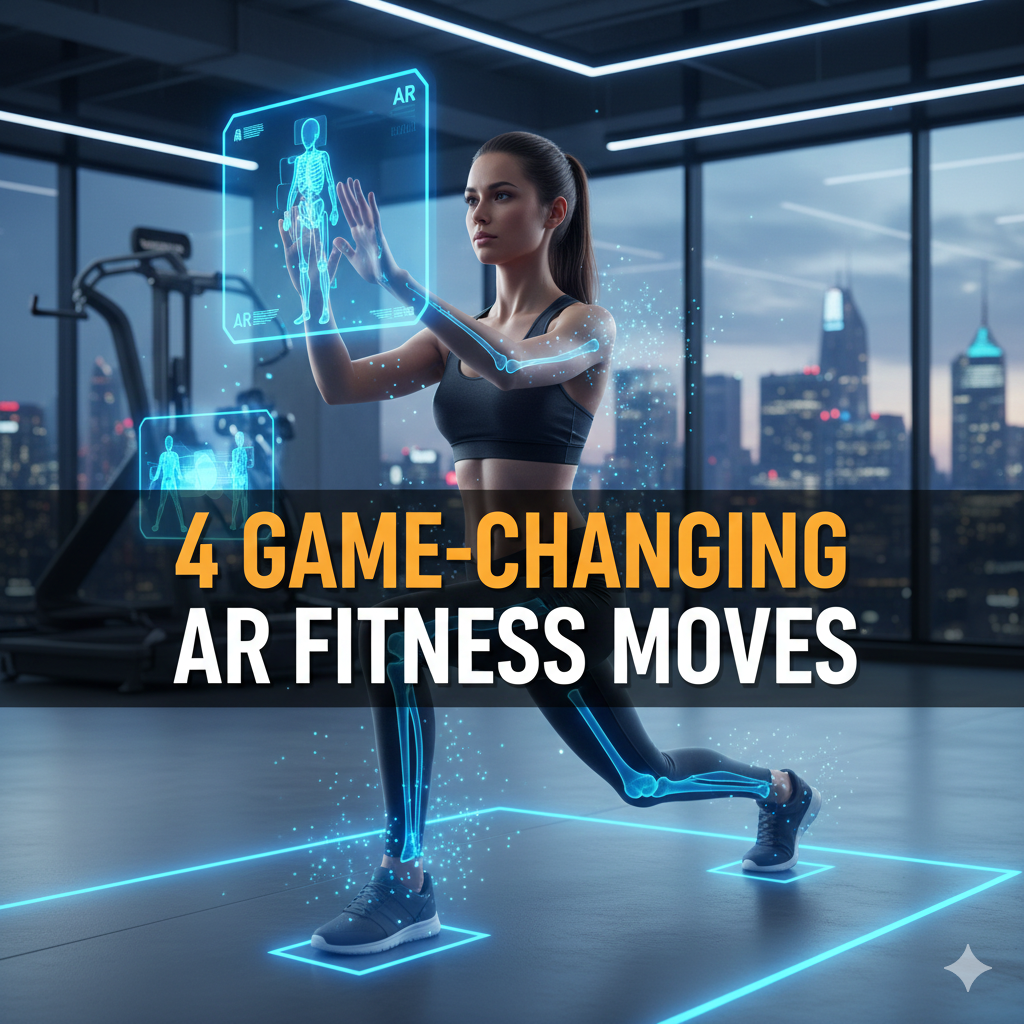
Imagine strapping on a headset or waving your phone at your living room floor — and suddenly your workout turns into an epic game. Virtual targets appear. Your body becomes the controller. Every squat, punch, and lunge scores you points.
That’s not science fiction anymore. That’s AR fitness.
Augmented reality (AR) fitness is one of the hottest new trends in health and wellness. It superimposes digital content on the real world, transforming your physical space into a place to work out. No fancy equipment needed. No boring routines. Just you and your body in a whole new dimension of movement.
We’re sharing 4 effective, very fun AR fitness moves for anyone, at any level in this article. If you are a novice trying to stay active, or simply an individual who is sick of the gym, these moves may be just up your alley.
Let’s get into it.
Here’s Why AR Fitness Isn’t Just a Gimmick
Before exploring the moves themselves, it’s worth asking: does AR fitness really work?
Short answer — yes.
People who work out via gamified or AR-style platforms exercise longer and harder than people doing traditional workouts, according to a study published in the journal Games for Health. Why? Because when your brain is focused on a target to hit or a challenge to complete, it stops focusing on the tightness of physical exertion.
That’s the secret sauce of AR fitness.
It fools your brain into exerting more effort — but without the feel of work.
How to Move in an AR World — Science Fact
Each AR fitness move has you doing two things simultaneously. Your body is doing actual physical work — burning calories, building muscle, improving coordination. Your brain is simultaneously working on a visual and cognitive challenge.
This double engagement is what makes AR workouts better at improving:
- Reaction time
- Balance and spatial awareness
- Motor coordination
- Cardiovascular endurance
| Benefit | Traditional Workout | AR Fitness Workout |
|---|---|---|
| Physical exertion | High | High |
| Mental engagement | Low–Medium | Very High |
| Exercise duration (avg) | 30–45 min | 40–60 min |
| Enjoyment factor | Medium | High |
| Coordination improvement | Medium | High |
AR fitness does not take away from a workout’s physical demands — it enhances them by keeping your head in the game.
Move #1 — The AR Target Punch

What It Is
AR Target Punch is one of the hottest moves in augmented reality exercise. It’s found in apps like FitXR, Supernatural VR, and several AR boxing apps.
Here’s how it works: Digital targets pop up in your field of view — floating in mid-air, or moving toward you. You have to punch them quickly and accurately before they fade away or connect with you.
It sounds simple. It’s not.
Muscles It Works
The AR Target Punch works more muscles than an ordinary round of shadowboxing, as the targets force you into unexpected positions.
Primary muscles:
- Shoulders (deltoids)
- Chest (pectorals)
- Triceps
- Core (obliques and rectus abdominis)
Secondary muscles:
- Upper back (for rotational power)
- Legs (when targets are low or need a step)
How to Do It Right
Your form is essential in order to get the most out of this move. Bad form translates to reduced power, increased stress, and decreased calorie expenditure.
Step-by-step:
- Stand with feet shoulder-width apart, knees slightly bent.
- Maintain a tight core — like you’re preparing for a gentle punch to the stomach.
- When a target presents itself, extend the opposite arm, fully rotating your torso into the punch.
- Snap back to guard position (fists by your chin).
- Stay light on your feet. Don’t plant yourself flat-footed.
Common mistakes to avoid:
- Locking out your elbow at full extension (this puts stress on the joint)
- Punching only with the arm rather than the whole body
- Forgetting to breathe
Calorie Burn Estimate
| Intensity Level | Calories Burned (30 min) |
|---|---|
| Light (slow targets) | 180–220 kcal |
| Moderate (medium speed) | 250–310 kcal |
| High (fast, multi-directional) | 340–400 kcal |
The AR Target Punch is great cardio. At high intensity, it approaches a bout on a rowing machine or a moderate-paced run.
Move #2 — The AR Squat and Reach

What It Is
This move elevates one of the most fundamental movements in fitness — the squat — and powers it up with augmented reality engagement. Instead of simply squatting down and back up, you’re reaching for digital objects placed at different heights. Some are at knee level. Others are above your head. Your body constantly has to adapt.
It’s basically a squat merged with a dynamic reach pattern, driven by AR cues.
Movement similar to this is integrated into the training programs for apps such as Holofit and Liteboxer. Even some bodyweight training smartphone AR apps employ this pattern.
Why This Move Is So Effective
Traditional squats are great. But they’re predictable. Your body adjusts to predictable movements quickly, which is why results often plateau.
The AR Squat and Reach breaks that pattern.
Because you’re reaching in multiple directions — forward, to the side, overhead — your muscles can’t settle into a comfortable movement pattern. Each rep challenges your stability in a slightly different way.
Key benefits:
- Strengthens the lower body (quads, glutes, hamstrings)
- Improves hip mobility
- Develops the core via anti-rotation requirements
- Enhances shoulder stability and mobility
- Trains full-body coordination
If you want to explore more about how full-body functional training supports long-term wellness, check out AR Body Health for in-depth guides on movement, recovery, and fitness performance.
How to Do It Right
Step-by-step:
- Stand with feet slightly wider than hip-width, toes angled out slightly.
- When the AR prompt comes on (a floating object or target), start your squat.
- Reach toward the target with both hands, or one, depending on its position.
- Pause at the bottom of the squat for a count of one.
- Press through your heels to come back up to standing.
- Reset and wait for the next prompt.
Pro tip: Your chest should remain tall the whole time. Hunching at the bottom of a squat places additional pressure on your lower spine.
A Sample AR Squat and Reach Progression
| Week | Target Height Variation | Reps Per Set | Sets |
|---|---|---|---|
| 1 | Mostly chest-to-overhead | 10 | 3 |
| 2 | Mix of floor and overhead | 12 | 3 |
| 3 | All directions, quick tempo | 14 | 4 |
| 4 | Random prompts, fast | 15+ | 4 |
By following a progression like this, you ensure that your body continues to adapt without getting injured.
Move #3 — The AR Lateral Lunge Tap
What It Is
Lateral (side-to-side) movement is arguably the most ignored aspect of everyday fitness. Most of us move in a forward and backward direction — walking, running, cycling. But side-to-side motion is what maintains your hips, knees, and ankles in good working order for decades.
The AR Lateral Lunge Tap fixes that gap.
In this move, AR targets appear to your left and right, sometimes a little in front of or behind you. You have to lunge sideways in order to tap or “collect” each target before it vanishes. It is the randomness of placement that makes it so uniquely effective.
Muscles It Works
Primary:
- Glutes (especially the glute medius — the side butt muscle most people neglect)
- Inner thighs (adductors)
- Quads
Secondary:
- Hip flexors
- Core stabilizers
- Calves (for balance and lateral push-off)
The glute medius is a key player in knee stability. Strengthening it with exercises like AR Lateral Lunge Taps can actually decrease knee pain over time — something a lot of runners and desk workers will appreciate.
According to Healthline’s guide on lateral movement training, incorporating side-to-side exercises into your routine significantly reduces the risk of lower body injury and improves athletic performance.
How to Do It Right
Step-by-step:
- Begin in a comfortable standing position, with feet hip-distance apart.
- When a target appears to your right, step your right foot out wide to the side.
- Bend your right knee and sink your hips back into a lateral lunge.
- Tap or reach your right hand toward the AR target.
- Push off your right foot and return to center.
- When the next target appears, repeat on the left.
Key things to focus on:
- Keep your lunging knee in line with your toes (don’t let it cave inward)
- Maintain an upright posture — don’t hunch over
- Land softly and control the movement
Why the “Tap” Element Matters
When doing traditional lateral lunges, people often speed through the movement. The AR tap means you’re fully committed to each lunge — there’s a target at the end, and you have to touch it. That requires going low enough and balancing long enough to make contact. This subtle addition takes your rep quality to a whole new level.
Move #4 — The AR Core Rotation Strike
What It Is
This is probably the most full-body move on this list. The AR Core Rotation Strike pairs rotational core work with striking, stepping, and balance challenges — all guided by AR prompts appearing in front of, behind, and all around your body.
Think of it as a full-body twist — with purpose.
In AR fitness apps, you’ll typically find this in martial arts-themed workouts — where you need to rotate and strike targets appearing on either side, behind you, or diagonally above. The rotation required to reach these targets is where the real core work happens.
Why Rotational Training Matters
Here’s something most people don’t know: the core isn’t only about doing crunches.
Your core is designed to rotate, stabilize against rotation, and transfer force from your lower body to your upper body (and vice versa). Rotational core strength is required in almost every athletic movement — swinging a bat, throwing a ball, changing direction while running.
Yet most ab workouts completely ignore this.
The AR Core Rotation Strike trains exactly this. It’s functional. It’s practical. And it transfers into real life in ways that sit-ups never will.
Core muscles trained:
- Obliques (internal and external)
- Transverse abdominis (the deep core)
- Erector spinae (lower back stabilizers)
- Hip rotators
Upper body muscles involved:
- Shoulders
- Chest
- Lats (back)
How to Do It Right
Step-by-step:
- Stand in an athletic position — feet shoulder-width apart, knees slightly bent.
- When an AR target appears to your side or diagonally, rotate your entire torso (not just your arms) toward it.
- Extend your striking arm or both arms out toward the target.
- At the point of “contact,” tighten your core and explode for power.
- Return to center under control — don’t just flip back haphazardly.
- Reset and stay ready for the next prompt.
Advanced tip: Pivot your back foot slightly as you rotate. This allows the hips to move through a greater range of motion and removes strain from the knee joint.
Rotation Strike Intensity Levels
| Level | Target Position | Rotation Angle | Rest Between Sets |
|---|---|---|---|
| Beginner | Side only | 45–90° | 60 sec |
| Intermediate | Side + diagonal | 90–135° | 45 sec |
| Advanced | All directions | Up to 180° | 30 sec |
How to Build a Weekly AR Fitness Routine With These 4 Moves
You don’t have to perform all four moves every day. A smart, structured plan will yield better results with less risk of burnout or injury.
Here’s a sample weekly plan:
| Day | Focus | Moves Included |
|---|---|---|
| Monday | Upper body + cardio | AR Target Punch (3 rounds, 4 min each) |
| Tuesday | Lower body + balance | AR Squat and Reach + AR Lateral Lunge Tap |
| Wednesday | Active rest | Light stretching or walking |
| Thursday | Full body | All 4 moves (2 rounds each) |
| Friday | Core + cardio | AR Core Rotation Strike (4 rounds) |
| Saturday | Fun session | Mix and match based on energy |
| Sunday | Rest | Recovery, foam rolling |
This plan keeps things fresh. You never do the exact same session twice in a row, which helps prevent plateaus and keeps motivation high.
The Gear You’ll Need (And What You Can Skip)
The real beauty of AR fitness is its accessibility. You don’t need a lot.
What helps:
- A smartphone with an AR-capable camera (most modern phones qualify)
- Or an AR/VR headset like the Meta Quest, Apple Vision Pro, or HTC Vive
- A clear space of at least 6×6 feet
- Comfortable workout shoes with lateral support
- Light wrist weights (optional, to increase punch intensity)
What you don’t need:
- A gym membership
- Expensive equipment
- A personal trainer (though one can assist with form)
The barrier to entry is genuinely low. Many AR fitness apps offer free trials, and some are completely free with limited features.
AR Fitness for Different Age Groups
AR fitness isn’t just for young people. The combination of fun and function makes it appealing across age groups.
| Age Group | Best Moves | Modifications Needed |
|---|---|---|
| Kids (10–14) | Target Punch, Squat and Reach | Reduced intensity, slower targets |
| Teens (15–19) | All 4 moves | Full intensity as needed |
| Adults (20–45) | All 4 moves | Focus on form and progression |
| Adults (45–60) | Lateral Lunge Tap, Squat and Reach | Reduce depth, increase rest |
| Seniors (60+) | Squat and Reach (modified) | Chair-assisted if required, slow targets |
The trick is to calibrate the challenge to your own fitness level — not someone else’s pace.
Frequently Asked Questions About AR Fitness Moves
Q: Do AR fitness moves burn as many calories as regular workouts?
Yes — and often more. Due to AR fitness keeping your brain engaged, you tend to work out longer and at a much higher intensity without actively realizing it. The science shows that people exercising in immersive environments burn more calories per session on average.
Q: Can I do these AR fitness moves without a headset?
Absolutely. Some smartphone apps use your phone’s camera to provide an AR fitness experience. You don’t need a pricey headset to get started. Good starting points include apps like Just Dance Now, Zombies Run (which is partially AR), and other AR workout apps on iOS and Android.
Q: Are these moves safe for people with knee or back pain?
It depends on the severity of the condition. In general, the AR Squat and Reach and the AR Target Punch can be adapted as low-impact options. However, anyone with a chronic injury or joint condition should speak to a physical therapist or doctor before starting a new fitness program.
Q: How long should each AR fitness session last?
Beginners should aim for 20–30 minutes per session. You can build up to 45–60 minutes as your fitness improves. The great thing about AR workouts is that time seems to fly — you’ll be surprised at how long you’ve been moving.
Q: Will AR fitness replace traditional gyms?
Probably not entirely — but it’s a powerful complement to traditional training. Free weights, resistance machines, and group fitness classes still have their place. AR fitness excels at building coordination, cardio, and consistency — because it’s so much more enjoyable.
Q: What’s the best AR fitness app for beginners?
FitXR and Supernatural are two of the most user-friendly options for headset owners. Smartphone-only users can look toward Holofit, or even simple AR-based workout games on iOS and Android, as solid starting points.
The Bigger Picture — Why AR Fitness Is the Future
The global AR fitness market is booming. Analysts predict it will exceed $6 billion by 2030, driven by improving smartphone cameras, cheaper AR glasses, and a generation of users raised on gaming who expect workouts to be just as engaging.
But beyond the market numbers, the real story is simpler: AR is getting people to move more.
When exercise becomes interactive, when it feels like play rather than punishment, people actually do it. They don’t skip sessions. They don’t dread Monday mornings. They look forward to their next round.
That’s the most powerful thing about these 4 AR fitness moves. They’re not just exercises. They’re a new kind of relationship with movement — one that feels natural, exciting, and sustainable.
Wrapping It All Up
We’ve covered a lot of territory here. Let’s bring it home.
The 4 powerful AR fitness moves — the AR Target Punch, AR Squat and Reach, AR Lateral Lunge Tap, and AR Core Rotation Strike — each target different areas of your body while sharing one thing in common: they make you want to keep going.
Every move is backed by legitimate fitness science. Each one trains muscles that matter. And together, they form a comprehensive full-body workout system that requires nothing more than a phone and a few feet of floor space.
You don’t have to be a gamer. You don’t need to be a workout warrior. All you have to do is be open to trying something different.
AR fitness isn’t the future of working out — it’s happening right now. And these four moves are where you start.
Lace up, clear some space, and let the digital world help you build a stronger, more capable real-world body.